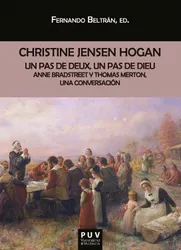
Un pas de deux, un pas de dieu : Anne Bradstreet y Thomas Merton, una conversación

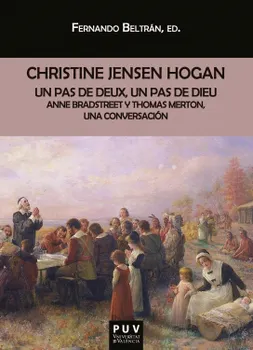
'Un Pas de Deux, Un Pas de Dieu' is a play depicting a meeting of Thomas Merton, twentieth-century Catholic monk and author, and Anne Bradstreet, one of the first published Puritan poets in New England. The play is set at Gethsemani, the Abbey in Kentucky, where Merton lived for half his life. The time is six months after his death, the day of the publication of his novel, 'My Argument with the Gestapo'. Merton's abiding interest in the publication of this work, a profound statement against war, is a continuing theme throughout the play. Anne Bradstreet recites a portion of her poem "Contemplations" intruding on Merton's solitude, much to his dismay. She is lost and seeking her home and is frightened by this "popish" monastery she has encountered. Thus the dialogue begins and progresses from concern with outer appearances (Merton had no use for Puritans and Bradstreet had a fear of Catholics), which are so different, to their inner lives, which are very similar. There is a realization that they are possibly in Purgatory and an exchange of thoughts on Salvation and God, church, the role of women, of family, of war and, of course, of writing. The play ends with a scene in which the two share bread, wine, and Trappist cheese. The poetry of each writer is used at times in the play. Bradstreet and Merton were witty, erudite individuals and the dialogue throughout shows their humor.
Sobre este libro

'Un Pas de Deux, Un Pas de Dieu' is a play depicting a meeting of Thomas Merton, twentieth-century Catholic monk and author, and Anne Bradstreet, one of the first published Puritan poets in New England. The play is set at Gethsemani, the Abbey in Kentucky, where Merton lived for half his life. The time is six months after his death, the day of the publication of his novel, 'My Argument with the Gestapo'. Merton's abiding interest in the publication of this work, a profound statement against war, is a continuing theme throughout the play. Anne Bradstreet recites a portion of her poem "Contemplations" intruding on Merton's solitude, much to his dismay. She is lost and seeking her home and is frightened by this "popish" monastery she has encountered. Thus the dialogue begins and progresses from concern with outer appearances (Merton had no use for Puritans and Bradstreet had a fear of Catholics), which are so different, to their inner lives, which are very similar. There is a realization that they are possibly in Purgatory and an exchange of thoughts on Salvation and God, church, the role of women, of family, of war and, of course, of writing. The play ends with a scene in which the two share bread, wine, and Trappist cheese. The poetry of each writer is used at times in the play. Bradstreet and Merton were witty, erudite individuals and the dialogue throughout shows their humor.

Empieza este libro hoy por 0 €

  • Disfruta de acceso completo a todos los libros de la app durante el periodo de prueba
  • Sin compromiso, cancela cuando quieras
Pruébalo gratis ahora
Más de 52 000 clientes han dado a Nextory 5 estrellas en la App Store y Google Play.

Los favoritos de otras personas

Omitir la lista
  1. 3.0

    The Star Child :

    Oscar Wilde

  2. The Adventures of Tom Sawyer & Huck Finn (Illustrated) : Enriched edition. American Classics Series

    Mark Twain

  3. Tom Sawyer Collection - All Four Books

    Mark Twain, Golden Deer

  4. En casa

    Judith Hermann

  5. La Piedra Angular : Una saga realista que desentraña la sociedad española del siglo XIX con maestría y profundidad

    Emilia Pardo Bazán

  6. Ratones en mi nevera

    Francisco Serrano García

  7. 35+ Anthology of Christmas stories. Classic collection

    Charles Dickens, G.K. Chesterton, L.M. Montgomery, L. Frank Baum, Mark Twain, Louisa May Alcott, Leo Tolstoy, Henry Wadsworth Longfellow, Nikolay Gogol, William Dean Howells, Joseph Rudyard Kipling, Elizabeth Harrison, John Milton, Hans Christian Andersen, Selma Lagerlof, Clement Moore, Henry van Dyke, Beatrix Potter, Anton Chehov

  8. Escribiendo En Verso

    Juan Moisés De La Serna

  9. 2.0

    Marvel's SPIDER-MAN : Hostile Takeover

    David Liss

  10. 3.0
    #1

    X-Men: Mutant Empire Omnibus

    Christopher Golden

  11. Cuentos de Asia, Europa & América : Luvina 100

    Amos Oz, Lídia Jorge, Ray Bradbury, Angélica Gorodischer, Eduardo Antonio Parra, Autar Krishen Rahbar, Hélia Correia, Claudia Apablaza, David Miklos, Yoon Sung-Hee, A.B. Yehoshua, Lutz Seiler, Hugo Chaparro Valderrama, Susan Straight, Amar Mitra, Baltasar Porcel, Ana María Shua, Aharon Appelfeld, Kim Keun, John le Carré, Soledad Puértolas, Fernando Ampuero, Carmen Boullosa, Paul Zachari, Antonio Tabucchi, Aimee Bender, Alberto Fuguet, Claudia Salazar Jiménez, Fabio Morábito, Michael Jaime Becerra, Ann Heon Mi, Devibharathi, Juan Manuel de Prada, John Mcgahern, Monika Maron, Alberto Garlini, Carmen Ollé, Juan Manuel Roca, Luis Panini, Shukti Roy, Mariella Mehr, Alessandro Baricco, Liam O'Flaherty, J. A. González Sainz, Nora Bossong, José Luis Peixoto, David L. Ulin, Ignacio Padilla, Diamela Eltit, Edgardo Rivera Martínez, Octavio Escobar Giraldo, Fernanda García Loa, Juan Ramírez Biedermann, Pyun Hye-Young, Felipe Benítez Reyes, Dacia Maraini, Hipólito G. Navarro, Rinny Gremaud, Patricia Reis, Philip Hoare, Sascha Reh, Alonso Cueto, Ricardo Silva Romero, Nicolás González Marzzucco, Alejandra Costamagna, Ben Ehrenreich, José Manuel Torres Funes, Enrique Serna, Chandrakanta Mura Singh, Gila Almagor, Dino Buzzati, Gonzalo Calcedo Juanes, Ingo Schulze, Tessa Hadley, Carola Aikin, Dulce María Cardoso, Leo Felipe Campos, Alberto Laiseca, José Gai, Héctor Abad Faciolince, Joya Mitra, Paola Lagazzi, Juan Pedro Aparicio, Ulrich Peltzer, José María Merino, A. M. Pires Cabral, Amrita Nilanjana, Orly Castel-Bloom, Peter Stamm, Isabel Río Novo, Miguel Bayón, Ned Beauman, Pilar Salamanca, Etgar Keret, Valeria Correa Fiz, David Machado, Louise Welsh, Antonio Skármeta, Roberto Carlos Pérez, César Aira

  12. 4.4

    El arte de la Guerra

    Sun Tzu