Public Talks 1. Complete freedom from thought - 9 September 1972 Duration: 76 minutes • Learning is instant perception and action. What place has thought in learning? • To learn about freedom must thought be completely silent? Does insight into freedom take time? • Can thinking, however rational, bring about a psychological revolution in us? • Is thought always conditioned? Is freedom the non-existence of thought? • My very being is related to thought. If you want to see something new, what do you do? • To have insight, let go of the old and listen. • Learning is not memorizing. • Q: Is feeling another way of thinking? • Q: Isn't the need to love and be loved essential? • Needing love is love of self 2. If I don't change now what will the future be? - 10 September 1972 Duration: 86 minutes • Is thought responsible for fragmentation? • Does fragmentation have its own activity? • What is the energy that perceives the total and doesn't live in fragmentation? • Does comparison bring about fear and pleasure? • Is thought seeking security in belief and dogma? • Can the mind learn instantly all the content of the unconscious in which there are deep, secret fears? • Does analysis imply time and division? Is consciousness separate from its content? • To get at the root of fear means learning about not being. • Q: What about guilt? 3. If freedom is responsibility, how do I act? - 16 September 1972 Duration: 78 minutes • Q: What is the action that will be a total response to the world around us? • Can one respond totally without learning about love and death in relation to daily life? • Do we live, or do we tolerate living? • Do we live according to ideas and conclusions based on belief, dogma and memory? • Is there an action which dissipates all images? • Is love relationship in which there is no image? Is disorder relationship in which there is the image? • Can a mind seeking comfort learn about death? • Find out whether death is something to be avoided or to be lived with naturally. • Can the mind free itself from the known? • Q: What relationship has literature, beauty and art to our daily life? • Q: Were you conditioned by the Masters? • Q: Can one help someone in distress? 4. To come upon the new, thought must be quiet - 17 September 1972 Duration: 66 minutes • If one is serious, one must learn for oneself if there is such a thing as the im measurable. • Thought cannot find the immeasurable because thought is measurement and time. • Can thought, realizing its limitations, be quiet? • Can the mind without effort see its content clearly, and the limitation, lack of space and time-binding quality of its consciousness? • When you say, 'I do not know,' does the content have importance? • There are various systems of meditation, gadgets, yoga, to make the mind quiet. These are unimportant. • Is truth the very perception of the false? • When the mind has perceived the truth of something, what is time? • Is there a different dimension which thought cannot touch? Public Discussion 5. You can learn only if you do not know - 12 September 1972 Duration: 90 minutes • Q: Does learning require thinking, or only awareness? • To be aware is to be conscious, to be in relationship with what you observe outwardly and also our inward reactions. • Awareness reveals that I have a conclusion from which I act, which prevents the free flow of energy. • You see that you have many opinions and conclusions. You don't know why you have them or how to be free of them. Start with not knowing. • Knowledge is in the past whilst learning is vital, in the present. • In learning, which is a constant movement, can opinion and conclusion ever be formed? • Can thought be slowed down naturally? In learning about the function of thought, slowing down takes place without control or effort.
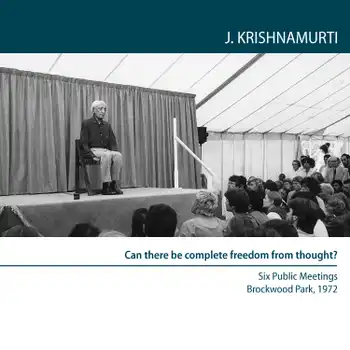
Can There Be Complete Freedom Of Thought? : Six Public Meetings Brockwood Park Uk 1972
Om den här boken
Public Talks 1. Complete freedom from thought - 9 September 1972 Duration: 76 minutes • Learning is instant perception and action. What place has thought in learning? • To learn about freedom must thought be completely silent? Does insight into freedom take time? • Can thinking, however rational, bring about a psychological revolution in us? • Is thought always conditioned? Is freedom the non-existence of thought? • My very being is related to thought. If you want to see something new, what do you do? • To have insight, let go of the old and listen. • Learning is not memorizing. • Q: Is feeling another way of thinking? • Q: Isn't the need to love and be loved essential? • Needing love is love of self 2. If I don't change now what will the future be? - 10 September 1972 Duration: 86 minutes • Is thought responsible for fragmentation? • Does fragmentation have its own activity? • What is the energy that perceives the total and doesn't live in fragmentation? • Does comparison bring about fear and pleasure? • Is thought seeking security in belief and dogma? • Can the mind learn instantly all the content of the unconscious in which there are deep, secret fears? • Does analysis imply time and division? Is consciousness separate from its content? • To get at the root of fear means learning about not being. • Q: What about guilt? 3. If freedom is responsibility, how do I act? - 16 September 1972 Duration: 78 minutes • Q: What is the action that will be a total response to the world around us? • Can one respond totally without learning about love and death in relation to daily life? • Do we live, or do we tolerate living? • Do we live according to ideas and conclusions based on belief, dogma and memory? • Is there an action which dissipates all images? • Is love relationship in which there is no image? Is disorder relationship in which there is the image? • Can a mind seeking comfort learn about death? • Find out whether death is something to be avoided or to be lived with naturally. • Can the mind free itself from the known? • Q: What relationship has literature, beauty and art to our daily life? • Q: Were you conditioned by the Masters? • Q: Can one help someone in distress? 4. To come upon the new, thought must be quiet - 17 September 1972 Duration: 66 minutes • If one is serious, one must learn for oneself if there is such a thing as the im measurable. • Thought cannot find the immeasurable because thought is measurement and time. • Can thought, realizing its limitations, be quiet? • Can the mind without effort see its content clearly, and the limitation, lack of space and time-binding quality of its consciousness? • When you say, 'I do not know,' does the content have importance? • There are various systems of meditation, gadgets, yoga, to make the mind quiet. These are unimportant. • Is truth the very perception of the false? • When the mind has perceived the truth of something, what is time? • Is there a different dimension which thought cannot touch? Public Discussion 5. You can learn only if you do not know - 12 September 1972 Duration: 90 minutes • Q: Does learning require thinking, or only awareness? • To be aware is to be conscious, to be in relationship with what you observe outwardly and also our inward reactions. • Awareness reveals that I have a conclusion from which I act, which prevents the free flow of energy. • You see that you have many opinions and conclusions. You don't know why you have them or how to be free of them. Start with not knowing. • Knowledge is in the past whilst learning is vital, in the present. • In learning, which is a constant movement, can opinion and conclusion ever be formed? • Can thought be slowed down naturally? In learning about the function of thought, slowing down takes place without control or effort.
Kom igång med den här boken idag för 0 kr
- Få full tillgång till alla böcker i appen under provperioden
- Ingen bindningstid, avsluta när du vill
Författare:
Uppläsare:
Språk:
Engelska
Format:

How to Overcome Your Fear of Public Speaking : Understanding What is Behind Your Fear of Public Speaking

Philosophy for Beginners How to Understand the Basics of Philosophy as Easy as Child's Play and Successfully Apply Them in Your Everyday Life by Means of Practical Exercises

Mind is a Myth : Enriched edition.

Mikään ei ole totta ja kaikki on mahdollista : Uuden venäjän surrealistinen sydän

Taistelu totuudesta : Mikä salaliittoteorioissa koukuttaa ja miksi ne pitää ottaa vakavasti?

The Observer Is The Observed

Divide or Conquer : How Great Teams Turn Conflict into Strength

Future Histories : What Ada Lovelace, Tom Paine, and the Paris Commune Can Teach Us About Digital Technology

The World Within; You Are The Story of Humanity

Laozi's Dao De Jing : A New Interpretation for a Transformative Time

Sports Motivation : The Ultimate Guide to Staying Motivated While Running or Playing Sports

The Mirror of Relationship : The Collected Works of J Krishnamurti 1936 - 1944

A los Pies del Maestro

The Awakening of Intelligence

Havaintoja : Päiväkirjamerkintöjä

Knowledge and Learning are two Different things : Eight Public Talks with Young People, Claremont Colleges, USA, 1968

Being A Light To Oneself : Four Small Group Discussions Ojai USA 1972

Breaking the pattern of egocentric activity : Ojai 1980 - Dialogue 4

Living with a sustained seriousness : Malibu 1970 - Small Group Discussion 1

The seed of a million years : Madras (Chennai) 1979_80 - Public Meetings

If I don't change now what will the future be? : Brockwood Park 1972 Public Talk 1

The Benediction of Meditation : Claremont 1968 - Students Talk 3

Why Do We Live With Stress?

Meditation is to discover an area in which there is no movement of thought : Saanen 1974 - Public Talk 7