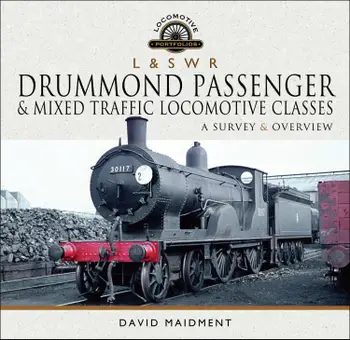
L & S W R Drummond Passenger & Mixed Traffic Locomotive Classes : A Survey & Overview

A detailed look at the nineteenth-century steam locomotive engineer and the ups and downs of his career, with numerous photos throughout.

Born in Scotland in 1840, Dugald Drummond had a long career in locomotive and railway engineering, including prominent positions on the Highland; London Brighton & South Coast Railway, North British, and Caledonian Railways, before arriving on the London & South Western Railway in the mid-1890s. There he replaced his mild-mannered and better-liked predecessor, William Adams.

His locomotives were a mix: His 4-4-0 tender and 0-4-4 tank classes were very good, but his 4-6-0 tender locomotives proved a disappointment, with the exception of the T14 class, which lasted in service until 1951. Many of his 4-4-0 tender and 0-4-4 tank locomotives, the T9 and M7 classes, lasted until the early 1960s on British Railways.

As a result of his stubborn nature, Drummond died in 1912 after an accident that scalded his feet, having refused to get proper treatment. But much of his work lived on for decades, and examples are preserved today in the National Collection and on the Swanage Railway.

Om den här boken

A detailed look at the nineteenth-century steam locomotive engineer and the ups and downs of his career, with numerous photos throughout.

Born in Scotland in 1840, Dugald Drummond had a long career in locomotive and railway engineering, including prominent positions on the Highland; London Brighton & South Coast Railway, North British, and Caledonian Railways, before arriving on the London & South Western Railway in the mid-1890s. There he replaced his mild-mannered and better-liked predecessor, William Adams.

His locomotives were a mix: His 4-4-0 tender and 0-4-4 tank classes were very good, but his 4-6-0 tender locomotives proved a disappointment, with the exception of the T14 class, which lasted in service until 1951. Many of his 4-4-0 tender and 0-4-4 tank locomotives, the T9 and M7 classes, lasted until the early 1960s on British Railways.

As a result of his stubborn nature, Drummond died in 1912 after an accident that scalded his feet, having refused to get proper treatment. But much of his work lived on for decades, and examples are preserved today in the National Collection and on the Swanage Railway.
Kom igång med den här boken idag för 0 kr

  • Få full tillgång till alla böcker i appen under provperioden
  • Ingen bindningstid, avsluta när du vill
Prova gratis nu
Mer än 52 000 personer har gett Nextory 5 stjärnor i App Store och på Google Play.