3.1(7)

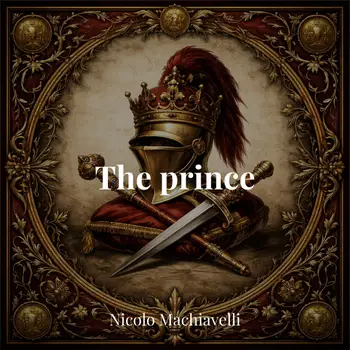
The Prince

Power is rarely given. It is taken—and kept.

In The Prince, Niccolò Machiavelli strips politics of illusion and presents power in its rawest form. Written in the turbulence of Renaissance Italy, this concise yet radical treatise examines how rulers acquire authority, maintain control, and survive in a world governed by ambition and instability.

Machiavelli’s philosophy broke from medieval moral idealism. He replaced abstract virtue with pragmatic realism, arguing that leadership requires calculation, adaptability, and sometimes severity. Rather than asking what is good, he asks what works. His analysis of fortune, fear, loyalty, and military strength reshaped political thought for centuries.

This audiobook explores Machiavelli’s reflections on hereditary versus newly acquired states, the delicate balance between love and fear, and the strategic use of reputation. Each chapter builds a framework of governance grounded in observation rather than idealism—without softening its unsettling conclusions.

For over five hundred years, The Prince has influenced statesmen, revolutionaries, corporate strategists, and political theorists. Its relevance endures because it confronts a timeless question: Is effective leadership compatible with moral purity?

Presented with clear, deliberate AI narration, this edition delivers steady pacing and articulate clarity, allowing Machiavelli’s precise arguments to unfold with intellectual intensity and focus.

Step into the anatomy of power.

Begin listening today.

Kom igång med den här boken idag för 0 kr

  • Få full tillgång till alla böcker i appen under provperioden
  • Ingen bindningstid, avsluta när du vill
Prova gratis nu
Mer än 52 000 personer har gett Nextory 5 stjärnor i App Store och på Google Play.

  1. 3.5

    Fursten

    Niccolò Machiavelli

  2. 3.5

    Fursten

    Niccolò Machiavelli

  3. 3.9

    Niccolò Machiavelli: The Prince : A philosophical treatise on the gaining and keeping of power

    Niccolò Machiavelli

  4. 4.0

    The Prince

    Niccolò Machiavelli

  5. 33 Masterpieces of Philosophy and Science to Read Before You Die (Illustrated) : Utopia, The Meditations, The Art of War, The Kama Sutra, Candide

    Thomas More, Marcus Aurelius Antoninus, Sun Tzu, Vatsyayana, Voltaire, Edwin A. Abbott, Aristotle, Dale Carnegie, Gilbert Keith Chesterton, René Descartes, Epictetus, Sigmund Freud, Hermann Hesse, David Hume, Lao Tzu, David Herbert Lawrence, Niccolò Machiavelli, John Mill, Prentice Mulford, Friedrich Nietzsche, Plato, Bertrand Russell, H.G. Wells, Frances Bacon

  6. SELF-MASTERY: 30 Best Books to Guide You To Your Goals : The Collected Wisdom from the Greatest Books on Becoming Wealthy & Successful

    P.T. Barnum, Benjamin Franklin, Wallace D. Wattles, William Walker Atkinson, Orison Swett Marden, James Allen, Russell Conwell, Henry Harrison Brown, Thorstein Veblen, Émile Coué, Kahlil Gibran, Marcus Aurelius, Niccolò Machiavelli, Lao Tzu

  7. The Art of War

    Niccolò Machiavelli

  8. The Prince - Audiobook

    Niccolò Machiavelli, Classic Audiobooks

  9. Discourses on the First Decade of Titus Livius : Enriched edition. Roman Republicanism, Civic Virtue, and the Dynamics of Power Through Livy's History

    Niccolò Machiavelli

  10. Achieving Prosperity - Ultimate Collection

    Wallace D. Wattles, William Walker Atkinson, P.T. Barnum, Benjamin Franklin, Orison Swett Marden, James Allen, Russell Conwell, Henry Harrison Brown, Thorstein Veblen, Émile Coué, Kahlil Gibran, Marcus Aurelius, Niccolò Machiavelli, Lao Tzu, B.F. Austin, Charles F. Haanel, Robert Collier, Elbert Hubbard, William Crosbie Hunter, Harry A. Lewis, Florence Scovel Shinn

  11. 33 Human Science Masterpieces You Must Read Before You Die. Illustrated : The Art of Public Speaking, The Meditations, The Kama Sutra and other masterpieces

    Edwin A. Abbott, Aristotle, Dale Carnegie, Gilbert Chesterton, René Descartes, Epictetus, Marcus Aurelius Antoninus, Sigmund Freud, Hermann Hesse, David Hume, Lao Tzu, Confucius, Swami Abhedananda, Anonimous, David Herbert Lawrence, Niccolò Machiavelli, Benedictus de Spinoza, John Mill, Prentice Mulford, Thomas More, Friedrich Nietzsche, J. Allanson Picton, Plato, Sun Tzu, Vatsyayana, Voltaire, H.G. Wells, Frances Bacon