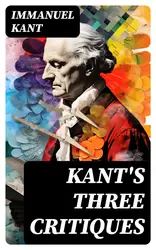
THE THREE CRITIQUES: The Critique of Pure Reason, The Critique of Practical Reason & The Critique of Judgment : Foundational Insights into Ethics and Aesthetics

In "The Three Critiques: The Critique of Pure Reason, The Critique of Practical Reason, and The Critique of Judgment," Immanuel Kant presents a groundbreaking exploration of epistemology, ethics, and aesthetics, fundamentally reshaping Western philosophy. Each critique acts as a pillar in Kant's critical philosophy, addressing the limits of human understanding, the nature of moral judgment, and the conditions for aesthetic appreciation. The texts are marked by a rigorous analytic style, replete with intricate arguments and foundational concepts such as the categorical imperative and the aesthetic sublime that anchor Kant's transcendental idealism within both metaphysics and human experience. Immanuel Kant (1724-1804), a pivotal figure in Enlightenment thought, was profoundly influenced by the philosophical debates of his time, especially regarding the nature of knowledge and morality. His engagement with rationalism and empiricism led to his distinct method of critical examination, seeking to resolve the tensions between subjective experience and objective reality. The challenges posed by skepticism and dogmatism drove Kant to develop a comprehensive framework that articulated the relationship between reason, will, and the aesthetic experience. Scholars and readers alike will find "The Three Critiques" indispensable for understanding modern philosophy's emergence. With clarity and depth, Kant'Äôs works not only provide a robust foundation for ethical and aesthetic inquiry but also challenge readers to contemplate their own cognitive capacities and moral responsibilities. This collection is essential for anyone seeking insight into the philosophical currents that define contemporary thought.
Kom igång med den här boken idag för 0 kr

  • Få full tillgång till alla böcker i appen under provperioden
  • Ingen bindningstid, avsluta när du vill
Prova gratis nu
Mer än 52 000 personer har gett Nextory 5 stjärnor i App Store och på Google Play.

  1. 12 Masterpieces You Have to Read Before You Die. Philosophy
    Niccolo Machiavelli, Tommaso Campanella, Francis Bacon, Thomas More, John Stuart Mill, Immanuel Kant, Kahlil Gibran, Leo Tolstoy, G.K. Chesterton, Henry David Thoreau

  2. 3.0

    Classic Philosophical Works (Thus Spoke Zarathustra, The Apology of Socrates, Tao Te Ching...)

    Plato, Friedrich Nietzsche, Herman Hesse, Leo Tolstoy, Immanuel Kant, Sun Tzu

  3. 5.0

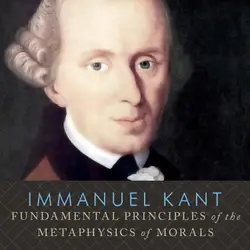
    Fundamental Principles of the Metaphysics of Morals

    Immanuel Kant

  4. Dreams of a Spirit-Seer

    Immanuel Kant

  5. The Ethics of Immanuel Kant : Enriched edition. Exploring Kant's Deontological Ethics and the Categorical Imperative

    Immanuel Kant

  6. Kant's Three Critiques : The Critique of Pure Reason, The Critique of Practical Reason & The Critique of Judgment

    Immanuel Kant

  7. Pedagogiikasta

    Immanuel Kant

  8. 4.0

    3500 Final Quotes

    Marcus Aurelius, Jane Austen, Beaumarchais, Napoleon Bonaparte, Buddha, Winston Churchill, Cicero, Confucius, Nicolas de Chamfort, Charles de Gaulle, Antoine de Saint-Exupéry, Denis Diderot, Fyodor Dostoevsky, Albert Einstein, Ralph Waldo Emerson, Anne Frank, Mahatma Gandhi, Immanuel Kant, Søren Kierkegaard, Martin Luther King, Georg Christoph Lichtenberg, Abraham Lincoln, Montesquieu, Friedrich Nietzsche, Plato, Marcel Proust, Arthur Schopenhauer, William Shakespeare, Socrates, Baruch Spinoza, Henry David Thoreau, Leonardo da Vinci, Voltaire, Oscar Wilde, Laozi

  9. 2000 Final Quotations

    Marcus Aurelius, Jane Austen, Buddha, Anton Chekhov, Cicero, Emil Cioran, Confucius, Albert Einstein, Anne Frank, Mahatma Gandhi, Johann Wolfgang Goethe, Carl Jung, Immanuel Kant, Friedrich Nietzsche, Marcel Proust, Arthur Schopenhauer, William Shakespeare, Baruch Spinoza, Leonardo da Vinci, Laozi

  10. 3.0

    An Answer to the Question: What is Enlightenment?

    Immanuel Kant

  11. Critique of Pure Reason

    Immanuel Kant

  12. 4.3
    #12

    Tankar kring en universell historieskrivning för en kosmopolitisk plan

    Immanuel Kant