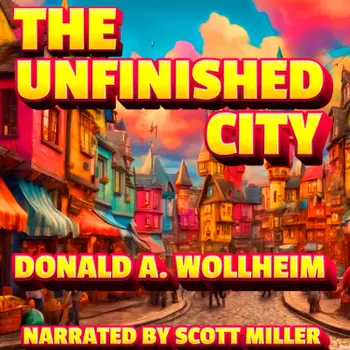

Some cities invite admiration. Others invite conquest. The Unfinished City invites something far more dangerous: temptation. When a traveler from a distant land enters Oo, he finds a place unlike any other—a river city of laughing citizens, half-built towers, incomplete carvings, and goods that always stop just short of flawlessness. Every corner suggests work abandoned at the final moment. Every object refuses the last polish.
To the people of Oo, this is reverence. Only their god may be perfect. To the visitor, it is waste.
He prides himself on skill. On calculation. On slipping through crowded streets unnoticed while appearing entirely at ease. As he studies the city’s strange custom, his irritation grows. If perfection exists anywhere, it must be in the temple at the city’s heart. And when he finds it—cold, immaculate, gleaming with impossible detail—he cannot resist testing whether the god’s watchfulness is as complete as its carving.
What follows is not a chase filled with shouting crowds or clashing steel. It is quieter. Stranger. More deliberate. A journey through jungle and darkness shadowed by smiling men who never seem to hurry and never seem to doubt the outcome. The visitor believes he understands pursuit. He believes he understands risk. But he has never before faced a world that refuses to finish what it begins—because something else always does. The Unfinished City is early planetary fantasy with a sharp edge. It blends exotic setting with moral irony and delivers its judgment slowly, almost playfully, until there is nowhere left to turn.
Donald A. Wollheim wrote this tale early in his career, long before he became one of the most influential editors and publishers in science fiction. Born in 1914, Wollheim was active in early fandom and was one of the founding figures behind organized science fiction communities in the 1930s.