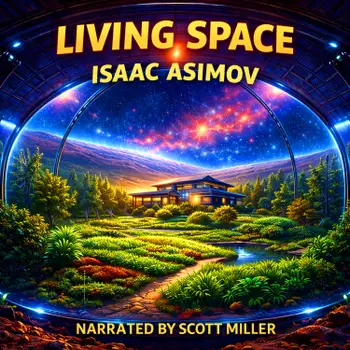
Humanity has solved overpopulation at last. Instead of crowding together, families now live in perfect isolation, each on their own version of Earth—vast, silent, and seemingly lifeless. In Living Space, that elegant solution is taken for granted, until a single disturbance raises an impossible question: what if the system isn’t as flawless as everyone believes?
Isaac Asimov builds a calm, orderly future and then quietly introduces doubt. The story unfolds with methodical precision, blending domestic normalcy with mounting unease. Beneath the comfort of advanced technology lies a deeper tension—about ownership, entitlement, and the dangers of assuming humanity is always alone. What begins as a bureaucratic inconvenience grows into something far more unsettling, forcing characters to confront the limits of logic in an infinite universe.
This is classic Asimov: clear-eyed, idea-driven, and relentlessly thoughtful. Living Space doesn’t rely on spectacle or action, but on the slow realization that even perfect systems carry hidden risks. It’s a story about unintended consequences, cultural blind spots, and how small anomalies can expose vast truths.
Isaac Asimov was one of the most influential science fiction writers of the twentieth century, known for combining scientific rigor with sharp social insight. Across hundreds of stories and essays, he explored how human institutions respond to technology, power, and change. Living Space reflects his talent for turning abstract concepts into intimate, unsettling human drama—proof that the biggest dangers often arrive quietly.