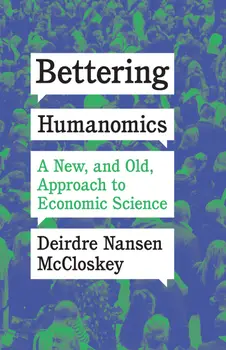
Bettering Humanomics : A New, and Old, Approach to Economic Science

Deirdre Nansen McCloskey's latest meticulous work examines how economics can become a more "human" science.

Economic historian Deirdre Nansen McCloskey has distinguished herself through her writing on the Great Enrichment and the betterment of the poor—not just materially but spiritually. In Bettering Humanomics she continues her intellectually playful yet rigorous analysis with a focus on humans rather than the institutions. Going against the grain of contemporary neo-institutional and behavioral economics which privilege observation over understanding, she asserts her vision of "humanomics," which draws on the work of Bart Wilson, Vernon Smith, and most prominently, Adam Smith. She argues for an economics that uses a comprehensive understanding of human action beyond behaviorism.

McCloskey clearly articulates her points of contention with believers in "imperfections," from Samuelson to Stiglitz, claiming that they have neglected scientific analysis in their haste to diagnose the ills of the system. In an engaging and erudite manner, she reaffirms the global successes of market-tested betterment and calls for empirical investigation that advances from material incentives to an awareness of the human within historical and ethical frameworks. Bettering Humanomics offers a critique of contemporary economics and a proposal for an economics as a better human science.

À propos de ce livre

Deirdre Nansen McCloskey's latest meticulous work examines how economics can become a more "human" science.

Economic historian Deirdre Nansen McCloskey has distinguished herself through her writing on the Great Enrichment and the betterment of the poor—not just materially but spiritually. In Bettering Humanomics she continues her intellectually playful yet rigorous analysis with a focus on humans rather than the institutions. Going against the grain of contemporary neo-institutional and behavioral economics which privilege observation over understanding, she asserts her vision of "humanomics," which draws on the work of Bart Wilson, Vernon Smith, and most prominently, Adam Smith. She argues for an economics that uses a comprehensive understanding of human action beyond behaviorism.

McCloskey clearly articulates her points of contention with believers in "imperfections," from Samuelson to Stiglitz, claiming that they have neglected scientific analysis in their haste to diagnose the ills of the system. In an engaging and erudite manner, she reaffirms the global successes of market-tested betterment and calls for empirical investigation that advances from material incentives to an awareness of the human within historical and ethical frameworks. Bettering Humanomics offers a critique of contemporary economics and a proposal for an economics as a better human science.
Commencez ce livre dès aujourd'hui pour 0 €

  • Accédez à tous les livres de l'app pendant la période d'essai
  • Sans engagement, annulez à tout moment
Essayer gratuitement
Plus de 52 000 personnes ont noté Nextory 5 étoiles sur l'App Store et Google Play.