Cymbeline

William Shakespeare's "Cymbeline" is a masterful blend of romance, tragedy, and comedy that unfolds within the intricate tapestry of the British royal court. Set against a backdrop of mistaken identities and external conflict, the play delves into themes of honor, fidelity, and the complexities of love. Shakespeare employs a rich and lyrical language, weaving poetic dialogue with captivating prose to explore the characters' emotional landscapes. The play is also contextualized by its time, reflecting the era's fascination with nationalism and the idealization of past heroic figures, while subtly critiquing the sociopolitical dynamics of power and gender. Shakespeare, a pivotal figure in English literature, wrote "Cymbeline" during the late stage of his career, around 1609-1610, when his works increasingly explored complex human emotions and social commentary. The playwright's own experiences in a rapidly changing society, marked by the tensions of political power and personal relationships, likely influenced the creation of this intricate narrative. The intermingling of myth and reality in the play may also resonate with Shakespeare's ongoing preoccupations with the nature of truth and perception. "Cymbeline" is highly recommended for readers interested in the richness of Shakespearean themes and the evolution of his narrative style. Its compelling blend of elements makes it an enduring piece that invites audiences to reflect on the nature of love, loyalty, and deception. Engaging with this play will not only enhance one's appreciation for Shakespeare's genius but also offer valuable insights into the human condition.


À propos de ce livre

William Shakespeare's "Cymbeline" is a masterful blend of romance, tragedy, and comedy that unfolds within the intricate tapestry of the British royal court. Set against a backdrop of mistaken identities and external conflict, the play delves into themes of honor, fidelity, and the complexities of love. Shakespeare employs a rich and lyrical language, weaving poetic dialogue with captivating prose to explore the characters' emotional landscapes. The play is also contextualized by its time, reflecting the era's fascination with nationalism and the idealization of past heroic figures, while subtly critiquing the sociopolitical dynamics of power and gender. Shakespeare, a pivotal figure in English literature, wrote "Cymbeline" during the late stage of his career, around 1609-1610, when his works increasingly explored complex human emotions and social commentary. The playwright's own experiences in a rapidly changing society, marked by the tensions of political power and personal relationships, likely influenced the creation of this intricate narrative. The intermingling of myth and reality in the play may also resonate with Shakespeare's ongoing preoccupations with the nature of truth and perception. "Cymbeline" is highly recommended for readers interested in the richness of Shakespearean themes and the evolution of his narrative style. Its compelling blend of elements makes it an enduring piece that invites audiences to reflect on the nature of love, loyalty, and deception. Engaging with this play will not only enhance one's appreciation for Shakespeare's genius but also offer valuable insights into the human condition.
Commencez ce livre dès aujourd'hui pour 0 €

  • Accédez à tous les livres de l'app pendant la période d'essai
  • Sans engagement, annulez à tout moment
Essayer gratuitement
Plus de 52 000 personnes ont noté Nextory 5 étoiles sur l'App Store et Google Play.

  1. 4.7

    Le Songe d'une Nuit d'Eté

    William Shakespeare

  2. La Tempête

    William Shakespeare

  3. 13 nov.

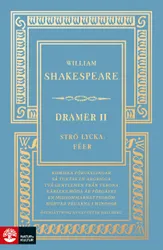
    Dramer II. Strö lycka, féer : Komiska förväxlingar, Så tuktas en argbigga, Två gentlemän från Verona, Kärleks möda är förgäves, En midsommarnattsdröm, Muntra fruarna i Windsor.

    William Shakespeare

  4. Nouveau

    William Shakespeare : Unabridged version with stage directions

    William Shakespeare

  5. Nouveau

    William Shakespeare : Unabridged version with stage directions

    William Shakespeare

  6. Nouveau

    William Shakespeare : Unabridged version with stage directions

    William Shakespeare

  7. Nouveau

    50 Clásicos que Debes Leer Antes de Morir : Un viaje literario por los tesoros de la literatura universal

    Dante Alighieri, Aristóteles, Jane Austen, Charles Baudelaire, Giovanni Boccaccio, Anne Brontë, C. Collodi, James Fenimore Cooper, Fedor Mikhaïlovitch Dostoïevski, Arthur Conan Doyle, Alexandre Dumas, José de Espronceda, Gustave Flaubert, Sigmund Freud, Benito Pérez Galdós, Kahlil Gibran, Johann Wolfgang Goethe, Victor Hugo, Thomas Hardy, Nathaniel Hawthorne, Vicente Blasco Ibáñez, Washington Irving, James Joyce, Mariano José Larra, Jack London, Federico García Lorca, H.P. Lovecraft, Antonio Machado, Gustav Meyrink, John Stuart Mill, Amado Nervo, Friedrich Nietzsche, Solomon Northup, Alexander Sergeyevich Pushkin, Francisco de Quevedo, Walter Scott, William Shakespeare, Robert Louis Stevenson, Harriet Beecher Stowe, Jonathan Swift, Mark Twain, Miguel De Unamuno, Ramón María Valle-Inclán, Julio Verne, Virginia Woolf

  8. Nouveau

    The Big Book of Christmas

    Louisa May Alcott, O.Henry, Mark Twain, Beatrix Potter, Charles Dickens, William Shakespeare, Harriet Beecher Stowe, Emily Dickinson, Robert Louis Stevenson, Rudyard Kipling

  9. Nouveau
    4.1

    Hamlet

    William Shakespeare

  10. Nouveau

    Hamlet

    William Shakespeare

  11. Nouveau
    3.3

    Romeo and Juliet

    William Shakespeare

  12. Nouveau
    3.8

    The Tempest

    William Shakespeare