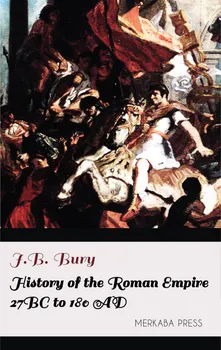
History of the Roman Empire 27 BC to 180 AD

JULIUS CESAR, the triumvir and the founder of the Roman Empire, was the grandnephew of C. Julius Caesar, the dictator, his adoptive father. Originally named, like his true father, C. Octavius, he entered the Julian family after the dictator’s death, and, according to the usual practice of adopted sons, called himself C. Julius Caesar Octavianus. But the name Octavianus soon fell into disuse, and by his contemporaries he was commonly spoken of as Caesar, just as Scipio Emilianus was commonly called Scipio.

The victory of Actium (Sept. 2, 31 BC), and the death of Marcus Antonius (Aug. 1, 30 BC) placed the supreme power in the hands of Caesar, for so we may best call him until he becomes Augustus. The Roman world lay at his feet and he had no rival. He was not a man of genius and his success had perhaps been chiefly due to his imperturbable self-control. He was no general; he was hardly a soldier, though not devoid of personal courage, as he had shown in his campaign in Illyricum. As a statesman he was able, but not creative or original, and he would never have succeeded informing a permanent constitution but for the example of the great dictator. In temper he was cool, without ardor or enthusiasm. His mind was logical and he aimed at precision in thought and expression. His culture was wide, if superficial; his knowledge of Greek imperfect. In literary style he affected simplicity and correctness; and he was an acute critic. Like many educated men of his time, he was not free from superstition. His habits were always simple, his food plain, and his surroundings modest. His family affections were strong and sometimes misled him into weakness. His presence was imposing, though he was not tall, and his features were marked by symmetrical beauty; but the pallor of his complexion showed that his health was naturally delicate. It was due to his self-control and his simple manner of life that he lived to be an old man.


À propos de ce livre

JULIUS CESAR, the triumvir and the founder of the Roman Empire, was the grandnephew of C. Julius Caesar, the dictator, his adoptive father. Originally named, like his true father, C. Octavius, he entered the Julian family after the dictator’s death, and, according to the usual practice of adopted sons, called himself C. Julius Caesar Octavianus. But the name Octavianus soon fell into disuse, and by his contemporaries he was commonly spoken of as Caesar, just as Scipio Emilianus was commonly called Scipio.

The victory of Actium (Sept. 2, 31 BC), and the death of Marcus Antonius (Aug. 1, 30 BC) placed the supreme power in the hands of Caesar, for so we may best call him until he becomes Augustus. The Roman world lay at his feet and he had no rival. He was not a man of genius and his success had perhaps been chiefly due to his imperturbable self-control. He was no general; he was hardly a soldier, though not devoid of personal courage, as he had shown in his campaign in Illyricum. As a statesman he was able, but not creative or original, and he would never have succeeded informing a permanent constitution but for the example of the great dictator. In temper he was cool, without ardor or enthusiasm. His mind was logical and he aimed at precision in thought and expression. His culture was wide, if superficial; his knowledge of Greek imperfect. In literary style he affected simplicity and correctness; and he was an acute critic. Like many educated men of his time, he was not free from superstition. His habits were always simple, his food plain, and his surroundings modest. His family affections were strong and sometimes misled him into weakness. His presence was imposing, though he was not tall, and his features were marked by symmetrical beauty; but the pallor of his complexion showed that his health was naturally delicate. It was due to his self-control and his simple manner of life that he lived to be an old man.
Commencez ce livre dès aujourd'hui pour 0 €

  • Accédez à tous les livres de l'app pendant la période d'essai
  • Sans engagement, annulez à tout moment
Essayer gratuitement
Plus de 52 000 personnes ont noté Nextory 5 étoiles sur l'App Store et Google Play.

  1. Nouveau

    The Dark Ages Collection

    J. B. Bury, Edward Creasy, Henry Bradley, Edward Gibbon, David Hume, Charles Oman

  2. Nouveau

    The Cambridge Modern History

    J. B. Bury, Mandell Creighton, R. Nisbet Bain, George Walter Prothero, Adolphus William Ward, Lord Acton

  3. The Dark Ages Collection

    J. B. Bury, Edward Creasy, Henry Bradley, Edward Gibbon, David Hume, Charles Oman

  4. The Cambridge Modern History

    J. B. Bury, Mandell Creighton, R. Nisbet Bain, George Walter Prothero, Adolphus William Ward, Lord Acton

  5. The Cambridge Modern History

    J. B. Bury, R. Nisbet, Mandell Creighton, Adolphus William Ward, Lord Acton

  6. The Dark Ages Collection  : The Complete Writings of J. B. Bury on Medieval Civilization and History

    J. B. Bury

  7. The Dark Ages Collection : Medieval History, Fall of Rome, Viking Raids, Crusades & More – A Compelling Anthology of Europe's Lost Centuries

    J. B. Bury, Edward Creasy, Henry Bradley, Edward Gibbon

  8. The Cambridge Modern History : The Complete Multi-Volume Collection – From the Renaissance to the 20th Century by Leading Historians

    J. B. Bury, Mandell Creighton, Robert Nisbet Bain, G. W. Prothero, Sir Adolphus William Ward

  9. History of the Later Roman Empire : From Arcadius to Irene (395 A.D. to 800 A.D)

    J. B. Bury

  10. The Cambridge Modern History Collection : A Comprehensive Scholarly Survey of Global Events from the Renaissance to the Twentieth Century

    J. B. Bury, Mandell Creighton, Robert Nisbet Bain, George Gordon Byron, Adolphus Ward

  11. The Dark Ages Collection : Epic Tales and Historical Writings from the Fall of Rome to the Dawn of the Renaissance

    J. B. Bury, Edward Creasy, Henry Bradley, Edward Gibbon

  12. A History of the Later Roman Empire (Vol. 1&2) : Enriched edition. From the Death of Theodosius I to the Death of Justinian - German Conquest of Western Europe & the Age of Justinian

    J. B. Bury