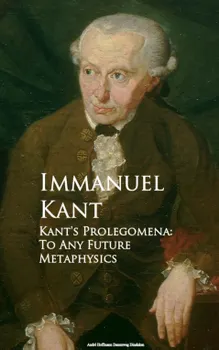
Kant's Prolegomena : To Any Future Metaphysics

KANT'S Prolegomena, although a small book, is indubitably the most important of his writings. It furnishes us with a key to his main work, The Critique of Pure Reason; in fact, it is an extract containing all the salient ideas of Kant's system. It approaches the subject in the simplest and most direct way, and is therefore best adapted as an introduction into his philosophy. For this reason, The Open Court Publishing Company has deemed it advisable to bring out a new edition of the work, keeping in view its broader use as a preliminary survey and explanation of Kant's philosophy in general. In order to make the book useful for this broader purpose, the editor has not only stated his own views concerning the problem underlying the Prolegomena, but has also collected the most important materials which have reference to Kant's philosophy, or to the reception which was accorded to it in various quarters. The selections have not been made from a partisan standpoint, but have been chosen with a view to characterising the attitude of different minds, and to directing the student to the best literature on the subject.

It is not without good reasons that the appearance of the Critique of Pure Reason is regarded as the beginning of a new era in the history of philosophy; and so it seems that a comprehension of Kant's position, whether we accept or reject it, is indispensable to the student of philosophy. It is not his solution which makes the sage of Königsberg the initiator of modern thought, but his formulation of the problem.

The present translation is practically new, but it goes without saying that the editor utilised the labors of his predecessors, among whom Prof. John P. Mahaffy and John H. Bernard deserve special credit. Richardson's translation of 1818 may be regarded as superseded and has not been consulted, but occasional reference has been made to that of Prof. Ernest Belfort Bax.
À propos de ce livre

KANT'S Prolegomena, although a small book, is indubitably the most important of his writings. It furnishes us with a key to his main work, The Critique of Pure Reason; in fact, it is an extract containing all the salient ideas of Kant's system. It approaches the subject in the simplest and most direct way, and is therefore best adapted as an introduction into his philosophy. For this reason, The Open Court Publishing Company has deemed it advisable to bring out a new edition of the work, keeping in view its broader use as a preliminary survey and explanation of Kant's philosophy in general. In order to make the book useful for this broader purpose, the editor has not only stated his own views concerning the problem underlying the Prolegomena, but has also collected the most important materials which have reference to Kant's philosophy, or to the reception which was accorded to it in various quarters. The selections have not been made from a partisan standpoint, but have been chosen with a view to characterising the attitude of different minds, and to directing the student to the best literature on the subject.

It is not without good reasons that the appearance of the Critique of Pure Reason is regarded as the beginning of a new era in the history of philosophy; and so it seems that a comprehension of Kant's position, whether we accept or reject it, is indispensable to the student of philosophy. It is not his solution which makes the sage of Königsberg the initiator of modern thought, but his formulation of the problem.

The present translation is practically new, but it goes without saying that the editor utilised the labors of his predecessors, among whom Prof. John P. Mahaffy and John H. Bernard deserve special credit. Richardson's translation of 1818 may be regarded as superseded and has not been consulted, but occasional reference has been made to that of Prof. Ernest Belfort Bax.

Commencez ce livre dès aujourd'hui pour 0 €

  • Accédez à tous les livres de l'app pendant la période d'essai
  • Sans engagement, annulez à tout moment
Essayer gratuitement
Plus de 52 000 personnes ont noté Nextory 5 étoiles sur l'App Store et Google Play.

  1. Nouveau

    100 Clásicos de la Literatura Universal

    Francis Scott Fitzgerald, Mary Shelley, Lyman Frank Baum, Louisa May Alcott, Dante Alighieri, Jane Austen, Ambrose Bierce, Emily Brontë, Edgar Rice Burroughs, Lewis Carroll, Wilkie Collins, René Descartes, Charles Dickens, Emily Dickinson, Alexandre Dumas, Gustave Flaubert, Benito Pérez Galdós, Johann Wolfgang von Goethe, Thomas Hardy, E T A Hoffmann, Washington Irving, Henry James, James Joyce, Franz Kafka, Gaston Leroux, Federico García Lorca, H.P. Lovecraft, Publio Virgilio Marón, Lucy Maud Montgomery, John William Polidori, Marco Polo, Antoine de Saint-Exupéry, Emilio Salgari, Walter Scott, Mark Twain, Jules Verne, Julio Verne, H.G. Wells, Edith Wharton, Mary Wollstonecraft, Stefan Zweig, Sun Tzu, Bram Stoker, - Aristoteles, George Bernard Shaw, Henryk Sienkiewicz, Concepción Arenal, Charlotte Brontë, Miguel de Cervantes, G.K. Chesterton, Daniel Defoe, Fyodor Mikhailovich Dostoyevsky, Arthur Conan Doyle, Sigmund Freud, H. Rider Haggard, Homero, Immanuel Kant, Rudyard Kipling, Molière, Friedrich Nietzsche, Fernando de Rojas, Sófocles, William Makepeace Thackeray, León Tolstói, Voltaire, Ramón María del Valle-Inclán, Oscar Wilde, Virginia Woolf

  2. Hacia la paz perpetua

    Immanuel Kant

  3. Teoría y praxis : Estudio preliminar: Eduardo García Belsunce

    Immanuel Kant

  4. La paz perpetua : Octava edición

    Immanuel Kant

  5. Yaşam Felsefesi

    Immanuel Kant

  6. La Paz Perpetua :

    Immanuel Kant

  7. 12 Masterpieces You Have to Read Before You Die. Philosophy

    Niccolo Machiavelli, Tommaso Campanella, Francis Bacon, Thomas More, John Stuart Mill, Immanuel Kant, Kahlil Gibran, Leo Tolstoy, G.K. Chesterton, Henry David Thoreau

  8. Crítica de la Razón Pura

    Immanuel Kant

  9. 2.5

    An Answer to the Question: What is Enlightenment?

    Immanuel Kant

  10. 3.5

    Ikuiseen rauhaan

    Immanuel Kant

  11. Dreams of a Spirit-Seer

    Immanuel Kant

  12. The Critique of Judgment (Theory of the Aesthetic Judgment & Theory of the Teleological Judgment) : Exploring Aesthetics and Teleology in Kantian Philosophy

    Immanuel Kant