Love Eternal

Dodo Collections brings you another classic from H. Rider Haggard, ‘Love Eternal’.

Although English author H. Rider Haggard is popularly known today as "the father of the lost race novel," such adventure tales of vanished civilizations were scarcely his sole concern. As any reader who has pursued this writer further than his "big 3" (1885’s "King Solomon’s Mines," 1887’s "Allan Quatermain" and 1887’s "She") would tell you, Haggard was also very much concerned with the matter of reincarnation and with what we might call "love that survives beyond the grave." These two themes comprise the very heart of "She" and its three sequels (1905’s "Ayesha," 1921’s "She and Allan" and 1923’s "Wisdom’s Daughter") and crop up in such disparate works of the author as his very first, "Dawn" (1884), and "Stella Fregelius" (1904). But perhaps the author’s most concise statement on these two matters is to be found in his beautifully written but largely forgotten novel simply entitled "Love Eternal." Written in 1916 but not published until April 1918, it is a work that is obviously very close to its author’s heart and one that draws largely on his own youthful experiences.

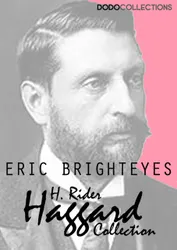
aH. Rider Haggard — was an English writer of adventure novels set in exotic locations, predominantly Africa, and a pioneer of the Lost World literary genre. He was also involved in agricultural reform throughout the British Empire. His stories, situated at the lighter end of Victorian literature, continue to be popular and influential.

His novels portray many of the stereotypes associated with colonialism, yet they are unusual for the degree of sympathy with which the native populations are portrayed. Africans often play heroic roles in the novels, although the protagonists are typically European (though not invariably). Notable examples are the heroic Zulu warrior Umslopogaasi and Ignosi, the rightful king of Kukuanaland, in King Solomon's Mines. Having developed an intense mutual friendship with the three Englishmen who help him regain his throne, he accepts their advice and abolishes witch-hunts and arbitrary capital punishment.


À propos de ce livre

Dodo Collections brings you another classic from H. Rider Haggard, ‘Love Eternal’.

Although English author H. Rider Haggard is popularly known today as "the father of the lost race novel," such adventure tales of vanished civilizations were scarcely his sole concern. As any reader who has pursued this writer further than his "big 3" (1885’s "King Solomon’s Mines," 1887’s "Allan Quatermain" and 1887’s "She") would tell you, Haggard was also very much concerned with the matter of reincarnation and with what we might call "love that survives beyond the grave." These two themes comprise the very heart of "She" and its three sequels (1905’s "Ayesha," 1921’s "She and Allan" and 1923’s "Wisdom’s Daughter") and crop up in such disparate works of the author as his very first, "Dawn" (1884), and "Stella Fregelius" (1904). But perhaps the author’s most concise statement on these two matters is to be found in his beautifully written but largely forgotten novel simply entitled "Love Eternal." Written in 1916 but not published until April 1918, it is a work that is obviously very close to its author’s heart and one that draws largely on his own youthful experiences.

aH. Rider Haggard — was an English writer of adventure novels set in exotic locations, predominantly Africa, and a pioneer of the Lost World literary genre. He was also involved in agricultural reform throughout the British Empire. His stories, situated at the lighter end of Victorian literature, continue to be popular and influential.

His novels portray many of the stereotypes associated with colonialism, yet they are unusual for the degree of sympathy with which the native populations are portrayed. Africans often play heroic roles in the novels, although the protagonists are typically European (though not invariably). Notable examples are the heroic Zulu warrior Umslopogaasi and Ignosi, the rightful king of Kukuanaland, in King Solomon's Mines. Having developed an intense mutual friendship with the three Englishmen who help him regain his throne, he accepts their advice and abolishes witch-hunts and arbitrary capital punishment.
Commencez ce livre dès aujourd'hui pour 0 €

  • Accédez à tous les livres de l'app pendant la période d'essai
  • Sans engagement, annulez à tout moment
Essayer gratuitement
Plus de 52 000 personnes ont noté Nextory 5 étoiles sur l'App Store et Google Play.

  1. Nouveau
    2.0

    King Solomon's Mines

    H. Rider Haggard

  2. Nouveau

    100 Clásicos de la Literatura Universal

    Francis Scott Fitzgerald, Mary Shelley, Lyman Frank Baum, Louisa May Alcott, Dante Alighieri, Jane Austen, Ambrose Bierce, Emily Brontë, Edgar Rice Burroughs, Lewis Carroll, Wilkie Collins, René Descartes, Charles Dickens, Emily Dickinson, Alexandre Dumas, Gustave Flaubert, Benito Pérez Galdós, Johann Wolfgang von Goethe, Thomas Hardy, E T A Hoffmann, Washington Irving, Henry James, James Joyce, Franz Kafka, Gaston Leroux, Federico García Lorca, H.P. Lovecraft, Publio Virgilio Marón, Lucy Maud Montgomery, John William Polidori, Marco Polo, Antoine de Saint-Exupéry, Emilio Salgari, Walter Scott, Mark Twain, Jules Verne, Julio Verne, H.G. Wells, Edith Wharton, Mary Wollstonecraft, Stefan Zweig, Sun Tzu, Bram Stoker, - Aristoteles, George Bernard Shaw, Henryk Sienkiewicz, Concepción Arenal, Charlotte Brontë, Miguel de Cervantes, G.K. Chesterton, Daniel Defoe, Fyodor Mikhailovich Dostoyevsky, Arthur Conan Doyle, Sigmund Freud, H. Rider Haggard, Homero, Immanuel Kant, Rudyard Kipling, Molière, Friedrich Nietzsche, Fernando de Rojas, Sófocles, William Makepeace Thackeray, León Tolstói, Voltaire, Ramón María del Valle-Inclán, Oscar Wilde, Virginia Woolf

  3. King Solomons Mines

    H. Rider Haggard

  4. 2.0
    #1

    King Solomon's Mines

    H. Rider Haggard

  5. She

    H. Rider Haggard

  6. Cleopatra

    H. Rider Haggard

  7. Maiwas Revenge

    H. Rider Haggard

  8. Historias de Allan Quatermain

    H. Rider Haggard

  9. Heu-Heu

    H. Rider Haggard

  10. El tesoro del lago

    H. Rider Haggard

  11. El niño de marfil

    H. Rider Haggard

  12. Allan Quatermain : Short stories

    H. Rider Haggard