2.7(3)

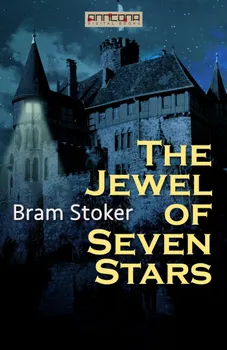
The Jewel of Seven Stars

The Jewel of Seven Stars is a horror novel by Bram Stoker first published in 1903.

The story is a first-person narrative of a young man pulled into an archaeologist's plot to revive Queen Tera, an ancient Egyptian mummy.

The Jewel of Seven Stars is part of a subgenre of Gothic fiction known as Gothic horror. First featured in Horace Walpole's The Castle of Otranto, Gothic horror combines elements of the Gothic and Romantic genres to create a pleasurably terrifying experience. Frankenstein, The Strange Case of Dr. Jekyll and Mr. Hyde, and Stoker’s Dracula are all considered landmarks of Gothic horror fiction.

The Jewel of Seven Stars was Bram Stoker's eighth novel. This novel, along with The Lair of The White Worm, is one of his most famous after Dracula. The story has been adapted to film several times.

The Jewel of Seven Stars was first published in the UK in 1903 and in the US in 1904. This is the 1912 edition that was published in an abridged version in the UK in 1912 by William Rider & Son, London. The publishers felt that the original ending of the book was too disturbing and asked Stoker to rewrite it. As a result, Chapter XVI "Powers - Old and New" was removed and the book was given a happier ending. "Powers - Old and New" was published as an excerpt under the name "The Bridal of Death" and in 1990 it appeared in the short story collection Midnight Tales, Peter Owen Publishers, London.

Although the abridged version was never published in the US, it was reprinted several times in the UK. The original version of this novel was not available in the UK until it was republished in 1996.

Abraham "Bram" Stoker (1847-1912) was an Irish author. Dracula was Bram Stoker's fifth and by far his most famous novel. Other novels include The Snake's Pass (1890), The Jewel of Seven Stars (1903), The Lady of the Shroud (1909) and The Lair of the White Worm (1911).
À propos de ce livre

The Jewel of Seven Stars is a horror novel by Bram Stoker first published in 1903.

The story is a first-person narrative of a young man pulled into an archaeologist's plot to revive Queen Tera, an ancient Egyptian mummy.

The Jewel of Seven Stars is part of a subgenre of Gothic fiction known as Gothic horror. First featured in Horace Walpole's The Castle of Otranto, Gothic horror combines elements of the Gothic and Romantic genres to create a pleasurably terrifying experience. Frankenstein, The Strange Case of Dr. Jekyll and Mr. Hyde, and Stoker’s Dracula are all considered landmarks of Gothic horror fiction.

The Jewel of Seven Stars was Bram Stoker's eighth novel. This novel, along with The Lair of The White Worm, is one of his most famous after Dracula. The story has been adapted to film several times.

The Jewel of Seven Stars was first published in the UK in 1903 and in the US in 1904. This is the 1912 edition that was published in an abridged version in the UK in 1912 by William Rider & Son, London. The publishers felt that the original ending of the book was too disturbing and asked Stoker to rewrite it. As a result, Chapter XVI "Powers - Old and New" was removed and the book was given a happier ending. "Powers - Old and New" was published as an excerpt under the name "The Bridal of Death" and in 1990 it appeared in the short story collection Midnight Tales, Peter Owen Publishers, London.

Although the abridged version was never published in the US, it was reprinted several times in the UK. The original version of this novel was not available in the UK until it was republished in 1996.

Abraham "Bram" Stoker (1847-1912) was an Irish author. Dracula was Bram Stoker's fifth and by far his most famous novel. Other novels include The Snake's Pass (1890), The Jewel of Seven Stars (1903), The Lady of the Shroud (1909) and The Lair of the White Worm (1911).
Commencez ce livre dès aujourd'hui pour 0 €

  • Accédez à tous les livres de l'app pendant la période d'essai
  • Sans engagement, annulez à tout moment
Essayer gratuitement
Plus de 52 000 personnes ont noté Nextory 5 étoiles sur l'App Store et Google Play.

  1. 3.6

    Dracula

    Bram Stoker

  2. 16 juil.
    4.0

    Dracula

    Bram Stoker

  3. Nouveau
    4.0

    Dracula

    Bram Stoker

  4. Nouveau
    #106

    Dracula – Chapter 15: The Empty Tomb

    Bram Stoker

  5. Nouveau
    3.0

    50 Masterpieces you have to read before you die vol: 2

    Lewis Carroll, Mark Twain, Jules Verne, Oscar Wilde, Arthur Conan Doyle, Louisa May Alcott, Jane Austen, G.K. Chesterton, Wilkie Collins, Charles Dickens, Fyodor Dostoyevsky, Alexandre Dumas, F. Scott Fitzgerald, E. M. Forster, Thomas Hardy, Hermann Hesse, James Joyce, Jack London, H.P. Lovecraft, Lucy Maud Montgomery, Edgar Allan Poe, Marcel Proust, William Shakespeare, Robert Louis Stevenson, H.G. Wells, Virginia Woolf, Rudyard Kipling, D. H. Lawrence, Thomas Mann, William Somerset Maugham, Herman Melville, George Sand, Mary Shelley, Walter Scott, Leo Tolstoy, Bram Stoker

  6. Nouveau

    50 Masterpieces you have to read before you die vol: 1

    Joseph Conrad, D. H. Lawrence, George Eliot, Leo Tolstoy, James Joyce, Charles Dickens, Jane Austen, Bram Stoker, Oscar Wilde, Louisa May Alcott, Honoré de Balzac, Edgar Rice Burroughs, Anne Brontë, Charlotte Brontë, Emily Brontë, Lewis Carroll, Willa Cather, Miguel de Cervantes, E. E. Cummings, Fyodor Dostoyevsky, Daniel Defoe, Arthur Conan Doyle, Alexandre Dumas, Gustave Flaubert, Henry James, Victor Hugo

  7. 100 Clásicos de la Literatura Universal

    Francis Scott Fitzgerald, Mary Shelley, Lyman Frank Baum, Louisa May Alcott, Dante Alighieri, Jane Austen, Ambrose Bierce, Emily Brontë, Edgar Rice Burroughs, Lewis Carroll, Wilkie Collins, René Descartes, Charles Dickens, Emily Dickinson, Alexandre Dumas, Gustave Flaubert, Benito Pérez Galdós, Johann Wolfgang von Goethe, Thomas Hardy, E T A Hoffmann, Washington Irving, Henry James, James Joyce, Franz Kafka, Gaston Leroux, Federico García Lorca, H.P. Lovecraft, Publio Virgilio Marón, Lucy Maud Montgomery, John William Polidori, Marco Polo, Antoine de Saint-Exupéry, Emilio Salgari, Walter Scott, Mark Twain, Jules Verne, Julio Verne, H.G. Wells, Edith Wharton, Mary Wollstonecraft, Stefan Zweig, Sun Tzu, Bram Stoker, - Aristoteles, George Bernard Shaw, Henryk Sienkiewicz, Concepción Arenal, Charlotte Brontë, Miguel de Cervantes, G.K. Chesterton, Daniel Defoe, Fyodor Mikhailovich Dostoyevsky, Arthur Conan Doyle, Sigmund Freud, H. Rider Haggard, Homero, Immanuel Kant, Rudyard Kipling, Molière, Friedrich Nietzsche, Fernando de Rojas, Sófocles, William Makepeace Thackeray, León Tolstói, Voltaire, Ramón María del Valle-Inclán, Oscar Wilde, Virginia Woolf

  8. 4.3

    Drácula

    Bram Stoker

  9. The Chain of Destiny

    Bram Stoker

  10. The Burial of the Rats

    Bram Stoker

  11. DRACULA'S HALLOWEEN

    Bram Stoker

  12. The Crystal Cup

    Bram Stoker