3.7(3)

The New Atlantis

Sir Francis Bacon’s ‘The New Atlantis’ is an Early Modern Utopian novel that explores an idealised view of what human progress can achieve. The novel centres around the Utopian Island of ‘Bensalem’ and its inhabitants, who embody Bacon’s dreams for humanity through their kind-hearted, enlightened, and communal spirit. Throughout this work, Bacon demonstrates the importance of religious freedom in Christian society, as well as the integration of science and ‘The Baconian Method’ into education. ‘Salomon’s House’ represents the apex of Bacon’s vision, a modern research university that focuses on the cutting edge of scientific discovery. ‘The New Atlantis’ was published posthumously in 1628, never completed. Despite this, it still offers a rich vision of what ‘The Father of Empiricism’ believed humanity could become. ‘The New Atlantis’ remains one of the most important works of Utopic Fiction, alongside Sir Thomas More’s ‘Utopia’.

Sir Francis Bacon (1561-1626) was an English author, philosopher, and statesman. A prolific author, his work has spanned science, religion and literary fiction. His work has had a profound impact on science, and he is often regarded as ‘The Father of Empiricism’. His most important books, ‘Novum Organum’ and ‘New Atlantis’ have a significant legacy. ‘Novum Organum’ was heavily influential to 17th century scholars, particularly Sir Thomas Browne who utilised ‘The Baconian Method’ for much of his encyclopaedia ‘Pseudodoxia Epidemica’. ‘Salomon’s House’ from ‘The New Atlantis’ was frequently used as inspiration for the establishment of ‘The Royal Society’, the United Kingdom’s national academy for sciences.

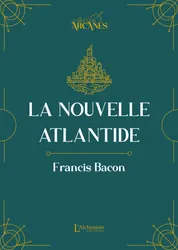
À propos de ce livre

Sir Francis Bacon’s ‘The New Atlantis’ is an Early Modern Utopian novel that explores an idealised view of what human progress can achieve. The novel centres around the Utopian Island of ‘Bensalem’ and its inhabitants, who embody Bacon’s dreams for humanity through their kind-hearted, enlightened, and communal spirit. Throughout this work, Bacon demonstrates the importance of religious freedom in Christian society, as well as the integration of science and ‘The Baconian Method’ into education. ‘Salomon’s House’ represents the apex of Bacon’s vision, a modern research university that focuses on the cutting edge of scientific discovery. ‘The New Atlantis’ was published posthumously in 1628, never completed. Despite this, it still offers a rich vision of what ‘The Father of Empiricism’ believed humanity could become. ‘The New Atlantis’ remains one of the most important works of Utopic Fiction, alongside Sir Thomas More’s ‘Utopia’.

Sir Francis Bacon (1561-1626) was an English author, philosopher, and statesman. A prolific author, his work has spanned science, religion and literary fiction. His work has had a profound impact on science, and he is often regarded as ‘The Father of Empiricism’. His most important books, ‘Novum Organum’ and ‘New Atlantis’ have a significant legacy. ‘Novum Organum’ was heavily influential to 17th century scholars, particularly Sir Thomas Browne who utilised ‘The Baconian Method’ for much of his encyclopaedia ‘Pseudodoxia Epidemica’. ‘Salomon’s House’ from ‘The New Atlantis’ was frequently used as inspiration for the establishment of ‘The Royal Society’, the United Kingdom’s national academy for sciences.

Commencez ce livre dès aujourd'hui pour 0 €

  • Accédez à tous les livres de l'app pendant la période d'essai
  • Sans engagement, annulez à tout moment
Essayer gratuitement
Plus de 52 000 personnes ont noté Nextory 5 étoiles sur l'App Store et Google Play.

  1. Nouveau

    The Gift of Friendship : What the Wisest Minds Said About Our Deepest Bonds Across Two Thousand Years

    Alfred H. Hyatt, Henry David Thoreau, Thomas Carlyle, Henry Mackenzie, Oliver Goldsmith, Samuel Johnson, George Berkeley, Richard Steele, Joseph Addison, Francis Bacon, Michel de Montaigne, Anthusa, Aristotle

  2. La Nouvelle Atlantide

    Francis Bacon, Lionel Cruzille (trad.)

  3. La sabiduría de los antiguos

    Francis Bacon

  4. 250 citations de philosophes anglais

    David Hume, John Locke, Francis Bacon, Thomas Hobbes, Thomas More

  5. 50 citations de Francis Bacon

    Francis Bacon

  6. 1800 Citations de philosophes

    Aristote, Épicure, Platon, Thalès de Milet, – Socrate, Protagoras, Anaximandre, Épictète, Héraclite, Marc Aurèle, René Descartes, Michel de Montaigne, Alexis de Tocqueville, Voltaire, Charles De Montesquieu, Jean-Jacques Rousseau, Emmanuel Kant, Hannah Arendt, Gottfried Wilhelm Leibniz, Georg Wilhelm Friedrich Hegel, Friedrich Nietzsche, Arthur Schopenhauer, David Hume, John Locke, Francis Bacon, Thomas Hobbes, Thomas More, Confucius, Érasme, Lao Tseu, Baruch Spinoza, Søren Kierkegaard, Nicolas Machiavel, Thomas d'Aquin, Henry David Thoreau

  7. Comprendre Francis Bacon

    Francis Bacon

  8. The Secret Teachings of All Ages Volume 2 : Lectures on Ancient Philosophy and the Foundations of Esoteric Wisdom

    Manly P. Hall, Alvin Boyd Kuhn, P. D. Ouspensky, Max Heindel, Francis Bacon

  9. The New Atlantis :

    Francis Bacon

  10. 12 Masterpieces You Have to Read Before You Die. Philosophy

    Niccolo Machiavelli, Tommaso Campanella, Francis Bacon, Thomas More, John Stuart Mill, Immanuel Kant, Kahlil Gibran, Leo Tolstoy, G.K. Chesterton, Henry David Thoreau

  11. Utopías del Renacimiento

    Tomás Moro, Tomaso Campanella, Francis Bacon

  12. The New Atlantis

    Francis Bacon