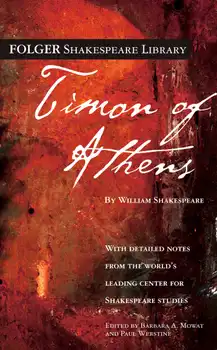
Timon of Athens

The real Timon of Athens lived there in the fifth century BCE, making him a contemporary of Socrates and Pericles. Shakespeare presents Timon as a figure who suffers such profound disillusionment that he becomes a misanthrope, or man-hater. This makes him a more interesting character than the caricature he had become to Shakespeare’s contemporaries, for whom “Timonist” was a slang term for an unsociable man.

Shakespeare’s play includes the wealthy, magnificent, and extravagantly generous figure of Timon before his transformation. Timon expects that, having received as gifts all that he owned, his friends will be equally generous to him.

Once his creditors clamor for repayment, Timon finds that his idealization of friendship is an illusion. He repudiates his friends, abandons Athens, and retreats to the woods. Yet his misanthropy arises from the destruction of an admirable illusion, from which his subsequent hatred can never be entirely disentangled.

The authoritative edition of Timon of Athens from The Folger Shakespeare Library, the trusted and widely used Shakespeare series for students and general readers, includes:

-Freshly edited text based on the best early printed version of the play

-Full explanatory notes conveniently placed on pages facing the text of the play

-Scene-by-scene plot summaries

-A key to the play’s famous lines and phrases

-An introduction to reading Shakespeare’s language

-An essay by a leading Shakespeare scholar providing a modern perspective on the play

-Fresh images from the Folger Shakespeare Library’s vast holdings of rare books

-An annotated guide to further reading

Essay by Coppélia Kahn

The Folger Shakespeare Library in Washington, DC, is home to the world’s largest collection of Shakespeare’s printed works, and a magnet for Shakespeare scholars from around the globe. In addition to exhibitions open to the public throughout the year, the Folger offers a full calendar of performances and programs. For more information, visit Folger.edu.
À propos de ce livre

The real Timon of Athens lived there in the fifth century BCE, making him a contemporary of Socrates and Pericles. Shakespeare presents Timon as a figure who suffers such profound disillusionment that he becomes a misanthrope, or man-hater. This makes him a more interesting character than the caricature he had become to Shakespeare’s contemporaries, for whom “Timonist” was a slang term for an unsociable man.

Shakespeare’s play includes the wealthy, magnificent, and extravagantly generous figure of Timon before his transformation. Timon expects that, having received as gifts all that he owned, his friends will be equally generous to him.

Once his creditors clamor for repayment, Timon finds that his idealization of friendship is an illusion. He repudiates his friends, abandons Athens, and retreats to the woods. Yet his misanthropy arises from the destruction of an admirable illusion, from which his subsequent hatred can never be entirely disentangled.

The authoritative edition of Timon of Athens from The Folger Shakespeare Library, the trusted and widely used Shakespeare series for students and general readers, includes:

-Freshly edited text based on the best early printed version of the play

-Full explanatory notes conveniently placed on pages facing the text of the play

-Scene-by-scene plot summaries

-A key to the play’s famous lines and phrases

-An introduction to reading Shakespeare’s language

-An essay by a leading Shakespeare scholar providing a modern perspective on the play

-Fresh images from the Folger Shakespeare Library’s vast holdings of rare books

-An annotated guide to further reading

Essay by Coppélia Kahn

The Folger Shakespeare Library in Washington, DC, is home to the world’s largest collection of Shakespeare’s printed works, and a magnet for Shakespeare scholars from around the globe. In addition to exhibitions open to the public throughout the year, the Folger offers a full calendar of performances and programs. For more information, visit Folger.edu.
Commencez ce livre dès aujourd'hui pour 0 €

  • Accédez à tous les livres de l'app pendant la période d'essai
  • Sans engagement, annulez à tout moment
Essayer gratuitement
Plus de 52 000 personnes ont noté Nextory 5 étoiles sur l'App Store et Google Play.

  1. Hamlet

    William Shakespeare

  2. Othello

    William Shakespeare

  3. 13 nov.

    Dramer II. Strö lycka, féer : Komiska förväxlingar, Så tuktas en argbigga, Två gentlemän från Verona, Kärleks möda är förgäves, En midsommarnattsdröm, Muntra fruarna i Windsor.

    William Shakespeare

  4. Nouveau

    William Shakespeare: The Complete Works (Illustrated)

    William Shakespeare

  5. Nouveau

    The Big Book of Christmas: 140+ authors and 400+ novels, novellas, stories, poems & carols

    Hans Christian Andersen, Charles Dickens, Louisa May Alcott, Lucy Maud Montgomery, Anne Brontë, Willa Cather, G.K. Chesterton, F. Marion Crawford, Fyodor Dostoyevsky, Arthur Conan Doyle, Mary E. Wilkins Freeman, The Brothers Grimm, Thomas Hardy, Nathaniel Hawthorne, O.Henry, E T A Hoffmann, Washington Irving, James Joyce, Rudyard Kipling, H.P. Lovecraft, John Milton, Beatrix Potter, Arthur Quiller-Couch, Walter Scott, Robert Louis Stevenson, Harriet Beecher Stowe, Leo Tolstoy, Anthony Trollope, Mark Twain, Oscar Wilde, Anton Chekhov, L. Frank Baum, William Blake, Samuel Taylor Coleridge, Emily Dickinson, Henry Wadsworth Longfellow, Clement C. Moore, William Shakespeare, Andrew Lang

  6. Nouveau
    3.0

    50 Masterpieces you have to read before you die vol: 2

    Lewis Carroll, Mark Twain, Jules Verne, Oscar Wilde, Arthur Conan Doyle, Louisa May Alcott, Jane Austen, G.K. Chesterton, Wilkie Collins, Charles Dickens, Fyodor Dostoyevsky, Alexandre Dumas, F. Scott Fitzgerald, E. M. Forster, Thomas Hardy, Hermann Hesse, James Joyce, Jack London, H.P. Lovecraft, Lucy Maud Montgomery, Edgar Allan Poe, Marcel Proust, William Shakespeare, Robert Louis Stevenson, H.G. Wells, Virginia Woolf, Rudyard Kipling, D. H. Lawrence, Thomas Mann, William Somerset Maugham, Herman Melville, George Sand, Mary Shelley, Walter Scott, Leo Tolstoy, Bram Stoker

  7. Nouveau

    Romeo and Juliet

    William Shakespeare

  8. Nouveau

    50 Clásicos que Debes Leer Antes de Morir : Un viaje literario por los tesoros de la literatura universal

    Dante Alighieri, Aristóteles, Jane Austen, Charles Baudelaire, Giovanni Boccaccio, Anne Brontë, C. Collodi, James Fenimore Cooper, Fedor Mikhaïlovitch Dostoïevski, Arthur Conan Doyle, Alexandre Dumas, José de Espronceda, Gustave Flaubert, Sigmund Freud, Benito Pérez Galdós, Kahlil Gibran, Johann Wolfgang Goethe, Johann Wolfgang von Goethe, Victor Hugo, Thomas Hardy, Nathaniel Hawthorne, Vicente Blasco Ibáñez, Washington Irving, James Joyce, Mariano José de Larra, Jack London, Federico García Lorca, H.P. Lovecraft, Antonio Machado, Gustav Meyrink, John Stuart Mill, Amado Nervo, Friedrich Nietzsche, Solomon Northup, Alexander Sergeyevich Pushkin, Francisco de Quevedo, Walter Scott, William Shakespeare, Robert Louis Stevenson, Harriet Beecher Stowe, Jonathan Swift, Mark Twain, Miguel De Unamuno, Ramón María del Valle-Inclán, Julio Verne, Virginia Woolf

  9. The Big Book of Christmas

    Louisa May Alcott, O.Henry, Mark Twain, Beatrix Potter, Charles Dickens, William Shakespeare, Harriet Beecher Stowe, Emily Dickinson, Robert Louis Stevenson, Rudyard Kipling

  10. 4.5
    #10

    As You Like It

    William Shakespeare

  11. 2.5

    Othello

    William Shakespeare

  12. A Midsummer Night's Dream

    William Shakespeare