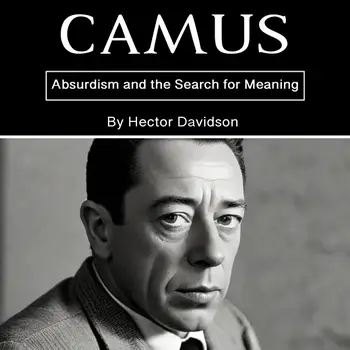
Camus : Absurdism and the Search for Meaning

Albert Camus, a prominent French philosopher and writer, is renowned for his exploration of Absurdism, a philosophical perspective addressing the inherent conflict between human beings' quest for meaning and the indifferent universe that provides none. Born in Mondovi, Algeria, in 1913, Camus’s early experiences with poverty and colonialism profoundly influenced his worldview. His intellectual journey was marked by his involvement in the French Resistance during World War II and his role as a public intellectual, shaping his distinctive approach to existentialist themes.

Absurdism, at the heart of Camus's philosophy, highlights the tension between our innate desire for meaning and the universe's inherent indifference. Camus posits that this conflict gives rise to what he terms "the absurd." This condition reflects the realization that our search for purpose clashes with the chaotic and meaningless nature of existence.

In his seminal essay, The Myth of Sisyphus, Camus introduces the figure of Sisyphus as an emblem of the absurd hero. Sisyphus, condemned to roll a boulder up a hill for eternity only to see it roll back down, symbolizes the human struggle against the absurd. Camus famously concludes that “one must imagine Sisyphus happy,” suggesting that the very act of persevering in the face of eternal struggle can become a source of triumph and personal fulfillment.

À propos de ce livre

Albert Camus, a prominent French philosopher and writer, is renowned for his exploration of Absurdism, a philosophical perspective addressing the inherent conflict between human beings' quest for meaning and the indifferent universe that provides none. Born in Mondovi, Algeria, in 1913, Camus’s early experiences with poverty and colonialism profoundly influenced his worldview. His intellectual journey was marked by his involvement in the French Resistance during World War II and his role as a public intellectual, shaping his distinctive approach to existentialist themes.

Absurdism, at the heart of Camus's philosophy, highlights the tension between our innate desire for meaning and the universe's inherent indifference. Camus posits that this conflict gives rise to what he terms "the absurd." This condition reflects the realization that our search for purpose clashes with the chaotic and meaningless nature of existence.

In his seminal essay, The Myth of Sisyphus, Camus introduces the figure of Sisyphus as an emblem of the absurd hero. Sisyphus, condemned to roll a boulder up a hill for eternity only to see it roll back down, symbolizes the human struggle against the absurd. Camus famously concludes that “one must imagine Sisyphus happy,” suggesting that the very act of persevering in the face of eternal struggle can become a source of triumph and personal fulfillment.
Commencez ce livre dès aujourd'hui pour 0 €

  • Accédez à tous les livres de l'app pendant la période d'essai
  • Sans engagement, annulez à tout moment
Essayer gratuitement
Plus de 52 000 personnes ont noté Nextory 5 étoiles sur l'App Store et Google Play.

D'autres ont également lu

Passer la liste
  1. De la vie heureuse de Sénèque

    Sénèque .

  2. 3.5

    Pensées pour moi-même

    Marc Aurèle

  3. 1800 Citations de philosophes

    Aristote, Épicure, Platon, Thalès de Milet, – Socrate, Protagoras, Anaximandre, Épictète, Héraclite, Marc Aurèle, René Descartes, Michel de Montaigne, Alexis de Tocqueville, Voltaire, Charles De Montesquieu, Jean-Jacques Rousseau, Emmanuel Kant, Hannah Arendt, Gottfried Wilhelm Leibniz, Georg Wilhelm Friedrich Hegel, Friedrich Nietzsche, Arthur Schopenhauer, David Hume, John Locke, Francis Bacon, Thomas Hobbes, Thomas More, Confucius, Érasme, Lao Tseu, Baruch Spinoza, Søren Kierkegaard, Nicolas Machiavel, Thomas d'Aquin, Henry David Thoreau

  4. Summary of Massimo Pigliucci's How to Be a Stoic

    Everest Media

  5. 5.0

    Understanding and Treating Chronic Shame : Healing Right Brain Relational Trauma

    Patricia DeYoung

  6. #5

    Healing Your Inner Child: Heal Childhood Trauma by Letting Go of Shame and Codependency, Creating Healthy Emotional Habits, Restoring Self-Worth, and Cultivating Authentic Relationships

    Eva Spencer

  7. The Stoicism Collection : Letters from a Stoic, Meditations, Seneca's 'On' Essays, The Enchiridion and Discourses, Life of Marcus Aurelius, & More

    Marcus Aurelius, Seneca, Epictetus, John Lord

  8. 4.0

    Kant en 60 minutes

    Walther Ziegler

  9. #1

    Apologie de Socrate de Platon - La réponse de Socrate à ses premiers accusateurs (Commentaire) : Comprendre la philosophie avec lePetitPhilosophe.fr

    Bertrand Conard, lePetitPhilosophe

  10. Dictionnaire philosophique : Essais satiriques sur la religion, la morale et la raison à l’âge des Lumières – Pour lecteurs de philosophie critique et libre pensée

    Voltaire, Ligaran

  11. Double Click : Twin Photographers in the Golden Age of Magazines

    Carol Kino

  12. Prix Nobel

    100 citations de George Bernard Shaw

    George Bernard Shaw