4.5(68)

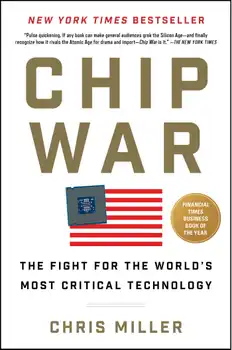
Chip War : The Fight for the World's Most Critical Technology

The Financial Times Business Book of the Year, this epic account of the decades-long battle to control one of the world’s most critical resources—microchip technology—with the United States and China increasingly in fierce competition is “pulse quickening…a nonfiction thriller” (The New York Times).

You may be surprised to learn that microchips are the new oil—the scarce resource on which the modern world depends. Today, military, economic, and geopolitical power are built on a foundation of computer chips. Virtually everything—from missiles to microwaves—runs on chips, including cars, smartphones, the stock market, even the electric grid. Until recently, America designed and built the fastest chips and maintained its lead as the #1 superpower, but America’s edge is in danger of slipping, undermined by players in Taiwan, Korea, and Europe taking over manufacturing. Now, as Chip War reveals, China, which spends more on chips than any other product, is pouring billions into a chip-building initiative to catch up to the US. At stake is America’s military superiority and economic prosperity.

Economic historian Chris Miller explains how the semiconductor came to play a critical role in modern life and how the US became dominant in chip design and manufacturing and applied this technology to military systems. America’s victory in the Cold War and its global military dominance stems from its ability to harness computing power more effectively than any other power. Until recently, China had been catching up, aligning its chip-building ambitions with military modernization. Here, in this paperback edition of the book, the author has added intriguing new material focused on "America's Chip Comeback,” which overviews the global consequences of the just passed CHIPS Act, the new export controls on China, and the effort to rally allies to better guard chip technology.

Illuminating, timely, and fascinating, Chip War is “an essential and engrossing landmark study” (The Times, London).
À propos de ce livre

The Financial Times Business Book of the Year, this epic account of the decades-long battle to control one of the world’s most critical resources—microchip technology—with the United States and China increasingly in fierce competition is “pulse quickening…a nonfiction thriller” (The New York Times).

You may be surprised to learn that microchips are the new oil—the scarce resource on which the modern world depends. Today, military, economic, and geopolitical power are built on a foundation of computer chips. Virtually everything—from missiles to microwaves—runs on chips, including cars, smartphones, the stock market, even the electric grid. Until recently, America designed and built the fastest chips and maintained its lead as the #1 superpower, but America’s edge is in danger of slipping, undermined by players in Taiwan, Korea, and Europe taking over manufacturing. Now, as Chip War reveals, China, which spends more on chips than any other product, is pouring billions into a chip-building initiative to catch up to the US. At stake is America’s military superiority and economic prosperity.

Economic historian Chris Miller explains how the semiconductor came to play a critical role in modern life and how the US became dominant in chip design and manufacturing and applied this technology to military systems. America’s victory in the Cold War and its global military dominance stems from its ability to harness computing power more effectively than any other power. Until recently, China had been catching up, aligning its chip-building ambitions with military modernization. Here, in this paperback edition of the book, the author has added intriguing new material focused on "America's Chip Comeback,” which overviews the global consequences of the just passed CHIPS Act, the new export controls on China, and the effort to rally allies to better guard chip technology.

Illuminating, timely, and fascinating, Chip War is “an essential and engrossing landmark study” (The Times, London).
Commencez ce livre dès aujourd'hui pour 0 €

  • Accédez à tous les livres de l'app pendant la période d'essai
  • Sans engagement, annulez à tout moment
Essayer gratuitement
Plus de 52 000 personnes ont noté Nextory 5 étoiles sur l'App Store et Google Play.

D'autres ont aimé

Passer la liste
  1. 5.0

    Summary of Zero to One

    Paul Adams

  2. 4.4

    L'Étranger - Le meurtre de l'Arabe - Albert Camus (Commentaire de texte) : Commentaire et Analyse de texte

    lePetitLitteraire, Marine Riguet

  3. 4.3

    107 Days

    Kamala Harris

  4. Histoire de la grandeur et de la décadence de César Birotteau d'Honoré de Balzac : Les Fiches de lecture d'Universalis

    Encyclopaedia Universalis

  5. Revue des Deux Mondes juillet-août 2025 : L'humour, une arme politique

    Aurélie Julia, Christian Authier, Yves de Gaulle, Jean-Michel Djian, Isabelle Rivère, Frédéric Verger, Jean-Pierre Naugrette, Darcos Xavier, Robert Kopp, Catherine Van Offelen, Marin De Viry, Claudine Wéry, Jean-François Roseau, Benoît Forgeot, Michaël Ferrier, Judith Sibony, Stéphane Barsacq, Christine Clerc, Sébastien Lapaque, Aurélien Tillier, Michel Delon, Charles Ficat, Stéphane Guégan, François Huguenin, Richard Millet, Olivier Bellamy

  6. The Almanack Of Naval Ravikant : Khushi aur Samriddhi ki guide (Hindi Edition)

    Eric Jorgenson

  7. 4.0

    L'Étranger d'Albert Camus (Analyse approfondie) : Approfondissez votre lecture de cette œuvre avec notre profil littéraire (résumé, fiche de lecture et axes de lecture)

    Julie Pihard, Profil-litteraire.fr

  8. 5.0

    Les lois de la nature humaine

    Robert Greene

  9. 7 Powers : The Foundations of Business Strategy

    Hamilton Helmer

  10. L'économie parasitaire : Rentes, privilèges et pouvoir : freins à la croissance.

    Beat Bürgenmeier

  11. 5.0

    Buy Then Build : How Acquisition Entrepreneurs Outsmart the Startup Game

    Walker Deibel

  12. Nana d'Émile Zola : Les Fiches de lecture d'Universalis

    Encyclopaedia Universalis