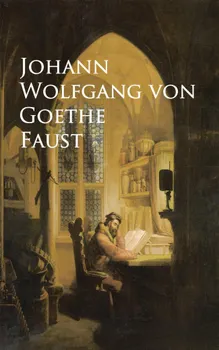
Faust

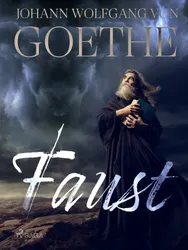
Faust: The First Part of the Tragedy is the first part of Goethe's Faust and is considered by many as the greatest work of German literature. It was first published in 1808. The first part of Faust is not divided into acts, but is structured as a sequence of scenes in a variety of settings. After a dedicatory poem and a prelude in the theater, the actual plot begins with a prologue in Heaven, where the Lord challenges Mephistopheles, the Devil, that Mephistopheles cannot lead astray the Lord's favourite striving scholar, Dr. Faust. We then see Faust in his study, who, disappointed of science with natural means, attempts and fails to gain knowledge of nature and the universe by magical ones. The dejected Faust contemplates suicide, but is held back by the sounds of the beginning Easter celebrations. He joins his assistant Wagner for an Easter walk in the countryside, among the celebrating people, and is followed home by a poodle. Back in the study, the poodle transforms itself into Mephistopheles, who offers Faust a contract: he will do Faust's bidding on earth, and Faust will do the same for him in hell (if, as Faust adds in an important side clause, Mephisto can get him to be satisfied and to want a moment to last forever). Faust signs in blood, and Mephisto first takes him to Auerbach's tavern in Leipzig, where the devil plays tricks on some drunken revellers. Having then been transformed into a young man by a witch, Faust encounters Margaret (Gretchen) and she excites his desires. Through a scheme involving jewellery and Gretchen's neighbour Marthe, Mephisto brings about Faust's and Gretchen's liaison. After a period of separation, Faust seduces Gretchen, who accidentally kills her mother with a sleeping potion Faust had given her. Gretchen is pregnant, and her torment is further increased when Faust and Mephisto kill her enraged brother in a sword fight.

À propos de ce livre

Faust: The First Part of the Tragedy is the first part of Goethe's Faust and is considered by many as the greatest work of German literature. It was first published in 1808. The first part of Faust is not divided into acts, but is structured as a sequence of scenes in a variety of settings. After a dedicatory poem and a prelude in the theater, the actual plot begins with a prologue in Heaven, where the Lord challenges Mephistopheles, the Devil, that Mephistopheles cannot lead astray the Lord's favourite striving scholar, Dr. Faust. We then see Faust in his study, who, disappointed of science with natural means, attempts and fails to gain knowledge of nature and the universe by magical ones. The dejected Faust contemplates suicide, but is held back by the sounds of the beginning Easter celebrations. He joins his assistant Wagner for an Easter walk in the countryside, among the celebrating people, and is followed home by a poodle. Back in the study, the poodle transforms itself into Mephistopheles, who offers Faust a contract: he will do Faust's bidding on earth, and Faust will do the same for him in hell (if, as Faust adds in an important side clause, Mephisto can get him to be satisfied and to want a moment to last forever). Faust signs in blood, and Mephisto first takes him to Auerbach's tavern in Leipzig, where the devil plays tricks on some drunken revellers. Having then been transformed into a young man by a witch, Faust encounters Margaret (Gretchen) and she excites his desires. Through a scheme involving jewellery and Gretchen's neighbour Marthe, Mephisto brings about Faust's and Gretchen's liaison. After a period of separation, Faust seduces Gretchen, who accidentally kills her mother with a sleeping potion Faust had given her. Gretchen is pregnant, and her torment is further increased when Faust and Mephisto kill her enraged brother in a sword fight.

Commencez ce livre dès aujourd'hui pour 0 €

  • Accédez à tous les livres de l'app pendant la période d'essai
  • Sans engagement, annulez à tout moment
Essayer gratuitement
Plus de 52 000 personnes ont noté Nextory 5 étoiles sur l'App Store et Google Play.

  1. 4.0

    Faust

    Johann Wolfgang von Goethe

  2. 3.9

    Les souffrances du jeune Werther : Enregistrement historique de 1959

    Johann Wolfgang von Goethe

  3. Trois Contes Initiatiques : Le Serpent Vert, Le Nouveau Pâris et La Nouvelle Mélusine

    Johann Wolfgang von Goethe, Oswald Wirth, Rudolf Steiner

  4. Les Souffrances du jeune Werther

    Johann Wolfgang von Goethe

  5. Faust : une pièce de théâtre de Johann Wolfgang von Goethe inspirée de la vie de Johann Georg Faust, alchimiste allemand du xvie siècle

    Johann Wolfgang von Goethe

  6. 100 Clásicos de la Literatura

    Francis Scott Fitzgerald, Mary Shelley, Lyman Frank Baum, Louisa May Alcott, Dante Alighieri, Jane Austen, Ambrose Bierce, Emily Brontë, Edgar Rice Burroughs, Lewis Carroll, Wilkie Collins, René Descartes, Charles Dickens, Emily Dickinson, Alexandre Dumas, Gustave Flaubert, Benito Pérez Galdós, Johann Wolfgang von Goethe, Thomas Hardy, E T A Hoffmann, Washington Irving, Henry James, James Joyce, Franz Kafka, Gaston Leroux, Federico García Lorca, H.P. Lovecraft, Publio Virgilio Marón, Lucy Maud Montgomery, John William Polidori, Marco Polo, Antoine de Saint-Exupéry, Emilio Salgari, Walter Scott, Mark Twain, Jules Verne, H.G. Wells, Edith Wharton, Mary Wollstonecraft, Fernando de Rojas

  7. 15 sept.

    Die neue Melusine. Eine Novelle. : Hörbuchzeit: Klassiker der Weltliteratur

    Hörbuchzeit, Johann Wolfgang von Goethe

  8. 8 sept.

    Der Prokurator. Eine Novelle. : Hörbuchzeit: Klassiker der Weltliteratur

    Hörbuchzeit, Johann Wolfgang von Goethe

  9. 28 août

    Die Sängerin Antonelli. Eine Novelle. : Hörbuchzeit: Klassiker der Weltliteratur

    Hörbuchzeit, Johann Wolfgang von Goethe

  10. 25 août

    Die wunderlichen Nachbarskinder. Eine Novelle. : Hörbuchzeit: Klassiker der Weltliteratur

    Hörbuchzeit, Johann Wolfgang von Goethe

  11. Nouveau

    Zum Schäkespears Tag. Eine Rede auf William Shakespeare. : Hörbuchzeit: Klassiker der Weltliteratur

    Hörbuchzeit, Johann Wolfgang von Goethe

  12. Goethe's Literary Essays : A selection in English

    Johann Wolfgang von Goethe