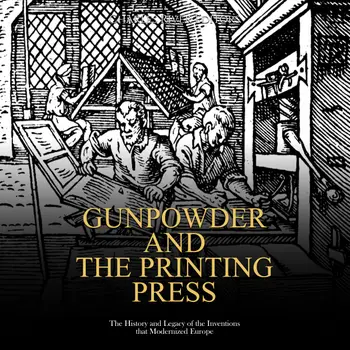
Gunpowder and the Printing Press: The History and Legacy of the Inventions that Modernized Europe

In addition to the wheelbarrow, the seismograph, the waterwheel, deep drilling, suspension bridges, and ship rudders, among countless other life-changing contraptions, the Chinese developed what were later dubbed the “Four Great Inventions of China.” Two of those were gunpowder and printing, which both spread through South Asia and the Middle East before making it to Europe.

For a time, gunpowder was a mere curiosity, but its destructive power and military potential would be realized quickly. The first record of a cannon in Europe comes from a manuscript written in 1326, which has an illustration showing an armored man with what looks like a slow match lighting a vase-shaped object. This crude cannon was called a pot de fer in French and vasi in Italian. While medieval engineers developed new types of cannons and explosives capable of destroying walls and castles, others were making the first handguns possible. European sources first mentioned the widespread use of handgonnes, as they were often called, in the late 14th century, precisely the time when gunpowder became cheaper.

The history of printing was for ancient Asia an advancement in culture and communication, but for Europe in the 15th century, it was much more, plunging the continent into a new paradigm and aligning it for the modern world. Its importance is often overlooked, but the timeliness of the printing machine was equivalent to the invention of alphabets in antiquity and ranks up there with the digital revolution and the introduction of the internet. Put simply, it made the Renaissance possible and led to the modernization of Europe. Based on earlier Asian principles, Johannes Gutenberg’s movable type printing press propelled an industry that led to the education of the West and ultimately removed the tight grip of the Vatican from daily European life.
À propos de ce livre

In addition to the wheelbarrow, the seismograph, the waterwheel, deep drilling, suspension bridges, and ship rudders, among countless other life-changing contraptions, the Chinese developed what were later dubbed the “Four Great Inventions of China.” Two of those were gunpowder and printing, which both spread through South Asia and the Middle East before making it to Europe.

For a time, gunpowder was a mere curiosity, but its destructive power and military potential would be realized quickly. The first record of a cannon in Europe comes from a manuscript written in 1326, which has an illustration showing an armored man with what looks like a slow match lighting a vase-shaped object. This crude cannon was called a pot de fer in French and vasi in Italian. While medieval engineers developed new types of cannons and explosives capable of destroying walls and castles, others were making the first handguns possible. European sources first mentioned the widespread use of handgonnes, as they were often called, in the late 14th century, precisely the time when gunpowder became cheaper.

The history of printing was for ancient Asia an advancement in culture and communication, but for Europe in the 15th century, it was much more, plunging the continent into a new paradigm and aligning it for the modern world. Its importance is often overlooked, but the timeliness of the printing machine was equivalent to the invention of alphabets in antiquity and ranks up there with the digital revolution and the introduction of the internet. Put simply, it made the Renaissance possible and led to the modernization of Europe. Based on earlier Asian principles, Johannes Gutenberg’s movable type printing press propelled an industry that led to the education of the West and ultimately removed the tight grip of the Vatican from daily European life.
Commencez ce livre dès aujourd'hui pour 0 €

  • Accédez à tous les livres de l'app pendant la période d'essai
  • Sans engagement, annulez à tout moment
Essayer gratuitement
Plus de 52 000 personnes ont noté Nextory 5 étoiles sur l'App Store et Google Play.

  1. Hispania romana: La historia de la conquista de España y la península ibérica por la antigua Roma

    Charles River Editors

  2. 5.0

    NASA’s Space Race Programs: The History and Legacy of NASA Missions in the 1950s and 1960s

    Charles River Editors

  3. The Ottoman Empire’s Greatest Victories: The History and Legacy of the Most Important Battles Won by the Ottomans

    Charles River Editors

  4. The Occupation and Liberation of France during World War II: The History of the Decisive Campaigns in 1940 and 1944

    Charles River Editors

  5. The 20th Century’s Most Influential Artists: The Lives and Art of Pablo Picasso, Salvador Dali, Andy Warhol, and Jackson Pollock

    Charles River Editors

  6. 3.3

    Ukraine: The History and Legacy of Ukraine from the Middle Ages to Today

    Charles River Editors

  7. The Jacobites: The History and Legacy of the Movement to Restore the Stuart Dynasty to the British Throne

    Charles River Editors

  8. The History of France Under German Occupation During World War II

    Charles River Editors

  9. Ellington and Armstrong: The Lives and Careers of America’s Most Famous Jazz Performers

    Charles River Editors

  10. The German Invasions of France during the World Wars: The History of Germany’s Campaigns in World War I and World War II

    Charles River Editors

  11. The Ottoman Empire’s Worst Defeats: The History and Legacy of the Decisive Battles that Checked the Ottomans’ Expansion into Europe

    Charles River Editors

  12. 5.0

    The Evolution of Modern Mathematics: The Lives of Influential Mathematicians Who Helped Bring Math into the Computer Age Kindle

    Charles River Editors