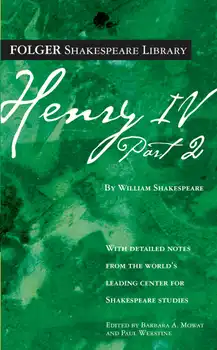
À propos de ce livre

Henry IV, Part 2 is the only Shakespeare play that is a “sequel,” in the modern sense, to an earlier play of his. Like most sequels, it repeats many elements from the previous work, Henry IV, Part 1. This play again puts on stage Henry IV’s son, Prince Hal, who continues to conceal his potential greatness by consorting with tavern dwellers, including the witty Sir John Falstaff.

As in Part 1, Prince Hal and Falstaff seek to best each other in conversation, while Falstaff tries to ingratiate himself with Hal and Hal disdains him. Part 2 adds some fresh characters, the rural justices Shallow and Silence and Shallow’s household. Political rebellion, while important to the plot, does not loom as large as in Part 1. There are no glorious champions; combat is replaced by deception, cunning, and treachery.

The authoritative edition of Henry IV, Part 2 from The Folger Shakespeare Library, the trusted and widely used Shakespeare series for students and general readers, includes:

-Freshly edited text based on the best early printed version of the play

-Full explanatory notes conveniently placed on pages facing the text of the play

-Scene-by-scene plot summaries

-A key to the play’s famous lines and phrases

-An introduction to reading Shakespeare’s language

-An essay by a leading Shakespeare scholar providing a modern perspective on the play

-Fresh images from the Folger Shakespeare Library’s vast holdings of rare books

-An annotated guide to further reading

Essay by A. R. Braunmuller

The Folger Shakespeare Library in Washington, DC, is home to the world’s largest collection of Shakespeare’s printed works, and a magnet for Shakespeare scholars from around the globe. In addition to exhibitions open to the public throughout the year, the Folger offers a full calendar of performances and programs. For more information, visit Folger.edu.

Commencez ce livre dès aujourd'hui pour 0 €

  • Accédez à tous les livres de l'app pendant la période d'essai
  • Sans engagement, annulez à tout moment
Essayer gratuitement
Plus de 52 000 personnes ont noté Nextory 5 étoiles sur l'App Store et Google Play.

  1. 5.0

    Romeo and Juliet (lättläst)

    William Shakespeare

  2. 3.0

    Hamlet - Livre Audio

    William Shakespeare, Livres audio en français

  3. 3.8

    Roméo et Juliette - Livre Audio

    William Shakespeare, Livres audio en français

  4. 5.0

    Hamlet (lättläst)

    William Shakespeare

  5. 4.0

    Romeo et Juliette (Romeo and Juliet in French)

    William Shakespeare

  6. 4.7

    Le Songe d'une Nuit d'Eté

    William Shakespeare

  7. 5.0

    Hamlet

    William Shakespeare

  8. Le Songe D'Une Nuit D'Été

    William Shakespeare

  9. 4.0

    Hamlet

    William Shakespeare

  10. Développez votre culture générale en 1000 citations

    Napoléon Bonaparte, Winston Churchill, Confucius, Albert Einstein, Friedrich Nietzsche, Platon, William Shakespeare, Lao Tseu, Sun Tzu

  11. 3500 citations ultimes

    Marc Aurèle, Jane Austen, Beaumarchais, Napoléon Bonaparte, Bouddha, Winston Churchill, Cicéron, Confucius, Nicolas de Chamfort, Charles de Gaulle, Antoine de Saint-Exupéry, Léonard de Vinci, Denis Diderot, Fiodor Dostoïevski, Albert Einstein, Ralph Waldo Emerson, Anne Frank, Mahatma Gandhi, Emmanuel Kant, Søren Kierkegaard, Martin Luther King, Georg Christoph Lichtenberg, Abraham Lincoln, Montesquieu, Friedrich Nietzsche, Platon, Marcel Proust, Arthur Schopenhauer, William Shakespeare, – Socrate, Baruch Spinoza, Henry David Thoreau, Lao Tseu, Voltaire, Oscar Wilde

  12. 3.0

    50 Masterpieces you have to read before you die vol: 2

    Lewis Carroll, Mark Twain, Jules Verne, Oscar Wilde, Arthur Conan Doyle, Louisa May Alcott, Jane Austen, G.K. Chesterton, Wilkie Collins, Charles Dickens, Fyodor Dostoyevsky, Alexandre Dumas, F. Scott Fitzgerald, E. M. Forster, Thomas Hardy, Hermann Hesse, James Joyce, Jack London, H.P. Lovecraft, Lucy Maud Montgomery, Edgar Allan Poe, Marcel Proust, William Shakespeare, Robert Louis Stevenson, H.G. Wells, Virginia Woolf, Rudyard Kipling, D. H. Lawrence, Thomas Mann, William Somerset Maugham, Herman Melville, George Sand, Mary Shelley, Walter Scott, Leo Tolstoy, Bram Stoker