3.3(4)

Madame Bovary

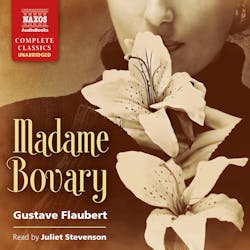
Madame Bovary (1856) is Gustave Flaubert's debut novel. The story focuses on a doctor's wife, Emma Bovary, who has adulterous affairs and lives beyond her means in order to escape the banalities and emptiness of provincial life. Though the basic plot is rather simple, even archetypal, the novel's true art lies in its details and hidden patterns. Flaubert was a notorious perfectionist and claimed always to be searching for le mot juste ("the precise word").

When it was first serialized in La Revue de Paris between 1 October 1856 and 15 December 1856, the novel was attacked for obscenity by public prosecutors. The resulting trial, held in January 1857, made the story notorious. After Flaubert's acquittal on 7 February 1857, Madame Bovary became a bestseller when it was published as a single volume in April 1857. Flaubert's masterpiece is now considered a seminal work of realism and one of the most influential novels ever written. In fact, the notable British-American critic James Wood writes in How Fiction Works: "Flaubert established for good or ill, what most readers think of as modern realist narration, and his influence is almost too familiar to be visible".

Long established as one of the greatest novels ever written, the book has often been described as a "perfect" work of fiction. Henry James writes: "Madame Bovary has a perfection that not only stamps it, but that makes it stand almost alone; it holds itself with such a supreme unapproachable assurance as both excites and defies judgment." Giorgio de Chirico said that in his opinion "from the narrative point of view, the most perfect book is Madame Bovary by Flaubert".

Gustave Flaubert (1821-1880) was an influential French writer widely considered one of the greatest novelists in Western literature. He is known especially for his first published novel, Madame Bovary (1857), for his Correspondence, and for his scrupulous devotion to his style and aesthetics. The celebrated short story writer Maupassant was a protégé of Flaubert.

À propos de ce livre

Madame Bovary (1856) is Gustave Flaubert's debut novel. The story focuses on a doctor's wife, Emma Bovary, who has adulterous affairs and lives beyond her means in order to escape the banalities and emptiness of provincial life. Though the basic plot is rather simple, even archetypal, the novel's true art lies in its details and hidden patterns. Flaubert was a notorious perfectionist and claimed always to be searching for le mot juste ("the precise word").

When it was first serialized in La Revue de Paris between 1 October 1856 and 15 December 1856, the novel was attacked for obscenity by public prosecutors. The resulting trial, held in January 1857, made the story notorious. After Flaubert's acquittal on 7 February 1857, Madame Bovary became a bestseller when it was published as a single volume in April 1857. Flaubert's masterpiece is now considered a seminal work of realism and one of the most influential novels ever written. In fact, the notable British-American critic James Wood writes in How Fiction Works: "Flaubert established for good or ill, what most readers think of as modern realist narration, and his influence is almost too familiar to be visible".

Long established as one of the greatest novels ever written, the book has often been described as a "perfect" work of fiction. Henry James writes: "Madame Bovary has a perfection that not only stamps it, but that makes it stand almost alone; it holds itself with such a supreme unapproachable assurance as both excites and defies judgment." Giorgio de Chirico said that in his opinion "from the narrative point of view, the most perfect book is Madame Bovary by Flaubert".

Gustave Flaubert (1821-1880) was an influential French writer widely considered one of the greatest novelists in Western literature. He is known especially for his first published novel, Madame Bovary (1857), for his Correspondence, and for his scrupulous devotion to his style and aesthetics. The celebrated short story writer Maupassant was a protégé of Flaubert.
Commencez ce livre dès aujourd'hui pour 0 €

  • Accédez à tous les livres de l'app pendant la période d'essai
  • Sans engagement, annulez à tout moment
Essayer gratuitement
Plus de 52 000 personnes ont noté Nextory 5 étoiles sur l'App Store et Google Play.

  1. 50 Chefs-D'œuvre Que Vous Devez Lire Avant De Mourir : Vol 1 (Golden Deer Classics)

    Mark Twain, Stendhal, Edgar Allan Poe, Victor Hugo, Gustave Flaubert, Alexandre Dumas, Arthur Conan Doyle, René Descartes, Lewis Carroll, Charles Baudelaire, Guillaume Apollinaire, Golden Deer, Alain-Fournier, Jules Amédée d'Aurevilly, Paul Bourget, Charlotte Brontë, Emily Brontë, Pierre Corneille, Nikolai Gogol, Gustave Leroux, Marquis De Sade, Jack London, Sinclair Lewis, Daniel Lesueur, Marcel Proust, Edmond Rostand, Jean-Jacques Rousseau, Mary Shelley, Bram Stoker, Sun Tzu, Rodolphe Töpffer, Vatsyayana, Jules Verne, Voltaire, H.G. Wells, Oscar Wilde, Emile Zola

  2. 4.5

    Madame Bovary

    Gustave Flaubert

  3. 2.7

    Madame Bovary - Livre Audio

    Gustave Flaubert, Livres audio en français

  4. 50 Chefs-D'œuvre Que Vous Devez Lire Avant De Mourir: Vol 2

    Honoré de Balzac, Alphonse Daudet, Arthur Conan Doyle, Alexandre Dumas, Gustave Flaubert, Francis Scott Fitzgerald, Nikolai Gogol, Victor Hugo, Maurice Leblanc, Jack London, Madame de La Fayette, Guy De Maupassant, Friedrich Nietzsche, Jean-Jacques Rousseau, Robert Louis Stevenson, Jules Verne, H.G. Wells, Michel de Montaigne, Golden Deer Classics

  5. 3.8

    La Danse des Morts

    Gustave Flaubert

  6. 3.5

    Madame Bovary

    Gustave Flaubert

  7. 5.0

    Ça peut pas faire de mal (Tome 3) - Balzac, Flaubert, Zola, Maupassant

    Guillaume Gallienne, Honoré de Balzac, Gustave Flaubert, Guy De Maupassant

  8. 3.3

    Madame Bovary

    Gustave Flaubert

  9. 5.0

    Un coeur simple

    Gustave Flaubert

  10. 50 Masterpieces you have to read before you die vol: 1

    Louisa May Alcott, Jane Austen, Joseph Conrad, D. H. Lawrence, George Eliot, Leo Tolstoy, James Joyce, Charles Dickens, Bram Stoker, Oscar Wilde, Honoré de Balzac, Edgar Rice Burroughs, Anne Brontë, Charlotte Brontë, Emily Brontë, Lewis Carroll, Willa Cather, Miguel de Cervantes, E. Cummings, Fyodor Dostoyevsky, Daniel Defoe, Arthur Conan Doyle, Alexandre Dumas, Gustave Flaubert, Henry James, Victor Hugo

  11. Madame Bovary

    Gustave Flaubert

  12. 5.0

    Madame Bovary - Audiobook

    Gustave Flaubert, Classic Audiobooks