À propos de ce livre

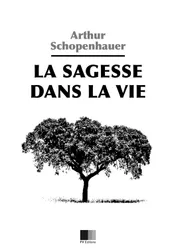
Schopenhauer is one of the few philosophers who can be generally understood without a commentary. All his theories claim to be drawn direct from the facts, to be suggested by observation, and to interpret the world as it is; and whatever view he takes, he is constant in his appeal to the experience of common life. This characteristic endows his style with a freshness and vigor which would be difficult to match in the philosophical writing of any country, and impossible in that of Germany. If it were asked whether there were any circumstances apart from heredity, to which he owed his mental habit, the answer might be found in the abnormal character of his early education, his acquaintance with the world rather than with books, the extensive travels of his boyhood, his ardent pursuit of knowledge for its own sake and without regard to the emoluments and endowments of learning. He was trained in realities even more than in ideas; and hence he is original, forcible, clear, an enemy of all philosophic indefiniteness and obscurity; so that it may well be said of him, in the words of a writer in the Revue Contemporaine, ce n'est pas un philosophe comme les autres, c'est un philosophe qui a vu le monde.
Commencez ce livre dès aujourd'hui pour 0 €

  • Accédez à tous les livres de l'app pendant la période d'essai
  • Sans engagement, annulez à tout moment
Essayer gratuitement
Plus de 52 000 personnes ont noté Nextory 5 étoiles sur l'App Store et Google Play.

  1. La Sagesse dans la vie

    Arthur Schopenhauer

  2. 4.1

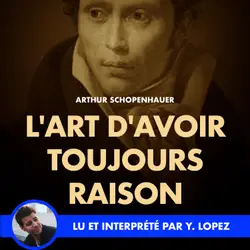
    L'Art d'avoir toujours raison

    Arthur Schopenhauer

  3. Nouveau

    Essai sur le libre arbitre

    Arthur Schopenhauer

  4. 1800 Citations de philosophes

    Aristote, Épicure, Platon, Thalès de Milet, – Socrate, Protagoras, Anaximandre, Épictète, Héraclite, Marc Aurèle, René Descartes, Michel de Montaigne, Alexis de Tocqueville, Voltaire, Charles De Montesquieu, Jean-Jacques Rousseau, Emmanuel Kant, Hannah Arendt, Gottfried Wilhelm Leibniz, Georg Wilhelm Friedrich Hegel, Friedrich Nietzsche, Arthur Schopenhauer, David Hume, John Locke, Francis Bacon, Thomas Hobbes, Thomas More, Confucius, Érasme, Lao Tseu, Baruch Spinoza, Søren Kierkegaard, Nicolas Machiavel, Thomas d'Aquin, Henry David Thoreau

  5. 5.0

    L'Art d'avoir toujours raison (L'édition intégrale) : Édition enrichie. Les stratégies de persuasion et de débat selon Schopenhauer

    Arthur Schopenhauer

  6. L'Art d'avoir toujours raison (L'édition intégrale) : Édition enrichie. Stratagèmes de dialectique et techniques de persuasion pour triompher en débat

    Arthur Schopenhauer

  7. 3500 citations ultimes

    Marc Aurèle, Jane Austen, Beaumarchais, Napoléon Bonaparte, Bouddha, Winston Churchill, Cicéron, Confucius, Nicolas de Chamfort, Charles de Gaulle, Antoine de Saint-Exupéry, Léonard de Vinci, Denis Diderot, Fiodor Dostoïevski, Albert Einstein, Ralph Waldo Emerson, Anne Frank, Mahatma Gandhi, Emmanuel Kant, Søren Kierkegaard, Martin Luther King, Georg Christoph Lichtenberg, Abraham Lincoln, Montesquieu, Friedrich Nietzsche, Platon, Marcel Proust, Arthur Schopenhauer, William Shakespeare, – Socrate, Baruch Spinoza, Henry David Thoreau, Lao Tseu, Voltaire, Oscar Wilde

  8. Nouveau

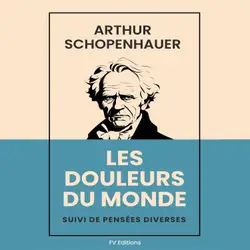
    Les douleurs du monde

    Arthur Schopenhauer

  9. Nouveau

    Le destin de l’individu

    Arthur Schopenhauer

  10. Nouveau

    L’art d’avoir toujours raison : version intégrale

    Arthur Schopenhauer

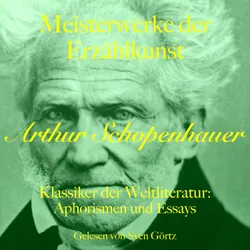
  11. Arthur Schopenhauer: Meisterwerke der Erzählkunst : Klassiker der Weltliteratur: Aphorismen und Essays

    Arthur Schopenhauer

  12. L'art d'avoir toujours raison

    Arthur Schopenhauer