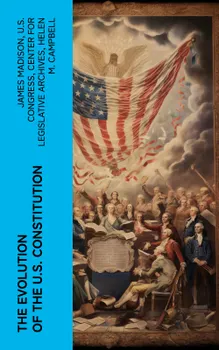
The Evolution of the U.S. Constitution

James Madison introduced 12 amendments to the First Congress in 1789. Ten of these would go on to become what we now consider to be the Bill of Rights. One was never passed, while another dealing with Congressional salaries was not ratified until 1992, when it became the 27th Amendment. Based on the Virginia Declaration of Rights, the English Bill of Rights, the writings of the Enlightenment, and the rights defined in the Magna Carta, the Bill of Rights contains rights that many today consider to be fundamental to America. The Constitution of the United States of America is the supreme law of the United States. Empowered with the sovereign authority of the people by the framers and the consent of the legislatures of the states, it is the source of all government powers, and also provides important limitations on the government that protect the fundamental rights of United States citizens. The Constitution acted like a colossal merger, uniting a group of states with different interests, laws, and cultures. Under America's first national government, the Articles of Confederation, the states acted together only for specific purposes. The Constitution united its citizens as members of a whole, vesting the power of the union in the people. Without it, the American Experiment might have ended as quickly as it had begun. Contents: The Journal of the Debates in the Convention Which Framed the Constitution of the United States Constitutional Amendment Process Measures Proposed to Amend the Constitution Congress Creates the Bill of Rights Constitution Amendments Biographies of the Founding Fathers

À propos de ce livre

James Madison introduced 12 amendments to the First Congress in 1789. Ten of these would go on to become what we now consider to be the Bill of Rights. One was never passed, while another dealing with Congressional salaries was not ratified until 1992, when it became the 27th Amendment. Based on the Virginia Declaration of Rights, the English Bill of Rights, the writings of the Enlightenment, and the rights defined in the Magna Carta, the Bill of Rights contains rights that many today consider to be fundamental to America. The Constitution of the United States of America is the supreme law of the United States. Empowered with the sovereign authority of the people by the framers and the consent of the legislatures of the states, it is the source of all government powers, and also provides important limitations on the government that protect the fundamental rights of United States citizens. The Constitution acted like a colossal merger, uniting a group of states with different interests, laws, and cultures. Under America's first national government, the Articles of Confederation, the states acted together only for specific purposes. The Constitution united its citizens as members of a whole, vesting the power of the union in the people. Without it, the American Experiment might have ended as quickly as it had begun. Contents: The Journal of the Debates in the Convention Which Framed the Constitution of the United States Constitutional Amendment Process Measures Proposed to Amend the Constitution Congress Creates the Bill of Rights Constitution Amendments Biographies of the Founding Fathers
Commencez ce livre dès aujourd'hui pour 0 €

  • Accédez à tous les livres de l'app pendant la période d'essai
  • Sans engagement, annulez à tout moment
Essayer gratuitement
Plus de 52 000 personnes ont noté Nextory 5 étoiles sur l'App Store et Google Play.

  1. 50+ Classic collection. Political science : The Art of War, The Republic, The Athenian Constitution, The Prince, Utopia, Common Sense, Utilitarianism, Marxism, Anarchism, Socialism

    Sun Sun Tzu, Lao Lao Tzu, Plato Plato, Marcus Marcus Aurelius, Niccolo Machiavelli, Thomas More, Tommaso Campanella, Francis Bacon, Thomas Paine, Richard Henry Lee, Thomas Jefferson, James Madison, George Washington, John Stuart Mil, Karl Marx, Friedrich Engels, Vladimir Lenin, Rosa Luxemburg, Peter Kropotkin, Emma Goldman, Leon Trotsky, Aristotle Aristotle

  2. Nouveau
    2.0

    The Federalist Papers

    Alexander Hamilton, James Madison, John Jay

  3. Nouveau
    2.0

    The Federalist Papers

    Alexander Hamilton, James Madison, John Jay

  4. 2.0

    The Federalist Papers

    Alexander Hamilton, James Madison, John Jay

  5. The Founding of America : The Words that Shaped a Nation

    Alexander Hamilton, James Madison, Thomas Jefferson, Robert J. Allison

  6. The Constitution of the United States of America

    James Madison, Alexander Hamilton, John Jay

  7. Declaration of Independence

    George Washington, Thomas Jefferson, Benjamin Franklin, James Madison

  8. The Federalist Papers :

    Alexander Hamilton, James Madison, John Jay

  9. The Federalist Papers : Complete Founding Fathers' Writings

    Alexander Hamilton, James Madison, John Jay

  10. The Federalist Papers : A Foundational Guide to American Government, Liberty, and Constitutional Law

    Alexander Hamilton, James Madison, John Jay

  11. The Federalist Papers : Foundational Essays on Liberty, Law, and the United States Constitution

    Alexander Hamilton, James Madison, John Jay

  12. Bill of Rights (Books of American Wisdom) :

    James Madison, George Mason