The First Men in The Moon The Original Manuscript

Britain won the Moon Race! Decades before Neal Armstrong took his "giant leap for mankind" two intrepid adventurers from Lympne, England, journeyed there using not a rocket, but an antigravity coating. Mr. Bedford, who narrates the tale, tells of how he fell in with eccentric inventor Mr. Cavor, grew to believe in his researches, helped him build a sphere for traveling in space, and then partnered with him in an expedition to the Moon. What they found was fantastic! There was not only air and water, but the Moon was honeycombed with caverns and tunnels in which lived an advanced civilization of insect-like beings. While Bedford is frightened by them and bolts home, Cavor stays and is treated with great respect. So why didn't Armstrong and later astronauts find the evidence of all this? Well, according to broadcasts by Cavor over the newly-discovered radio technology, he told the Selenites too much about mankind, and apparently, they removed the welcome mat!

Produced by Macc Kay

Production executive Avalon Giuliano

ICON Intern Eden Garret Giuliano

©2021 Eden Garret Giuliano (P) 2021 Eden Garret Giuliano

Geoffrey Giuliano is the author of over thirty internationally bestselling biographies, including the London Sunday Times bestseller 'Blackbird: The Life and Times of Paul McCartney' and 'Dark Horse: The Private Life of George Harrison'. He can be heard on the Westwood One Radio Network and has written and produced over seven hundred original spoken word albums and video documentaries on various aspects of popular culture. In addition, Giuliano is an occasional lecturer at Northwestern University. He is also a well-known movie actor in such films as 'Mechanic Resurrection and the 'Scorpion King' series, among many. Geoffrey is a near lifelong student of Bhakti (Devotional) Yoga and an ardent animal rights advocate. He makes his home with his son Eden in Bangkok and Vrndavana, and Jaipur India

À propos de ce livre

Britain won the Moon Race! Decades before Neal Armstrong took his "giant leap for mankind" two intrepid adventurers from Lympne, England, journeyed there using not a rocket, but an antigravity coating. Mr. Bedford, who narrates the tale, tells of how he fell in with eccentric inventor Mr. Cavor, grew to believe in his researches, helped him build a sphere for traveling in space, and then partnered with him in an expedition to the Moon. What they found was fantastic! There was not only air and water, but the Moon was honeycombed with caverns and tunnels in which lived an advanced civilization of insect-like beings. While Bedford is frightened by them and bolts home, Cavor stays and is treated with great respect. So why didn't Armstrong and later astronauts find the evidence of all this? Well, according to broadcasts by Cavor over the newly-discovered radio technology, he told the Selenites too much about mankind, and apparently, they removed the welcome mat!

Produced by Macc Kay

Production executive Avalon Giuliano

ICON Intern Eden Garret Giuliano

©2021 Eden Garret Giuliano (P) 2021 Eden Garret Giuliano

Geoffrey Giuliano is the author of over thirty internationally bestselling biographies, including the London Sunday Times bestseller 'Blackbird: The Life and Times of Paul McCartney' and 'Dark Horse: The Private Life of George Harrison'. He can be heard on the Westwood One Radio Network and has written and produced over seven hundred original spoken word albums and video documentaries on various aspects of popular culture. In addition, Giuliano is an occasional lecturer at Northwestern University. He is also a well-known movie actor in such films as 'Mechanic Resurrection and the 'Scorpion King' series, among many. Geoffrey is a near lifelong student of Bhakti (Devotional) Yoga and an ardent animal rights advocate. He makes his home with his son Eden in Bangkok and Vrndavana, and Jaipur India

Commencez ce livre dès aujourd'hui pour 0 €

  • Accédez à tous les livres de l'app pendant la période d'essai
  • Sans engagement, annulez à tout moment
Essayer gratuitement
Plus de 52 000 personnes ont noté Nextory 5 étoiles sur l'App Store et Google Play.

  1. 5.0

    La guerre des Mondes

    H.G. Wells

  2. 50 Chefs-D'œuvre Que Vous Devez Lire Avant De Mourir : Vol 1 (Golden Deer Classics)

    Mark Twain, Stendhal, Edgar Allan Poe, Victor Hugo, Gustave Flaubert, Alexandre Dumas, Arthur Conan Doyle, René Descartes, Lewis Carroll, Charles Baudelaire, Guillaume Apollinaire, Golden Deer, Alain-Fournier, Jules Amédée d'Aurevilly, Paul Bourget, Charlotte Brontë, Emily Brontë, Pierre Corneille, Nikolai Gogol, Gustave Leroux, Marquis De Sade, Jack London, Sinclair Lewis, Daniel Lesueur, Marcel Proust, Edmond Rostand, Jean-Jacques Rousseau, Mary Shelley, Bram Stoker, Sun Tzu, Rodolphe Töpffer, Vatsyayana, Jules Verne, Voltaire, H.G. Wells, Oscar Wilde, Emile Zola

  3. 50 Chefs-D'œuvre Que Vous Devez Lire Avant De Mourir: Vol 2

    Honoré de Balzac, Alphonse Daudet, Arthur Conan Doyle, Alexandre Dumas, Gustave Flaubert, Francis Scott Fitzgerald, Nikolai Gogol, Victor Hugo, Maurice Leblanc, Jack London, Madame de La Fayette, Guy De Maupassant, Friedrich Nietzsche, Jean-Jacques Rousseau, Robert Louis Stevenson, Jules Verne, H.G. Wells, Michel de Montaigne, Golden Deer Classics

  4. 4.5

    La Machine à explorer le temps - Livre Audio

    H.G. Wells, Livres audio en français

  5. Les nouvelles fantastiques de H.G. WELLS : 26 nouvelles en texte intégral par le père de la science-fiction contemporaine

    H.G. Wells, Herbert George Wells

  6. 3.5

    La Guerre des mondes - Livre Audio

    H.G. Wells

  7. 5.0

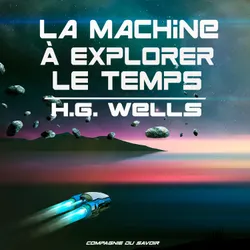
    La Machine à explorer le temps

    H.G. Wells

  8. 3.8

    L'Île du Docteur Moreau

    H.G. Wells

  9. 5.0

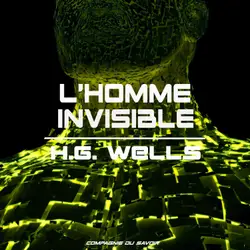
    L'Homme invisible

    H.G. Wells

  10. 3.0

    The First Men in the Moon

    H.G. Wells

  11. 3.0

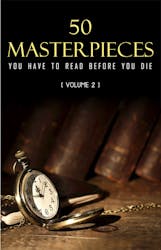
    50 Masterpieces you have to read before you die vol: 2

    Lewis Carroll, Mark Twain, Jules Verne, Oscar Wilde, Arthur Conan Doyle, Louisa May Alcott, Jane Austen, G.K. Chesterton, Wilkie Collins, Charles Dickens, Fyodor Dostoyevsky, Alexandre Dumas, F. Scott Fitzgerald, E. M. Forster, Thomas Hardy, Hermann Hesse, James Joyce, Jack London, H.P. Lovecraft, Lucy Maud Montgomery, Edgar Allan Poe, Marcel Proust, William Shakespeare, Robert Louis Stevenson, H.G. Wells, Virginia Woolf, Rudyard Kipling, D. H. Lawrence, Thomas Mann, William Somerset Maugham, Herman Melville, George Sand, Mary Shelley, Walter Scott, Leo Tolstoy, Bram Stoker

  12. 3.6

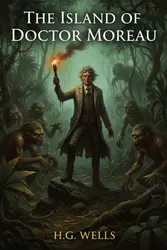
    The Island of Doctor Moreau

    H.G. Wells