The Machine Stops

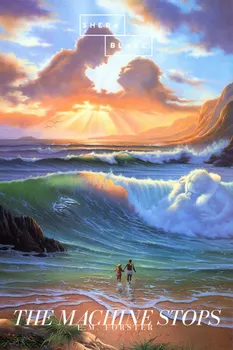
The Machine Stops is a science fiction short story by E. M. Forster. After initial publication in The Oxford and Cambridge Review (November 1909), the story was republished in Forster's The Eternal Moment and Other Stories in 1928. After being voted one of the best novellas up to 1965, it was included that same year in the populist anthology Modern Short Stories. In 1973 it was also included in The Science Fiction Hall of Fame, Volume Two. The story, set in a world where humanity lives underground and relies on a giant machine to provide their needs, predicted technologies such as instant messaging and the Internet. The story describes a world in which most of the human population has lost the ability to live on the surface of the Earth. Each individual now lives in isolation below ground in a standard room, with all bodily and spiritual needs met by the omnipotent, global Machine. Travel is permitted, but is unpopular and rarely necessary. Communication is made via a kind of instant messaging/video conferencing machine with which people conduct their only activity: the sharing of ideas and what passes for knowledge. The two main characters, Vashti and her son Kuno, live on opposite sides of the world. Vashti is content with her life, which, like most inhabitants of the world, she spends producing and endlessly discussing secondhand 'ideas'. Kuno, however, is a sensualist and a rebel. He persuades a reluctant Vashti to endure the journey (and the resultant unwelcome personal interaction) to his room. There, he tells her of his disenchantment with the sanitised, mechanical world. He confides to her that he has visited the surface of the Earth without permission, and that he saw other humans living outside the world of the Machine. However, the Machine recaptured him, and he has been threatened with 'Homelessness', that is, expulsion from the underground environment and presumed death.
À propos de ce livre

The Machine Stops is a science fiction short story by E. M. Forster. After initial publication in The Oxford and Cambridge Review (November 1909), the story was republished in Forster's The Eternal Moment and Other Stories in 1928. After being voted one of the best novellas up to 1965, it was included that same year in the populist anthology Modern Short Stories. In 1973 it was also included in The Science Fiction Hall of Fame, Volume Two. The story, set in a world where humanity lives underground and relies on a giant machine to provide their needs, predicted technologies such as instant messaging and the Internet. The story describes a world in which most of the human population has lost the ability to live on the surface of the Earth. Each individual now lives in isolation below ground in a standard room, with all bodily and spiritual needs met by the omnipotent, global Machine. Travel is permitted, but is unpopular and rarely necessary. Communication is made via a kind of instant messaging/video conferencing machine with which people conduct their only activity: the sharing of ideas and what passes for knowledge. The two main characters, Vashti and her son Kuno, live on opposite sides of the world. Vashti is content with her life, which, like most inhabitants of the world, she spends producing and endlessly discussing secondhand 'ideas'. Kuno, however, is a sensualist and a rebel. He persuades a reluctant Vashti to endure the journey (and the resultant unwelcome personal interaction) to his room. There, he tells her of his disenchantment with the sanitised, mechanical world. He confides to her that he has visited the surface of the Earth without permission, and that he saw other humans living outside the world of the Machine. However, the Machine recaptured him, and he has been threatened with 'Homelessness', that is, expulsion from the underground environment and presumed death.
Commencez ce livre dès aujourd'hui pour 0 €

  • Accédez à tous les livres de l'app pendant la période d'essai
  • Sans engagement, annulez à tout moment
Essayer gratuitement
Plus de 52 000 personnes ont noté Nextory 5 étoiles sur l'App Store et Google Play.

  1. Nouveau
    3.0

    50 Masterpieces you have to read before you die vol: 2

    Lewis Carroll, Mark Twain, Jules Verne, Oscar Wilde, Arthur Conan Doyle, Louisa May Alcott, Jane Austen, G.K. Chesterton, Wilkie Collins, Charles Dickens, Fyodor Dostoyevsky, Alexandre Dumas, F. Scott Fitzgerald, E. M. Forster, Thomas Hardy, Hermann Hesse, James Joyce, Jack London, H.P. Lovecraft, Lucy Maud Montgomery, Edgar Allan Poe, Marcel Proust, William Shakespeare, Robert Louis Stevenson, H.G. Wells, Virginia Woolf, Rudyard Kipling, D. H. Lawrence, Thomas Mann, William Somerset Maugham, Herman Melville, George Sand, Mary Shelley, Walter Scott, Leo Tolstoy, Bram Stoker

  2. 3.6

    The Machine Stops

    E. M. Forster

  3. A Passage to India

    E. M. Forster

  4. 3.7

    A Passage to India

    E. M. Forster

  5. A Passage to India

    E. M. Forster

  6. #2

    99 Classic Science-Fiction Short Stories : Works by Philip K. Dick, Ray Bradbury, Isaac Asimov, H.G. Wells, Edgar Allan Poe, Seabury Quinn, Jack London...and many more !

    Ray Bradbury, Philip K Dick, Abraham Merritt, Amelia Long Reynolds, Anthony Melvillle Rud, Arthur Train, Clark Ashton Smith, David H. Keller, Donald Allen Wollheim, E. M. Forster, Edgar Allan Poe, Edgar Fawcett, Ellis Parker Butler, Fletcher Pratt, Francis Flagg, Frank Owen, Frank R. Stockton, Fred M. White, George Allan England, Green Peyton Wertenbaker, H.G. Wells, Isaac Asimov, Jack G. Huekels, Jack London, Jack Williamson, Katherine MacLean, Leo Szilard, Miles John Breuer, Nelson Slade Bond, Peter B. Kyne, Ray Cummings, Raymond F. O'Kelley, Robert Barr, Robert Welles Ritchie, Roquia Sakhawat Hussain, Rudyard Kipling, Seabury Quinn, Tudor Jenks, W.L. Alden, Readym Anthologies

  7. 2.0

    Maurice

    E. M. Forster

  8. 4.8

    A Room with a View

    E. M. Forster

  9. 16 oct.

    Howards End

    E. M. Forster

  10. Nouveau

    Apocalypse Then : 6 Early Tales of Humanities End

    E. M. Forster, Jack London, Arthur Conan Doyle, M.P. Shiel, H.P. Lovecraft, Mary Shelley

  11. En färd till Indien

    E. M. Forster

  12. Aspects of the Novel

    E. M. Forster