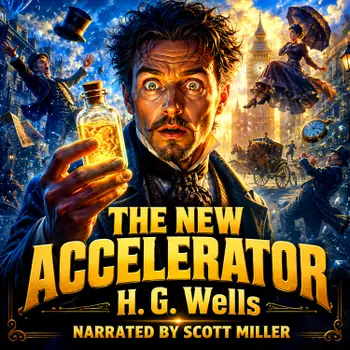
The New Accelerator : The Day The World Stood Still

What if a single drop of medicine could give you hours while everyone else experiences only seconds?

When Professor Gibberne unveils a revolutionary stimulant known as the New Accelerator, the promise seems irresistible. The drug does far more than sharpen the mind or energize the body. It speeds every process of human life to such an astonishing degree that the rest of the world appears almost motionless. For one extraordinary experiment, the professor and his skeptical friend step outside ordinary experience and into a reality where fluttering curtains hang frozen in midair, conversations become silent statues, and even a bee drifts through the sky with agonizing slowness.

At first, the experience feels exhilarating. Freed from the pace of everyday life, the pair explore a world that seems suspended for their private inspection. Yet the longer they remain in this accelerated state, the more unexpected complications arise. What begins as scientific triumph quickly raises practical questions, ethical concerns, and physical dangers that no laboratory test could fully predict. Wells combines humor, wonder, and scientific speculation to create one of the most imaginative thought experiments ever written.

Published in 1901, The New Accelerator remains remarkably fresh. Long before modern discussions about productivity, time management, and human enhancement, Wells imagined a discovery capable of transforming every profession and every aspect of daily life. The story showcases his gift for taking a single scientific idea and following it to surprising and entertaining conclusions.

H. G. Wells (1866–1946) was one of the most influential writers in the history of science fiction. His novels include The Time Machine, The War of the Worlds, The Invisible Man, and The First Men in the Moon, works that helped establish many of the foundations of modern speculative fiction.

À propos de ce livre

What if a single drop of medicine could give you hours while everyone else experiences only seconds?

When Professor Gibberne unveils a revolutionary stimulant known as the New Accelerator, the promise seems irresistible. The drug does far more than sharpen the mind or energize the body. It speeds every process of human life to such an astonishing degree that the rest of the world appears almost motionless. For one extraordinary experiment, the professor and his skeptical friend step outside ordinary experience and into a reality where fluttering curtains hang frozen in midair, conversations become silent statues, and even a bee drifts through the sky with agonizing slowness.

At first, the experience feels exhilarating. Freed from the pace of everyday life, the pair explore a world that seems suspended for their private inspection. Yet the longer they remain in this accelerated state, the more unexpected complications arise. What begins as scientific triumph quickly raises practical questions, ethical concerns, and physical dangers that no laboratory test could fully predict. Wells combines humor, wonder, and scientific speculation to create one of the most imaginative thought experiments ever written.

Published in 1901, The New Accelerator remains remarkably fresh. Long before modern discussions about productivity, time management, and human enhancement, Wells imagined a discovery capable of transforming every profession and every aspect of daily life. The story showcases his gift for taking a single scientific idea and following it to surprising and entertaining conclusions.

H. G. Wells (1866–1946) was one of the most influential writers in the history of science fiction. His novels include The Time Machine, The War of the Worlds, The Invisible Man, and The First Men in the Moon, works that helped establish many of the foundations of modern speculative fiction.

Commencez ce livre dès aujourd'hui pour 0 €

  • Accédez à tous les livres de l'app pendant la période d'essai
  • Sans engagement, annulez à tout moment
Essayer gratuitement
Plus de 52 000 personnes ont noté Nextory 5 étoiles sur l'App Store et Google Play.

  1. 50 Chefs-D'œuvre Que Vous Devez Lire Avant De Mourir : Vol 1 (Golden Deer Classics)

    Mark Twain, Stendhal, Edgar Allan Poe, Victor Hugo, Gustave Flaubert, Alexandre Dumas, Arthur Conan Doyle, René Descartes, Lewis Carroll, Charles Baudelaire, Guillaume Apollinaire, Golden Deer, Alain-Fournier, Jules Amédée d'Aurevilly, Paul Bourget, Charlotte Brontë, Emily Brontë, Pierre Corneille, Nikolai Gogol, Gustave Leroux, Marquis De Sade, Jack London, Sinclair Lewis, Daniel Lesueur, Marcel Proust, Edmond Rostand, Jean-Jacques Rousseau, Mary Shelley, Bram Stoker, Sun Tzu, Rodolphe Töpffer, Vatsyayana, Jules Verne, Voltaire, H.G. Wells, Oscar Wilde, Emile Zola

  2. 50 Chefs-D'œuvre Que Vous Devez Lire Avant De Mourir: Vol 2

    Honoré de Balzac, Alphonse Daudet, Arthur Conan Doyle, Alexandre Dumas, Gustave Flaubert, Francis Scott Fitzgerald, Nikolai Gogol, Victor Hugo, Maurice Leblanc, Jack London, Madame de La Fayette, Guy De Maupassant, Friedrich Nietzsche, Jean-Jacques Rousseau, Robert Louis Stevenson, Jules Verne, H.G. Wells, Michel de Montaigne, Golden Deer Classics

  3. 3.8

    L'Île du Docteur Moreau

    H.G. Wells

  4. 5.0

    La Machine à explorer le temps

    H.G. Wells

  5. 3.0

    The First Men in the Moon

    H.G. Wells

  6. Les nouvelles fantastiques de H.G. WELLS : 26 nouvelles en texte intégral par le père de la science-fiction contemporaine

    H.G. Wells, Herbert George Wells

  7. L'Homme invisible (Prometheus Classics)

    H.G. Wells

  8. 4.8

    La Machine à explorer le temps - Livre Audio

    H.G. Wells, Livres audio en français

  9. 3.5

    La Guerre des mondes - Livre Audio

    H.G. Wells

  10. 5.0

    La guerre des Mondes

    H.G. Wells

  11. 11 nouvelles fantastiques - HG Wells

    H.G. Wells

  12. Nouveau
    3.0

    50 Masterpieces you have to read before you die vol: 2

    Lewis Carroll, Mark Twain, Jules Verne, Oscar Wilde, Arthur Conan Doyle, Louisa May Alcott, Jane Austen, G.K. Chesterton, Wilkie Collins, Charles Dickens, Fyodor Dostoyevsky, Alexandre Dumas, F. Scott Fitzgerald, E. M. Forster, Thomas Hardy, Hermann Hesse, James Joyce, Jack London, H.P. Lovecraft, Lucy Maud Montgomery, Edgar Allan Poe, Marcel Proust, William Shakespeare, Robert Louis Stevenson, H.G. Wells, Virginia Woolf, Rudyard Kipling, D. H. Lawrence, Thomas Mann, William Somerset Maugham, Herman Melville, George Sand, Mary Shelley, Walter Scott, Leo Tolstoy, Bram Stoker