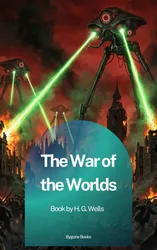
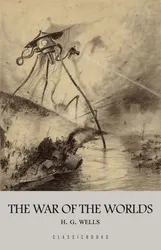
THE WAR OF THE WORLDS

H. G. Wells' seminal work, "The War of the Worlds," intertwines elements of science fiction with profound social criticism, reflecting the anxieties of late Victorian society. Through its vivid depiction of a Martian invasion, Wells employs a first-person narrative that draws readers into a harrowing exploration of survival and societal collapse. The novel's innovative use of unreliable narrators and intense imagery illustrates not only the terror of extraterrestrial encounters but also serves as an allegory for imperialism, colonialism, and the fragility of human civilization in the face of seemingly insurmountable forces. H. G. Wells, often hailed as the father of science fiction, was deeply influenced by the scientific advancements of his era, alongside his interest in social evolution. His background in biology and his progressive political beliefs informed his literary pursuits, leading him to challenge the status quo of his time. "The War of the Worlds" emerged in 1898 amidst a burgeoning fascination with science and technology, capturing the zeitgeist of an age teetering on the brink of modernity while grappling with its darker implications. This timeless novel is essential reading for those intrigued by the intersections of science, society, and human resilience. Whether you are a devoted science fiction enthusiast or a reader seeking profound philosophical reflections, Wells' harrowing tale will compel you to confront the very essence of humanity amid the unknown.
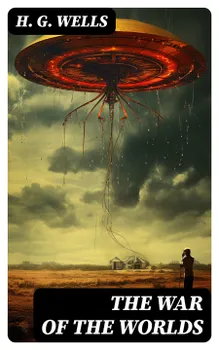
À propos de ce livre

H. G. Wells' seminal work, "The War of the Worlds," intertwines elements of science fiction with profound social criticism, reflecting the anxieties of late Victorian society. Through its vivid depiction of a Martian invasion, Wells employs a first-person narrative that draws readers into a harrowing exploration of survival and societal collapse. The novel's innovative use of unreliable narrators and intense imagery illustrates not only the terror of extraterrestrial encounters but also serves as an allegory for imperialism, colonialism, and the fragility of human civilization in the face of seemingly insurmountable forces. H. G. Wells, often hailed as the father of science fiction, was deeply influenced by the scientific advancements of his era, alongside his interest in social evolution. His background in biology and his progressive political beliefs informed his literary pursuits, leading him to challenge the status quo of his time. "The War of the Worlds" emerged in 1898 amidst a burgeoning fascination with science and technology, capturing the zeitgeist of an age teetering on the brink of modernity while grappling with its darker implications. This timeless novel is essential reading for those intrigued by the intersections of science, society, and human resilience. Whether you are a devoted science fiction enthusiast or a reader seeking profound philosophical reflections, Wells' harrowing tale will compel you to confront the very essence of humanity amid the unknown.

Commencez ce livre dès aujourd'hui pour 0 €

  • Accédez à tous les livres de l'app pendant la période d'essai
  • Sans engagement, annulez à tout moment
Essayer gratuitement
Plus de 52 000 personnes ont noté Nextory 5 étoiles sur l'App Store et Google Play.

  1. 50 Chefs-D'œuvre Que Vous Devez Lire Avant De Mourir: Vol 2

    Honoré de Balzac, Alphonse Daudet, Arthur Conan Doyle, Alexandre Dumas, Gustave Flaubert, Francis Scott Fitzgerald, Nikolai Gogol, Victor Hugo, Maurice Leblanc, Jack London, Madame de La Fayette, Guy De Maupassant, Friedrich Nietzsche, Jean-Jacques Rousseau, Robert Louis Stevenson, Jules Verne, H.G. Wells, Michel de Montaigne, Golden Deer Classics

  2. 50 Chefs-D'œuvre Que Vous Devez Lire Avant De Mourir : Vol 1 (Golden Deer Classics)

    Mark Twain, Stendhal, Edgar Allan Poe, Victor Hugo, Gustave Flaubert, Alexandre Dumas, Arthur Conan Doyle, René Descartes, Lewis Carroll, Charles Baudelaire, Guillaume Apollinaire, Golden Deer, Alain-Fournier, Jules Amédée d'Aurevilly, Paul Bourget, Charlotte Brontë, Emily Brontë, Pierre Corneille, Nikolai Gogol, Gustave Leroux, Marquis De Sade, Jack London, Sinclair Lewis, Daniel Lesueur, Marcel Proust, Edmond Rostand, Jean-Jacques Rousseau, Mary Shelley, Bram Stoker, Sun Tzu, Rodolphe Töpffer, Vatsyayana, Jules Verne, Voltaire, H.G. Wells, Oscar Wilde, Emile Zola

  3. 5.0

    La Machine à explorer le temps

    H.G. Wells

  4. Les nouvelles fantastiques de H.G. WELLS : 26 nouvelles en texte intégral par le père de la science-fiction contemporaine

    H.G. Wells, Herbert George Wells

  5. 3.5

    La Guerre des mondes - Livre Audio

    H.G. Wells

  6. 4.8

    La Machine à explorer le temps - Livre Audio

    H.G. Wells, Livres audio en français

  7. 3.8

    L'Île du Docteur Moreau

    H.G. Wells

  8. 5.0

    La guerre des Mondes

    H.G. Wells

  9. Nouveau

    Lost Sci-Fi Books 386 thru 390 : Legendary Stories from Wells, Asimov, Lovecraft, Tenn, and DeFord

    Isaac Asimov, H.G. Wells, H.P. Lovecraft, Miriam Allen deFord, William Tenn

  10. 3.0

    The First Men in the Moon

    H.G. Wells

  11. 3.0

    50 Masterpieces you have to read before you die vol: 2

    Lewis Carroll, Mark Twain, Jules Verne, Oscar Wilde, Arthur Conan Doyle, Louisa May Alcott, Jane Austen, G.K. Chesterton, Wilkie Collins, Charles Dickens, Fyodor Dostoyevsky, Alexandre Dumas, F. Scott Fitzgerald, E. M. Forster, Thomas Hardy, Hermann Hesse, James Joyce, Jack London, H.P. Lovecraft, Lucy Maud Montgomery, Edgar Allan Poe, Marcel Proust, William Shakespeare, Robert Louis Stevenson, H.G. Wells, Virginia Woolf, Rudyard Kipling, D. H. Lawrence, Thomas Mann, William Somerset Maugham, Herman Melville, George Sand, Mary Shelley, Walter Scott, Leo Tolstoy, Bram Stoker

  12. 5.0

    L'Homme invisible

    H.G. Wells