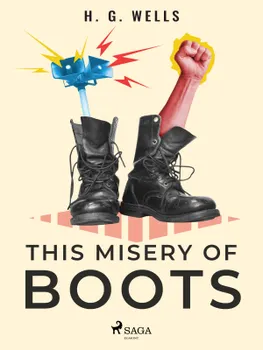
This Misery of Boots

‘This Misery of Boots’ is a compelling non-fiction book by H.G. Wells. The book uniquely and entertainingly puts forth the virtues of socialism and criticises working conditions in 20th Century Britain. Wells uses the symbol of the boot as a striking example of the various ‘preventable miseries’ that British citizens suffered at that time. This book is not simply a repeat of what other celebrated socialist thinkers such as Marx wrote, but a thought-provoking and well-balanced new vision. Wells argues that private property should be disbanded for essential services such as transport but argues against armed revolution. Wells argues that ‘it lies in the power of men to cure’ society’s ills and his ideas received praise from other great authors such as George Bernard Shaw. ‘This Misery of Boots’ remains relevant as many of the miseries Wells discusses still plague society to this day and it should be read by people interested in socialism and politics.

H. G. Wells (1866-1946) was a celebrated English writer, remembered mostly for his science fiction works. Often described as a futurist, H. G. Wells’ influence cannot be overstated for his works foresaw many technological innovations such as space travel, the atomic bomb, and the Internet. A four-time Nobel Prize in Literature nominee, Wells explored a wide array of themes in his works, from religion to social criticism and beyond. Some of his best works include the time-travel novel ‘The Time Machine’, the sci-fi adventure novel ‘The Island of Dr. Moreau’, and the mankind-versus-aliens novel ‘The War of the Worlds’. Wells occupies one of the central seats in the canon of science-fiction literature and his writing inspired other celebrated authors such as Ray Bradbury and Philip K. Dick. Wells’ stories are still widely read to this day and have had numerous cinematic adaptations including ‘The Invisible Man’ starring Elisabeth Moss.

À propos de ce livre

‘This Misery of Boots’ is a compelling non-fiction book by H.G. Wells. The book uniquely and entertainingly puts forth the virtues of socialism and criticises working conditions in 20th Century Britain. Wells uses the symbol of the boot as a striking example of the various ‘preventable miseries’ that British citizens suffered at that time. This book is not simply a repeat of what other celebrated socialist thinkers such as Marx wrote, but a thought-provoking and well-balanced new vision. Wells argues that private property should be disbanded for essential services such as transport but argues against armed revolution. Wells argues that ‘it lies in the power of men to cure’ society’s ills and his ideas received praise from other great authors such as George Bernard Shaw. ‘This Misery of Boots’ remains relevant as many of the miseries Wells discusses still plague society to this day and it should be read by people interested in socialism and politics.

H. G. Wells (1866-1946) was a celebrated English writer, remembered mostly for his science fiction works. Often described as a futurist, H. G. Wells’ influence cannot be overstated for his works foresaw many technological innovations such as space travel, the atomic bomb, and the Internet. A four-time Nobel Prize in Literature nominee, Wells explored a wide array of themes in his works, from religion to social criticism and beyond. Some of his best works include the time-travel novel ‘The Time Machine’, the sci-fi adventure novel ‘The Island of Dr. Moreau’, and the mankind-versus-aliens novel ‘The War of the Worlds’. Wells occupies one of the central seats in the canon of science-fiction literature and his writing inspired other celebrated authors such as Ray Bradbury and Philip K. Dick. Wells’ stories are still widely read to this day and have had numerous cinematic adaptations including ‘The Invisible Man’ starring Elisabeth Moss.

Commencez ce livre dès aujourd'hui pour 0 €

  • Accédez à tous les livres de l'app pendant la période d'essai
  • Sans engagement, annulez à tout moment
Essayer gratuitement
Plus de 52 000 personnes ont noté Nextory 5 étoiles sur l'App Store et Google Play.

  1. 50 Chefs-D'œuvre Que Vous Devez Lire Avant De Mourir: Vol 2

    Honoré de Balzac, Alphonse Daudet, Arthur Conan Doyle, Alexandre Dumas, Gustave Flaubert, Francis Scott Fitzgerald, Nikolai Gogol, Victor Hugo, Maurice Leblanc, Jack London, Madame de La Fayette, Guy De Maupassant, Friedrich Nietzsche, Jean-Jacques Rousseau, Robert Louis Stevenson, Jules Verne, H.G. Wells, Michel de Montaigne, Golden Deer Classics

  2. 50 Chefs-D'œuvre Que Vous Devez Lire Avant De Mourir : Vol 1 (Golden Deer Classics)

    Mark Twain, Stendhal, Edgar Allan Poe, Victor Hugo, Gustave Flaubert, Alexandre Dumas, Arthur Conan Doyle, René Descartes, Lewis Carroll, Charles Baudelaire, Guillaume Apollinaire, Golden Deer, Alain-Fournier, Jules Amédée d'Aurevilly, Paul Bourget, Charlotte Brontë, Emily Brontë, Pierre Corneille, Nikolai Gogol, Gustave Leroux, Marquis De Sade, Jack London, Sinclair Lewis, Daniel Lesueur, Marcel Proust, Edmond Rostand, Jean-Jacques Rousseau, Mary Shelley, Bram Stoker, Sun Tzu, Rodolphe Töpffer, Vatsyayana, Jules Verne, Voltaire, H.G. Wells, Oscar Wilde, Emile Zola

  3. Les nouvelles fantastiques de H.G. WELLS : 26 nouvelles en texte intégral par le père de la science-fiction contemporaine

    H.G. Wells, Herbert George Wells

  4. 3.5

    La Guerre des mondes - Livre Audio

    H.G. Wells

  5. 4.8

    La Machine à explorer le temps - Livre Audio

    H.G. Wells, Livres audio en français

  6. 5.0

    La Machine à explorer le temps

    H.G. Wells

  7. 3.8

    L'Île du Docteur Moreau

    H.G. Wells

  8. 5.0

    La guerre des Mondes

    H.G. Wells

  9. Nouveau

    Lost Sci-Fi Books 386 thru 390 : Legendary Stories from Wells, Asimov, Lovecraft, Tenn, and DeFord

    Isaac Asimov, H.G. Wells, H.P. Lovecraft, Miriam Allen deFord, William Tenn

  10. 3.0

    The First Men in the Moon

    H.G. Wells

  11. 3.0

    50 Masterpieces you have to read before you die vol: 2

    Lewis Carroll, Mark Twain, Jules Verne, Oscar Wilde, Arthur Conan Doyle, Louisa May Alcott, Jane Austen, G.K. Chesterton, Wilkie Collins, Charles Dickens, Fyodor Dostoyevsky, Alexandre Dumas, F. Scott Fitzgerald, E. M. Forster, Thomas Hardy, Hermann Hesse, James Joyce, Jack London, H.P. Lovecraft, Lucy Maud Montgomery, Edgar Allan Poe, Marcel Proust, William Shakespeare, Robert Louis Stevenson, H.G. Wells, Virginia Woolf, Rudyard Kipling, D. H. Lawrence, Thomas Mann, William Somerset Maugham, Herman Melville, George Sand, Mary Shelley, Walter Scott, Leo Tolstoy, Bram Stoker

  12. 5.0

    L'Homme invisible

    H.G. Wells