Om den här boken

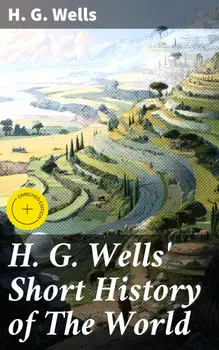
In "H. G. Wells' Short History of The World," the illustrious author skillfully distills the vast narrative of human civilization into a concise and engaging overview. This ambitious work blends an approachable prose style with a panoramic view of history, traversing eras from early prehistory through to the early 20th century, while Wells deftly weaves scientific insights with socio-political contexts. The book is a testament to Wells' belief in a progressive narrative, offering a critical perspective on humanity's achievements and failures, all the while emphasizing the overarching themes of evolution, societal development, and the quest for knowledge. H. G. Wells, often hailed as the father of science fiction, brought a unique perspective to historical writing, informed by his profound understanding of both literature and the emerging scientific paradigms of his time. Influenced by his education and his concerns about the future, particularly in the wake of technological advancements and the geopolitical tensions of World War I, Wells sought to provide readers with a historical framework that would encourage critical thinking and reflection on humanity's trajectory. This book is highly recommended for those who wish to grasp the fundamentals of human history through a lens that skillfully balances simplicity and depth. It serves as an essential primer not only for students and history enthusiasts but also for anyone seeking to understand the interconnectedness of historical events and their lasting impact on contemporary society.

In this enriched edition, we have carefully created added value for your reading experience:

- A succinct Introduction situates the work's timeless appeal and themes.

- The Synopsis outlines the central plot, highlighting key developments without spoiling critical twists.

- A detailed Historical Context immerses you in the era's events and influences that shaped the writing.

- An Author Biography reveals milestones in the author's life, illuminating the personal insights behind the text.

- A thorough Analysis dissects symbols, motifs, and character arcs to unearth underlying meanings.

- Reflection questions prompt you to engage personally with the work's messages, connecting them to modern life.

- Hand‐picked Memorable Quotes shine a spotlight on moments of literary brilliance.

- Interactive footnotes clarify unusual references, historical allusions, and archaic phrases for an effortless, more informed read.

Kom igång med den här boken idag för 0 kr

  • Få full tillgång till alla böcker i appen under provperioden
  • Ingen bindningstid, avsluta när du vill
Prova gratis nu
Mer än 52 000 personer har gett Nextory 5 stjärnor i App Store och på Google Play.

Mer av H.G. Wells

  1. 3.6
    #3

    Tidsmaskinen

    H.G. Wells

  2. Mannen som sov i två sekler

    H.G. Wells

  3. 4.6
    #6

    Stjärnan

    H.G. Wells

  4. 3.0

    50 Masterpieces you have to read before you die vol: 1 (2020 Edition) : Included: Little Women, The Richest Man in Babylon Emma, The Call Of The Wild ....

    Louisa May Alcott, Dante Alighieri, Marcus Aurelius, Jane Austen, L. Frank Baum, Charlotte Brontë, Emily Brontë, Anne Brontë, Miguel de Cervantes, Agatha Christie, George S. Clason, Arthur Conan Doyle, Joseph Conrad, Charles Dickens, Fyodor Dostoyevsky, Alexandre Dumas, George Eliot, G.K. Chesterton, G.K. Chesterton, Zane Grey, Nathaniel Hawthorne, Napoleon Hill, Homer, Victor Hugo, Frances Hodgson Burnett, Washington Irving, Henry James, Franz Kafka, Rudyard Kipling, Jack London, Leo Tolstoy, H.P. Lovecraft, Lucy Maud Montgomery, Joseph Murphy, Robert Louis Stevenson, Edgar Allan Poe, Marcel Proust, Publius, Mary Shelley, Bram Stoker, Mark Twain, Sun Tzu, Lew Wallace, Wallace D. Wattles, H.G. Wells

  5. 3.6
    #3

    Tidsmaskinen

    H.G. Wells

  6. 3.4
    #1

    Världarnas krig

    H.G. Wells

  7. THE DARKNESS OF TOMORROW - Dystopian Novels & Post-Apocalyptic Stories : Classic Visions of Ruined Cities, Social Collapse, and Dark Futures

    H.G. Wells, Jack London, Edward Bulwer-Lytton, Jonathan Swift, Edgar Allan Poe, Owen Gregory, Hugh Benson, Edward Bellamy, Mary Shelley, William Hope Hodgson, Stanley G. Weinbaum, Fred M. White, Ignatius Donnelly, Ernest Bramah, Arthur Dudley Vinton, Richard Jefferies, Samuel Butler, Edwin A. Abbott, Anthony Trollope, Cleveland Moffett

  8. 50 Masterpieces you have to read before you die

    Frances Hodgson Burnett, Homer, Charles Dickens, Lyman Frank Baum, Nathaniel Hawthorne, Thomas Hardy, Robert Louis Stevenson, Henry Haggard, Wilkie Collins, H.G. Wells, Sir Walter Scott, Lucy Maud Montgomery, Louisa May Alcott, Henry Fielding, Mary Shelley, Arthur Conan Doyle, Leo Tolstoy, Euripides, Fyodor Dostoevsky, Alexander Pushkin, James Fenimore Cooper, Daniel Defoe, Joseph Conrad, Jonathan Swift, William Shakespeare, Oscar Wilde, John Bunyan, Charles Darwin, Alfred Tennyson, Bram Stoker, James Joyce, Dante Alighieri, Howard Pyle, Jane Austen, Emily Bronte, Giovanni Boccaccio, Rudyard Kipling

  9. 3.6
    #3

    Tidsmaskinen

    H.G. Wells

  10. Something Wicked : The Call of Cthulhu, Frankenstein, Dracula, The Murders in the Rue Morgue, Dr Jekyll & Mr Hyde…

    H.P. Lovecraft, H.G. Wells, Edgar Allan Poe, Henry James, Hugh Walpole, M. R. James, Wilkie Collins, E F Benson, Nathaniel Hawthorne, Ambrose Bierce, Arthur Machen, William Hope Hodgson, Arthur Conan Doyle, Grant Allen, Mary Shelley, Bram Stoker, Théophile Gautier, Richard Marsh, Joseph Sheridan Fanu, Thomas Hardy, Charles Dickens, Rudyard Kipling, Guy De Maupassant, Elizabeth Gaskell, Mark Twain, Daniel Defoe, Jerome K Jerome, Fitz-James O’Brien, Catherine Crowe, Émile Erckmann, Alexandre Chatrian, Pedro De Alarçon, Amelia B. Edwards, Washington Irving, John Meade Falkner, Harriet Beecher Stowe, Mary E. Freeman, Louisa M. Alcott, Edith Nesbit, Mary Louisa Molesworth, Francis Marion Crawford, John Kendrick Bangs, John Buchan, Sabine Baring-Gould, Cleveland Moffett, Louis Tracy, Nikolai Gogol, James Malcolm Rymer, Thomas Peckett Prest, Frederick Marryat, Oscar Wilde, Robert Louis Stevenson, Charlotte Perkins Gilman, W. W. Jacobs, Wilhelm Hauff, Mary Elizabeth Braddon, Robert W. Chambers, Edward Bulwer-Lytton, Thomas De Quincey, William Makepeace Thackeray, E. T. Hoffmann, Robert E. Howard, David Lindsay, Marie Belloc Lowndes, Edward Bellamy, Jack London, Pliny the Younger, Helena Blavatsky, Fergus Hume, Florence Marryat, Villiers de Adam, William Archer, William F. Harvey, Katherine Rickford, Ralph Adams Cram, Leopold Kompert, Brander Matthews, Vincent O'Sullivan, Ellis Parker Butler, A. T. Quiller-Couch, Fiona Macleod, Lafcadio Hearn, William T. Stead, Gambier Bolton, Andrew Jackson Davis, Nizida, Walter F. Prince, Chester Bailey Fernando, Leonard Kip, Frank R. Stockton, Bithia Mary Croker, Catherine L. Pirkis, Leonid Andreyev, Anatole France, Richard Le Gallienne, Lucy Maud Montgomery, Stanley G. Weinbaum, Horace Walpole, William Thomas Beckford, Matthew Gregory Lewis, Ann Radcliffe, Jane Austen, William Polidori, Charlotte Brontë, Emily Brontë, Walter Hubbell, George W. Reynolds, M.P. Shiel, Adelbert von Chamisso, Saki, H. H. Munro

  11. 3.7

    War of the Worlds

    H.G. Wells

  12. 4.0

    The Island of Dr. Moreau

    H.G. Wells