Om den här boken

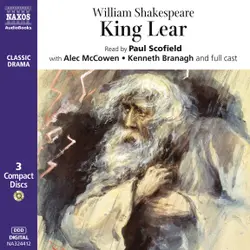
King Lear is a tragedy written by William Shakespeare. It depicts the gradual descent into madness of the title character, after he disposes of his kingdom giving bequests to two of his three daughters based on their flattery of him, bringing tragic consequences for all. Derived from the legend of Leir of Britain, a mythological pre-Roman Celtic king, the play has been widely adapted for the stage and motion pictures, with the title role coveted by many of the world's most accomplished actors. The first attribution to Shakespeare of this play, originally drafted in 1605 or 1606 at the latest with its first known performance on St. Stephen's Day in 1606, was a 1608 publication in a quarto of uncertain provenance; it may be an early draft or simply reflect the first performance text. The Tragedy of King Lear, a more theatrical revision, was included in the 1623 First Folio. Modern editors usually conflate the two, though some insist that each version has its own individual integrity that should be preserved. After the English Restoration, the play was often revised with a happy, non-tragic ending for audiences who disliked its dark and depressing tone, but since the 19th century Shakespeare's original version has been regarded as one of his supreme achievements. The tragedy is particularly noted for its probing observations on the nature of human suffering and kinship. George Bernard Shaw wrote, "No man will ever write a better tragedy than Lear."

Kom igång med den här boken idag för 0 kr

  • Få full tillgång till alla böcker i appen under provperioden
  • Ingen bindningstid, avsluta när du vill
Prova gratis nu
Mer än 52 000 personer har gett Nextory 5 stjärnor i App Store och på Google Play.

Mer av William Shakespeare

  1. 50 Masterpieces you have to read before you die

    Frances Hodgson Burnett, Homer, Charles Dickens, Lyman Frank Baum, Nathaniel Hawthorne, Thomas Hardy, Robert Louis Stevenson, Henry Haggard, Wilkie Collins, H.G. Wells, Sir Walter Scott, Lucy Maud Montgomery, Louisa May Alcott, Henry Fielding, Mary Shelley, Arthur Conan Doyle, Leo Tolstoy, Euripides, Fyodor Dostoevsky, Alexander Pushkin, James Fenimore Cooper, Daniel Defoe, Joseph Conrad, Jonathan Swift, William Shakespeare, Oscar Wilde, John Bunyan, Charles Darwin, Alfred Tennyson, Bram Stoker, James Joyce, Dante Alighieri, Howard Pyle, Jane Austen, Emily Bronte, Giovanni Boccaccio, Rudyard Kipling

  2. Stormen

    William Shakespeare

  3. 3.8

    Macbeth

    William Shakespeare

  4. 3.0
    #11

    Romeo och Julia

    William Shakespeare

  5. 4.1

    Hamlet

    William Shakespeare

  6. 3.0

    Romeo and Juliet - Audiobook

    William Shakespeare

  7. 50 Masterpieces you have to read before you die vol: 1

    Louisa May Alcott, Jane Austen, Honoré de Balzac, Henri Barbusse, Anne Brontë, Charlotte Brontë, Emily Brontë, Edgar Rice Burroughs, Samuel Butler, Lewis Carroll, Willa Cather, Miguel de Cervantes, Kate Chopin, John Cleland, Wilkie Collins, Joseph Conrad, Charles Dickens, Fyodor Dostoevsky, Alexandre Dumas, George Eliot, Ralph Waldo Emerson, Gustave Flaubert, E. M. Forster, H. Rider Haggard, Thomas Hardy, Nathaniel Hawthorne, Robert Heinlein, Victor Hugo, Aldous Huxley, Henry James, D. H. Lawrence, H.P. Lovecraft, Herman Melville, John Milton, Robert Musil, Vladimir Nabokov, George Orwell, Edgar Allan Poe, Marcel Proust, William Shakespeare, Mary Shelley, Leo Tolstoy

  8. 3.6

    Romeo och Julia

    William Shakespeare

  9. 3.5

    King Lear

    William Shakespeare

  10. Macbeth

    William Shakespeare

  11. 5.0

    Hamlet

    William Shakespeare

  12. 3.7

    Hamlet

    William Shakespeare