Om den här boken

This audiobook is narrated by an AI Voice.

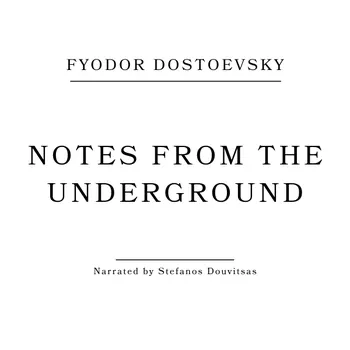
Notes from the Underground is an 1864 philosophical novella by Fyodor Dostoevsky that pioneered existentialist literature through the bitter, isolated confessions of an unnamed former civil servant.

It is a first-person narrative in the form of a "confession". The work was originally announced by Dostoevsky in Epoch under the title "A Confession".

The novella presents itself as an excerpt from the memoirs of a bitter, isolated, unnamed narrator (generally referred to by critics as the Underground Man), who is a retired civil servant living in St. Petersburg. Although the first part of the novella has the form of a monologue, the narrator's form of address to his reader is acutely dialogized. According to Mikhail Bakhtin, in the Underground Man's confession "there is literally not a single monologically firm, undissociated word". The Underground Man's every word anticipates the words of an other, with whom he enters into an obsessive internal polemic.

The Underground Man attacks contemporary Russian philosophy, especially Nikolay Chernyshevsky's What Is to Be Done? Generally, the work can be viewed as an attack on determinism: the idea that everything, including the human personality and will, can be reduced to the laws of nature, science and mathematics.

It is divided into two parts—Part 1 ("Underground"), a philosophical monologue attacking rational egoism, and Part 2 ("Apropos of the Wet Snow"), a narrative recounting humiliating episodes from his past.
Kom igång med den här boken idag för 0 kr

  • Få full tillgång till alla böcker i appen under provperioden
  • Ingen bindningstid, avsluta när du vill
Prova gratis nu
Mer än 52 000 personer har gett Nextory 5 stjärnor i App Store och på Google Play.

Mer av Fyodor Dostoevsky

  1. 50 Masterpieces you have to read before you die

    Frances Hodgson Burnett, Homer, Charles Dickens, Lyman Frank Baum, Nathaniel Hawthorne, Thomas Hardy, Robert Louis Stevenson, Henry Haggard, Wilkie Collins, H.G. Wells, Sir Walter Scott, Lucy Maud Montgomery, Louisa May Alcott, Henry Fielding, Mary Shelley, Arthur Conan Doyle, Leo Tolstoy, Euripides, Fyodor Dostoevsky, Alexander Pushkin, James Fenimore Cooper, Daniel Defoe, Joseph Conrad, Jonathan Swift, William Shakespeare, Oscar Wilde, John Bunyan, Charles Darwin, Alfred Tennyson, Bram Stoker, James Joyce, Dante Alighieri, Howard Pyle, Jane Austen, Emily Bronte, Giovanni Boccaccio, Rudyard Kipling

  2. 3.9

    Brott och straff

    Fyodor Dostoevsky

  3. 4.5

    Crime and Punishment

    Fyodor Dostoevsky

  4. 4.6

    Crime and Punishment

    Fyodor Dostoevsky

  5. 4.0

    Existentialism: Philosophical and Literary Works : Notes from Underground. Fear and Trembling. Ecce Homo. The Metamorphosis and others

    Fyodor Dostoevsky, Soren Kierkegaard, Friedrich Nietzsche, Rainer Maria Rilke, Franz Kafka

  6. 4.1

    White Nights

    Fyodor Dostoevsky, Clement Clarke Moore

  7. 50 Masterpieces you have to read before you die vol: 1

    Louisa May Alcott, Jane Austen, Honoré de Balzac, Henri Barbusse, Anne Brontë, Charlotte Brontë, Emily Brontë, Edgar Rice Burroughs, Samuel Butler, Lewis Carroll, Willa Cather, Miguel de Cervantes, Kate Chopin, John Cleland, Wilkie Collins, Joseph Conrad, Charles Dickens, Fyodor Dostoevsky, Alexandre Dumas, George Eliot, Ralph Waldo Emerson, Gustave Flaubert, E. M. Forster, H. Rider Haggard, Thomas Hardy, Nathaniel Hawthorne, Robert Heinlein, Victor Hugo, Aldous Huxley, Henry James, D. H. Lawrence, H.P. Lovecraft, Herman Melville, John Milton, Robert Musil, Vladimir Nabokov, George Orwell, Edgar Allan Poe, Marcel Proust, William Shakespeare, Mary Shelley, Leo Tolstoy

  8. 4.6

    Crime and Punishment

    Fyodor Dostoevsky

  9. 4.1

    Spelaren

    Fyodor Dostoevsky

  10. 50 Masterpieces You Have to Read : Volume One - An Essential Library of World Literature

    Louisa May Alcott, Jane Austen, Honoré de Balzac, Henri Barbusse, Anne Brontë, Charlotte Brontë, Emily Brontë, Edgar Rice Burroughs, Samuel Butler, Lewis Carroll, Willa Cather, Miguel de Cervantes, Kate Chopin, John Cleland, Wilkie Collins, Joseph Conrad, Charles Dickens, Fyodor Dostoevsky, Alexandre Dumas, George Eliot, Ralph Waldo Emerson, Gustave Flaubert, E. M. Forster, H. Rider Haggard, Thomas Hardy, Nathaniel Hawthorne, Robert Heinlein, Victor Hugo, Aldous Huxley, Henry James, D. H. Lawrence, H.P. Lovecraft, Herman Melville, John Milton, Robert Musil, Vladimir Nabokov, George Orwell, Edgar Allan Poe, Marcel Proust, William Shakespeare, Mary Shelley, Leo Tolstoy

  11. 4.0

    3500 Final Quotes

    Marcus Aurelius, Jane Austen, Beaumarchais, Napoleon Bonaparte, Buddha, Winston Churchill, Cicero, Confucius, Nicolas de Chamfort, Charles de Gaulle, Antoine de Saint-Exupéry, Denis Diderot, Fyodor Dostoevsky, Albert Einstein, Ralph Waldo Emerson, Anne Frank, Mahatma Gandhi, Immanuel Kant, Søren Kierkegaard, Martin Luther King, Georg Christoph Lichtenberg, Abraham Lincoln, Montesquieu, Friedrich Nietzsche, Plato, Marcel Proust, Arthur Schopenhauer, William Shakespeare, Socrates, Baruch Spinoza, Henry David Thoreau, Leonardo da Vinci, Voltaire, Oscar Wilde, Laozi

  12. 3.8

    Idioten

    Fyodor Dostoevsky