
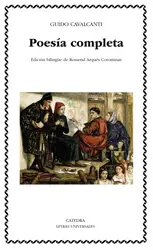
*Sonnets and Ballate of Guido Cavalcanti* gathers the principal lyric forms of one of medieval Italy's most intellectually demanding poets. In these poems, courtly love becomes a crisis of perception, reason, and embodiment: desire is figured as a force that unsettles the senses, threatens the integrity of the self, and often culminates in melancholy or death. Cavalcanti's exceptionally compressed diction, intricate syntax, vivid personification, and philosophical vocabulary give emotional experience an almost dramatic intensity. The collection belongs to the Florentine *dolce stil novo*, whose poets reimagined vernacular lyric through spiritualized love and refined introspection, yet Cavalcanti's darker materialism and psychological rigor distinguish him from more conciliatory treatments of devotion. The sonnet's argumentative structure and the ballata's musical, address-like movement together reveal a poet equally attentive to intellectual form and lyrical performance. Born into a prominent Florentine family in the later thirteenth century, Cavalcanti was a politically engaged citizen as well as a writer shaped by the scholastic culture of his city. His interest in Aristotelian and medical theories of sensation, intellect, and the passions informs the poems' remarkable analyses of erotic experience. Friendship and rivalry with Dante, who admired and eventually surpassed him in literary reputation, place Cavalcanti at a crucial moment in the formation of Italian literary language. His exile and turbulent civic life further illuminate the poems' preoccupation with instability, estrangement, and mortality. This volume is especially recommended for readers interested in medieval lyric, the history of Italian poetry, and the relationship between philosophy and literary form. It offers both the formal pleasures of musical verse and a searching account of consciousness under the pressure of desire. Students and scholars will find in Cavalcanti a foundational voice whose influence extends from Dante to Renaissance and modern lyric traditions.
This enriched edition has been carefully crafted to add value to your reading experience.
- A comprehensive Introduction outlines these selected works' unifying features, themes, or stylistic evolutions.
- A Historical Context section situates the works in their broader era—social currents, cultural trends, and key events that underpin their creation.
- A concise Synopsis (Selection) offers an accessible overview of the included texts, helping readers navigate plotlines and main ideas without revealing critical twists.
- A unified Analysis examines recurring motifs and stylistic hallmarks across the collection, tying the stories together while spotlighting the different work's strengths.
- Reflection questions inspire deeper contemplation of the author's overarching message, inviting readers to draw connections among different texts and relate them to modern contexts.
- Lastly, our hand‐picked Memorable Quotes distill pivotal lines and turning points, serving as touchstones for the collection's central themes.