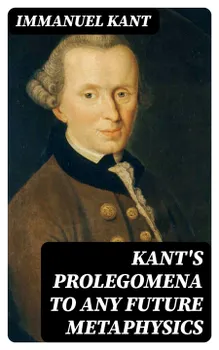
Kant's Prolegomena to Any Future Metaphysics : Enriched edition.

In "Kant's Prolegomena to Any Future Metaphysics," Immanuel Kant articulates a foundational inquiry into the nature, limitations, and possibilities of human knowledge. Framed as an accessible guide to his critical philosophy, this work seeks to address the essential question of how metaphysics can emerge as a legitimate science. Kant employs a rigorous yet precise literary style, enriched with systematic argumentation and clear exposition, which challenges existing metaphysical frameworks while seeking a common ground between empiricism and rationalism. This text serves as a precursor to his more extensive critiques, emphasizing the need for a critical examination of the faculties of human reason. Immanuel Kant, an eminent figure of the Enlightenment, wrote this work in response to the controversies surrounding metaphysics during his time, particularly the opposing schools of thought advocating for rationalism and empiricism. His revolutionary ideas on epistemology and ethics, alongside his grounding in mathematics and physics, provided him with a unique lens through which to analyze the metaphysical claims prevalent in philosophical discourse. His endeavor reflects both his intellectual heritage and his pioneering attempts to redefine the boundaries of philosophy. "Kant's Prolegomena" is an essential read for anyone interested in the development of modern philosophy. It is invaluable for scholars, students, and general readers alike, as it not only clarifies Kant's thought but also confronts fundamental questions that continue to resonate in contemporary philosophical inquiries. This text invites readers to reconsider the possibility of metaphysics as a meaningful enterprise, making it indispensable for a deeper understanding of Kant's broader philosophical project.

In this enriched edition, we have carefully created added value for your reading experience:

- A succinct Introduction situates the work's timeless appeal and themes.

- The Synopsis outlines the central plot, highlighting key developments without spoiling critical twists.

- A detailed Historical Context immerses you in the era's events and influences that shaped the writing.

- An Author Biography reveals milestones in the author's life, illuminating the personal insights behind the text.

- A thorough Analysis dissects symbols, motifs, and character arcs to unearth underlying meanings.

- Reflection questions prompt you to engage personally with the work's messages, connecting them to modern life.

- Hand‐picked Memorable Quotes shine a spotlight on moments of literary brilliance.

- Interactive footnotes clarify unusual references, historical allusions, and archaic phrases for an effortless, more informed read.
À propos de ce livre

In "Kant's Prolegomena to Any Future Metaphysics," Immanuel Kant articulates a foundational inquiry into the nature, limitations, and possibilities of human knowledge. Framed as an accessible guide to his critical philosophy, this work seeks to address the essential question of how metaphysics can emerge as a legitimate science. Kant employs a rigorous yet precise literary style, enriched with systematic argumentation and clear exposition, which challenges existing metaphysical frameworks while seeking a common ground between empiricism and rationalism. This text serves as a precursor to his more extensive critiques, emphasizing the need for a critical examination of the faculties of human reason. Immanuel Kant, an eminent figure of the Enlightenment, wrote this work in response to the controversies surrounding metaphysics during his time, particularly the opposing schools of thought advocating for rationalism and empiricism. His revolutionary ideas on epistemology and ethics, alongside his grounding in mathematics and physics, provided him with a unique lens through which to analyze the metaphysical claims prevalent in philosophical discourse. His endeavor reflects both his intellectual heritage and his pioneering attempts to redefine the boundaries of philosophy. "Kant's Prolegomena" is an essential read for anyone interested in the development of modern philosophy. It is invaluable for scholars, students, and general readers alike, as it not only clarifies Kant's thought but also confronts fundamental questions that continue to resonate in contemporary philosophical inquiries. This text invites readers to reconsider the possibility of metaphysics as a meaningful enterprise, making it indispensable for a deeper understanding of Kant's broader philosophical project.

In this enriched edition, we have carefully created added value for your reading experience:

- A succinct Introduction situates the work's timeless appeal and themes.

- The Synopsis outlines the central plot, highlighting key developments without spoiling critical twists.

- A detailed Historical Context immerses you in the era's events and influences that shaped the writing.

- An Author Biography reveals milestones in the author's life, illuminating the personal insights behind the text.

- A thorough Analysis dissects symbols, motifs, and character arcs to unearth underlying meanings.

- Reflection questions prompt you to engage personally with the work's messages, connecting them to modern life.

- Hand‐picked Memorable Quotes shine a spotlight on moments of literary brilliance.

- Interactive footnotes clarify unusual references, historical allusions, and archaic phrases for an effortless, more informed read.
Commencez ce livre dès aujourd'hui pour 0 €

  • Accédez à tous les livres de l'app pendant la période d'essai
  • Sans engagement, annulez à tout moment
Essayer gratuitement
Plus de 52 000 personnes ont noté Nextory 5 étoiles sur l'App Store et Google Play.

  1. Nouveau

    100 Clásicos de la Literatura Universal

    Francis Scott Fitzgerald, Mary Shelley, Lyman Frank Baum, Louisa May Alcott, Dante Alighieri, Jane Austen, Ambrose Bierce, Emily Brontë, Edgar Rice Burroughs, Lewis Carroll, Wilkie Collins, René Descartes, Charles Dickens, Emily Dickinson, Alexandre Dumas, Gustave Flaubert, Benito Pérez Galdós, Johann Wolfgang von Goethe, Thomas Hardy, E T A Hoffmann, Washington Irving, Henry James, James Joyce, Franz Kafka, Gaston Leroux, Federico García Lorca, H.P. Lovecraft, Publio Virgilio Marón, Lucy Maud Montgomery, John William Polidori, Marco Polo, Antoine de Saint-Exupéry, Emilio Salgari, Walter Scott, Mark Twain, Jules Verne, Julio Verne, H.G. Wells, Edith Wharton, Mary Wollstonecraft, Stefan Zweig, Sun Tzu, Bram Stoker, - Aristoteles, George Bernard Shaw, Henryk Sienkiewicz, Concepción Arenal, Charlotte Brontë, Miguel de Cervantes, G.K. Chesterton, Daniel Defoe, Fyodor Mikhailovich Dostoyevsky, Arthur Conan Doyle, Sigmund Freud, H. Rider Haggard, Homero, Immanuel Kant, Rudyard Kipling, Molière, Friedrich Nietzsche, Fernando de Rojas, Sófocles, William Makepeace Thackeray, León Tolstói, Voltaire, Ramón María del Valle-Inclán, Oscar Wilde, Virginia Woolf

  2. Hacia la paz perpetua

    Immanuel Kant

  3. Teoría y praxis : Estudio preliminar: Eduardo García Belsunce

    Immanuel Kant

  4. La paz perpetua : Octava edición

    Immanuel Kant

  5. Yaşam Felsefesi

    Immanuel Kant

  6. La Paz Perpetua :

    Immanuel Kant

  7. 12 Masterpieces You Have to Read Before You Die. Philosophy

    Niccolo Machiavelli, Tommaso Campanella, Francis Bacon, Thomas More, John Stuart Mill, Immanuel Kant, Kahlil Gibran, Leo Tolstoy, G.K. Chesterton, Henry David Thoreau

  8. Crítica de la Razón Pura

    Immanuel Kant

  9. 2.5

    An Answer to the Question: What is Enlightenment?

    Immanuel Kant

  10. 3.6

    Ikuiseen rauhaan

    Immanuel Kant

  11. Dreams of a Spirit-Seer

    Immanuel Kant

  12. Collected Works of Immanuel Kant: Complete Critiques, Philosophical Works and Essays (Including Kant's Inaugural Dissertation)

    Immanuel Kant