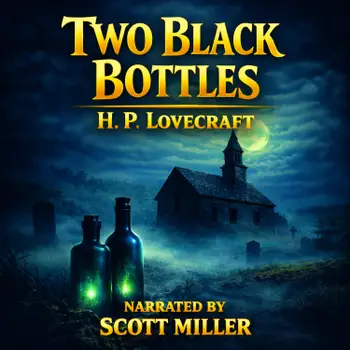
H. P. Lovecraft’s “Two Black Bottles,” co-written with Wilfred Blanch Talman, unfolds in the eerie, isolated village of Daalbergen—where superstition clings to every doorstep and the dead are never entirely at rest. When a young man arrives to settle his late uncle’s affairs, he’s greeted with fearful whispers about a sinister sexton, a deserted church, and a grave said to disturb itself in the night. What begins as a simple inheritance quickly spirals into a confrontation with forbidden rites, buried truths, and a soul trapped where no soul should be. Lovecraft guides the reader into a world where atmosphere is everything and dread grows with each turn of the page.
The deeper the narrator explores the abandoned parsonage and its shadowed belfry, the more he realizes that the villagers’ fears may be rooted in dangerous truths. Strange manuscripts, muttered incantations, and two mysterious black bottles hold the key to a long-buried horror—one that refuses to remain hidden.
H. P. Lovecraft (1890–1937) reshaped speculative fiction with his cosmic worldview, philosophical darkness, and meticulous world-building. His stories explored the limits of human understanding and the ancient forces lurking beyond it, influencing generations of writers, filmmakers, and artists.
Though Lovecraft struggled for recognition during his lifetime, his work later became foundational to modern horror and dark fantasy. Tales like “The Shadow Over Innsmouth,” “The Call of Cthulhu,” and “The Colour Out of Space” cemented his status as one of the most influential voices in 20th-century genre fiction.