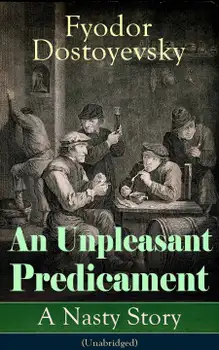
An Unpleasant Predicament: A Nasty Story (Unabridged) : A satirical tale of a civil servant's wedding crash and misguided kindness in 19th-century Russia

This carefully crafted ebook: "An Unpleasant Predicament: A Nasty Story (Unabridged)" is formatted for your eReader with a functional and detailed table of contents. An Unpleasant Predicament, also translated as "A Nasty Story" is a satirical story by Fyodor Dostoyevsky concerning the escapades of a Russian civil servant. After drinking a bit too much with two fellow civil servants, the protagonist, Ivan Ilyich Pralinsky, expounds on his desire to embrace a philosophy based on kindness to those in lower status social positions. After leaving the initial gathering, Ivan happens upon the wedding celebration of one of his subordinates. He decides to put his philosophy into action, and so crashes the party. Fyodor Dostoyevsky (1821–1881) was a Russian novelist, short story writer, essayist, journalist and philosopher. His literary works explore human psychology in the troubled political, social, and spiritual atmosphere of 19th-century Russia. Many of his works contain a strong emphasis on Christianity, and its message of absolute love, forgiveness and charity, explored within the realm of the individual, confronted with all of life's hardships and beauty. His major works include Crime and Punishment (1866), The Idiot (1869), Demons (1872) and The Brothers Karamazov (1880). Many literary critics rate him as one of the greatest and most prominent psychologists in world literature.
Tietoa kirjasta

This carefully crafted ebook: "An Unpleasant Predicament: A Nasty Story (Unabridged)" is formatted for your eReader with a functional and detailed table of contents. An Unpleasant Predicament, also translated as "A Nasty Story" is a satirical story by Fyodor Dostoyevsky concerning the escapades of a Russian civil servant. After drinking a bit too much with two fellow civil servants, the protagonist, Ivan Ilyich Pralinsky, expounds on his desire to embrace a philosophy based on kindness to those in lower status social positions. After leaving the initial gathering, Ivan happens upon the wedding celebration of one of his subordinates. He decides to put his philosophy into action, and so crashes the party. Fyodor Dostoyevsky (1821–1881) was a Russian novelist, short story writer, essayist, journalist and philosopher. His literary works explore human psychology in the troubled political, social, and spiritual atmosphere of 19th-century Russia. Many of his works contain a strong emphasis on Christianity, and its message of absolute love, forgiveness and charity, explored within the realm of the individual, confronted with all of life's hardships and beauty. His major works include Crime and Punishment (1866), The Idiot (1869), Demons (1872) and The Brothers Karamazov (1880). Many literary critics rate him as one of the greatest and most prominent psychologists in world literature.

Aloita kirja saman tien hintaan 0 €

  • Kokeilujakson aikana käytössäsi on kaikki sovelluksen kirjat
  • Ei sitoumusta, voit perua milloin vain
Kokeile nyt ilmaiseksi
Yli 52 000 ihmistä on antanut Nextorylle viisi tähteä App Storessa ja Google Playssä.

  1. 3.0

    50 Masterpieces you have to read before you die vol: 1 (2020 Edition) : Included: Little Women, The Richest Man in Babylon Emma, The Call Of The Wild ....

    Louisa May Alcott, Dante Alighieri, Marcus Aurelius, Jane Austen, L. Frank Baum, Charlotte Brontë, Emily Brontë, Anne Brontë, Miguel de Cervantes, Agatha Christie, George S. Clason, Arthur Conan Doyle, Joseph Conrad, Charles Dickens, Fyodor Dostoyevsky, Alexandre Dumas, George Eliot, G.K. Chesterton, G.K. Chesterton, Zane Grey, Nathaniel Hawthorne, Napoleon Hill, Homer, Victor Hugo, Frances Hodgson Burnett, Washington Irving, Henry James, Franz Kafka, Rudyard Kipling, Jack London, Leo Tolstoy, H.P. Lovecraft, Lucy Maud Montgomery, Joseph Murphy, Robert Louis Stevenson, Edgar Allan Poe, Marcel Proust, Publius, Mary Shelley, Bram Stoker, Mark Twain, Sun Tzu, Lew Wallace, Wallace D. Wattles, H.G. Wells

  2. 4.0

    Crime and Punishment

    Fyodor Dostoyevsky

  3. 4.0

    Fyodor Dostoyevsky: The Short Stories Collection

    Fyodor Dostoyevsky

  4. 4.0

    Rikos ja rangaistus : Rikastettu painos. Kuusiosainen romaani ynnä epilogi

    Fyodor Dostoyevsky

  5. 4.0

    Fyodor Dostoyevsky: The Essays : Winter Notes on Summer Impressions; Letters & Reminisances; Virginia Woolf's Essays on Dostoyevsky

    Fyodor Dostoyevsky

  6. The Essential Classics Collection : 1984; Great Expectations; The Brothers Karamazov; Pride and Prejudice; & The War of the Worlds

    George Orwell, Fyodor Dostoyevsky, Charles Dickens, Jane Austen, H.G. Wells

  7. World's Greatest Short Stories

    Daniel Defoe, Benjamin Franklin, Washington Irving, Mateo Falcone, Charlotte Bronte, Mary Shelley, Nathaniel Hawthorne, Nikolai Gogol, Edgar Allan Poe, Fyodor Dostoyevsky, Charles Dickens, Herman Melville, Mark Twain, Guy De Maupassant, Oscar Wilde, Leo Tolstoy, H.G. Wells, Ambrose Bierce, Stephen Crane, Kate Chopin, Jack London, E. M. Forster

  8. The Fyodor Dostoyevsky Collection. Signature Classics : Notes from the Underground, The Dream of a Ridiculous Man, White Nights and others

    Fyodor Dostoyevsky

  9. 10 Masterpieces You Have to Read Before You Die, Vol. 3

    Edgar Allan Poe, William Shakespeare, H.P. Lovecraft, Mary W. Shelley, Osamu Dazai, Jack London, Fyodor Dostoyevsky, Nathaniel Hawthorne, Frances Hodgson Burnett, Robert Louis Stevenson

  10. 50 Masterpieces you have to read before you die vol: 2

    Louisa, Jane Austen, Joseph Conrad, D. H. Lawrence, George Eliot, Leo Tolstoy, James Joyce, Charles Dickens, Bram Stoker, Oscar Wilde, Honoré de Balzac, Edgar Rice Burroughs, Anne Brontë, Charlotte Brontë, Emily Brontë, Lewis Carroll, Willa Cather, Miguel de Cervantes, E. E. Cummings, Fyodor Dostoyevsky, Daniel Defoe, Arthur Conan Doyle, Alexandre Dumas, Gustave Flaubert, Henry James, Victor Hugo, Bookish

  11. 3.0

    The Permanent Husband

    Fyodor Dostoyevsky

  12. 4.0

    The Adolescent

    Fyodor Dostoyevsky