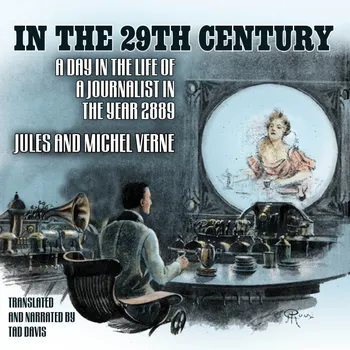
In the 29th Century : A Day in the Life of an American Journalist in the Year 2889

What kind of world did Jules Verne and his son Michel envision a thousand years in the future? One that, in many ways, wasn't that far off from life in our own time. This story, first published in 1889 (and later revised twice) is filled with air travel, billionaire publishers who control politics, countrysides covered with highways, gigantic cities with moving sidewalks, six-hour trips between Europe and America, telephoto communications, cryogenics, video news on demand, and even audiobooks.

It's also filled with a degree of satiric humor that may surprise people unfamiliar with this side of Verne.

Most available editions of the story in English reproduce the first version, which was written by Michel. This audiobook uses a new translation, by the narrator, of the final version of the story. This version was published in 1910, shortly after Jules Verne's death, and preserves many of the changes he made to the story after its initial publication.

Sit back for an hour and enjoy a fantasy about where the Vernes, father and son, thought we may have been heading over a hundred years ago. An afterword describes some of the main differences between the various versions of the story.
Tietoa kirjasta

What kind of world did Jules Verne and his son Michel envision a thousand years in the future? One that, in many ways, wasn't that far off from life in our own time. This story, first published in 1889 (and later revised twice) is filled with air travel, billionaire publishers who control politics, countrysides covered with highways, gigantic cities with moving sidewalks, six-hour trips between Europe and America, telephoto communications, cryogenics, video news on demand, and even audiobooks.

It's also filled with a degree of satiric humor that may surprise people unfamiliar with this side of Verne.

Most available editions of the story in English reproduce the first version, which was written by Michel. This audiobook uses a new translation, by the narrator, of the final version of the story. This version was published in 1910, shortly after Jules Verne's death, and preserves many of the changes he made to the story after its initial publication.

Sit back for an hour and enjoy a fantasy about where the Vernes, father and son, thought we may have been heading over a hundred years ago. An afterword describes some of the main differences between the various versions of the story.
Aloita kirja saman tien hintaan 0 €

  • Kokeilujakson aikana käytössäsi on kaikki sovelluksen kirjat
  • Ei sitoumusta, voit perua milloin vain
Kokeile nyt ilmaiseksi
Yli 52 000 ihmistä on antanut Nextorylle viisi tähteä App Storessa ja Google Playssä.