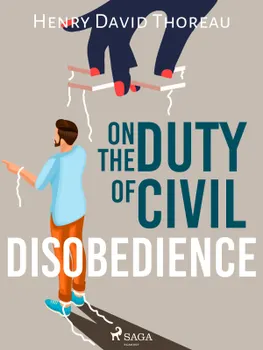
On the Duty of Civil Disobedience

‘Civil Disobedience’ (1849) is an essay by American poet, essayist, and philosopher, Henry David Thoreau, who is best known for his book ‘Walden’ (1854).

In this classic essay, Thoreau famously argues that citizens should not allow their government to overrule their consciences, arguing that their compliance enables governments to make them the agents of injustice.

A lifelong abolitionist, Thoreau was motivated to write this essay by his contempt for slavery and the plight of John Brown. His work went on to influence the political thoughts and actions of both Gandhi and Martin Luther King Jr.

This pioneering, thought-provoking classic, remains as relevant today as when it was first written.

Henry David Thoreau (1817 – 1862) was an American naturalist, poet, essayist and philosopher. A leading transcendentalist, he is best known for his book ‘Walden’ (1854), a deliberation on simple living in natural surroundings, and his advocation of civil liberties in the essay ‘Civil Disobedience’ (1849).

A lifelong abolitionist he praised the writings of Wendell Phillips and defended the abolitionist John Brown, most notably with his works, ‘A Plea for Captain John Brown’ (1859), ‘Remarks After the Hanging of John Brown’ (1859), and ‘The Last Days of John Brown (1860)’.

Thoreau's philosophy of civil disobedience went on to influence writers and leading political figures across the world, including Tolstoy, Gandhi, and Martin Luther King Jr. His pioneering works continue to resonate with people to this day.
Tietoa kirjasta

‘Civil Disobedience’ (1849) is an essay by American poet, essayist, and philosopher, Henry David Thoreau, who is best known for his book ‘Walden’ (1854).

In this classic essay, Thoreau famously argues that citizens should not allow their government to overrule their consciences, arguing that their compliance enables governments to make them the agents of injustice.

A lifelong abolitionist, Thoreau was motivated to write this essay by his contempt for slavery and the plight of John Brown. His work went on to influence the political thoughts and actions of both Gandhi and Martin Luther King Jr.

This pioneering, thought-provoking classic, remains as relevant today as when it was first written.

Henry David Thoreau (1817 – 1862) was an American naturalist, poet, essayist and philosopher. A leading transcendentalist, he is best known for his book ‘Walden’ (1854), a deliberation on simple living in natural surroundings, and his advocation of civil liberties in the essay ‘Civil Disobedience’ (1849).

A lifelong abolitionist he praised the writings of Wendell Phillips and defended the abolitionist John Brown, most notably with his works, ‘A Plea for Captain John Brown’ (1859), ‘Remarks After the Hanging of John Brown’ (1859), and ‘The Last Days of John Brown (1860)’.

Thoreau's philosophy of civil disobedience went on to influence writers and leading political figures across the world, including Tolstoy, Gandhi, and Martin Luther King Jr. His pioneering works continue to resonate with people to this day.

Aloita kirja saman tien hintaan 0 €

  • Kokeilujakson aikana käytössäsi on kaikki sovelluksen kirjat
  • Ei sitoumusta, voit perua milloin vain
Kokeile nyt ilmaiseksi
Yli 52 000 ihmistä on antanut Nextorylle viisi tähteä App Storessa ja Google Playssä.

  1. Walden

    Henry David Thoreau

  2. 3.6

    Walden - Elämää metsässä

    Henry David Thoreau

  3. 3.5

    Walden

    Henry David Thoreau

  4. 3.3

    Walking

    Henry David Thoreau

  5. Walden

    Henry David Thoreau

  6. 4.0

    Walden

    Henry David Thoreau

  7. 12 Masterpieces You Have to Read Before You Die. Philosophy

    Niccolo Machiavelli, Tommaso Campanella, Francis Bacon, Thomas More, John Stuart Mill, Immanuel Kant, Kahlil Gibran, Leo Tolstoy, G.K. Chesterton, Henry David Thoreau

  8. Skogsliv vid Walden

    Henry David Thoreau

  9. On the Duty of Civil Disobedience

    Henry David Thoreau

  10. On the Duty of Civil Disobedience : Enriched edition. A Transcendentalist Call to Conscience, Ethical Resistance, and Social Justice

    Henry David Thoreau

  11. 4.0

    3500 Final Quotes

    Marcus Aurelius, Jane Austen, Beaumarchais, Napoleon Bonaparte, Buddha, Winston Churchill, Cicero, Confucius, Nicolas de Chamfort, Charles de Gaulle, Antoine de Saint-Exupéry, Denis Diderot, Fyodor Dostoevsky, Albert Einstein, Ralph Waldo Emerson, Anne Frank, Mahatma Gandhi, Immanuel Kant, Søren Kierkegaard, Martin Luther King, Georg Christoph Lichtenberg, Abraham Lincoln, Montesquieu, Friedrich Nietzsche, Plato, Marcel Proust, Arthur Schopenhauer, William Shakespeare, Socrates, Baruch Spinoza, Henry David Thoreau, Leonardo da Vinci, Voltaire, Oscar Wilde, Laozi

  12. The Oxford Book of American Essays

    Benjamin Franklin, Ralph Waldo Emerson, Walt Whitman, Francis Hopkinson, Washington Irving, Richard Henry Dana, Nathaniel Hawthorne, Edgar Allan Poe, Theodore Roosevelt, Henry James, Henry David Thoreau, William Peterfield Trent