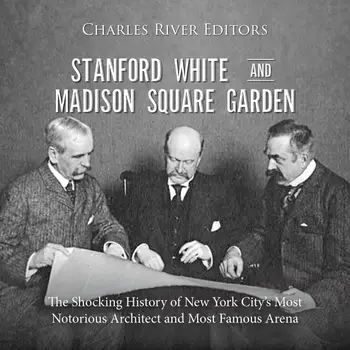
Stanford White and Madison Square Garden: The Shocking History of New York City’s Most Notorious Architect and Most Famous Arena

Of all the great cities in the world, few personify their country like New York City. As America’s largest city and best known immigration gateway into the country, the Big Apple represents the beauty, diversity and sheer strength of the United States, a global financial center that has enticed people chasing the “American Dream” for centuries.

As such, it’s only fitting that Madison Square Garden, the stadium that bills itself as the world’s most famous arena, resides in the heart of Manhattan. Just blocks away from the Empire State Building and situated atop Penn Station, the Garden is always bustling, whether it’s for special events or as the home of the NBA’s New York Knicks and NHL’s New York Rangers, and all the while, performing in the Garden has been a career benchmark for artists as varied as Elvis Presley, The Doors, Led Zeppelin, and Michael Jackson. As Billie Joel put it, “Madison Square Garden is the center of the universe as far as I'm concerned. It has the best acoustics, the best audiences, the best reputation, and the best history of great artists who have played there. It is the iconic, holy temple of Rock and Roll for most touring acts and, being a New Yorker, it holds a special significance to me.”

The Garden is now nearly 50 years old, making it one of the oldest sporting venues used in professional sports, but the current arena was not the first Madison Square Garden, and the area has a history as an entertainment center dating back to the 19th century. Ironically, its location on the less crowded fringes of Manhattan in the 19th century helped establish it as a place for hucksters like P.T. Barnum to hold events. In fact, a previous Garden was one of New York City’s tallest buildings in the early 20th century, and it was bankrolled by business titans like J.P. Morgan and Andrew Carnegie.
Tietoa kirjasta

Of all the great cities in the world, few personify their country like New York City. As America’s largest city and best known immigration gateway into the country, the Big Apple represents the beauty, diversity and sheer strength of the United States, a global financial center that has enticed people chasing the “American Dream” for centuries.

As such, it’s only fitting that Madison Square Garden, the stadium that bills itself as the world’s most famous arena, resides in the heart of Manhattan. Just blocks away from the Empire State Building and situated atop Penn Station, the Garden is always bustling, whether it’s for special events or as the home of the NBA’s New York Knicks and NHL’s New York Rangers, and all the while, performing in the Garden has been a career benchmark for artists as varied as Elvis Presley, The Doors, Led Zeppelin, and Michael Jackson. As Billie Joel put it, “Madison Square Garden is the center of the universe as far as I'm concerned. It has the best acoustics, the best audiences, the best reputation, and the best history of great artists who have played there. It is the iconic, holy temple of Rock and Roll for most touring acts and, being a New Yorker, it holds a special significance to me.”

The Garden is now nearly 50 years old, making it one of the oldest sporting venues used in professional sports, but the current arena was not the first Madison Square Garden, and the area has a history as an entertainment center dating back to the 19th century. Ironically, its location on the less crowded fringes of Manhattan in the 19th century helped establish it as a place for hucksters like P.T. Barnum to hold events. In fact, a previous Garden was one of New York City’s tallest buildings in the early 20th century, and it was bankrolled by business titans like J.P. Morgan and Andrew Carnegie.

Aloita kirja saman tien hintaan 0 €

  • Kokeilujakson aikana käytössäsi on kaikki sovelluksen kirjat
  • Ei sitoumusta, voit perua milloin vain
Kokeile nyt ilmaiseksi
Yli 52 000 ihmistä on antanut Nextorylle viisi tähteä App Storessa ja Google Playssä.

  1. The Dutch Golden Age: The Rise of the Netherlands as a Global Power in the 17th Century

    Charles River Editors

  2. 3.4

    Mustafa Kemal Atatürk and the Republic of Turkey: The History of the Ottoman Empire’s Collapse and the Establishment of a New State

    Charles River Editors

  3. The Ancient Kingdoms of Africa: The History and Legacy of the African Continent’s Most Prominent Kingdoms in Antiquity

    Charles River Editors

  4. 5.0

    The Rise and Fall of the Third Reich: The History and Legacy of Nazi Germany under Adolf Hitler

    Charles River Editors

  5. Uusi

    The Women of Athens and Sparta: The History of Women’s Lives and Social Roles in Ancient Greece’s Most Powerful City-States

    Charles River Editors

  6. The Counter-Reformation: The History of the Catholic Church’s Response to the Protestant Reformation

    Charles River Editors

  7. The Iranian Revolution and Iran Hostage Crisis: The History of the Events that Broke American Relations with Iran

    Charles River Editors

  8. Kublai Khan and Marco Polo: The History of a Unique Partnership at the Court of the Mongol Empire

    Charles River Editors

  9. 5.0

    The Evolution of Modern Mathematics: The Lives of Influential Mathematicians Who Helped Bring Math into the Computer Age Kindle

    Charles River Editors

  10. 3.0

    Flat Earth and Hollow Earth Theories: A History of Strange Tales and Bizarre Beliefs about the Planet

    Charles River Editors

  11. Persia and Islam: The History of the Islamic Empires that have Ruled Persia Since the Middle Ages

    Charles River Editors

  12. 3.4

    Albert Speer and Germania: The History of Nazi Germany’s Lead Architect and His Plans for a Future German Capital

    Charles River Editors