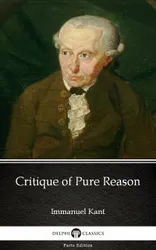
THE CRITIQUE OF PURE REASON : Enriched edition. Exploring the Boundaries of Human Knowledge: Rationalism, Empiricism, and Enlightenment in Kantian Philosophy

Immanuel Kant's "The Critique of Pure Reason" is a pivotal work in Western philosophy that meticulously examines the relationship between human experience and knowledge. Written in a dense yet eloquently rational style, Kant presents his groundbreaking ideas on metaphysics, epistemology, and the limits of human reason. The book delves into the nature of perception and understanding, positing that while our experiences are shaped by sensory input, our cognitive faculties impose inherent structures that govern our understanding of reality. This seminal text emerged during the Enlightenment, a period characterized by a burgeoning confidence in human reason and a re-evaluation of traditional metaphysical notions. Kant, born in 1724 in Königsberg, Prussia, was influenced by his background in mathematics, physics, and the rationalist and empiricist traditions. His desire to reconcile the empiricist's emphasis on experience with the rationalist's focus on innate ideas provoked him to explore the fundamental faculties of knowledge. Encapsulating the complexities of human understanding and the very limits of reason, Kant's work became a cornerstone for later philosophical inquiry, challenging scholars and laypersons alike to reconsider the foundations of human cognition. For readers keen to explore the complexities of knowledge and the interplay between perception and reality, "The Critique of Pure Reason" is an essential resource. Kant's meticulous arguments and innovative theories beckon those who seek to engage with profound philosophical questions, making this work a crucial text for anyone interested in the evolution of thought from the Enlightenment to contemporary philosophy.

In this enriched edition, we have carefully created added value for your reading experience:

- A succinct Introduction situates the work's timeless appeal and themes.

- The Synopsis outlines the central plot, highlighting key developments without spoiling critical twists.

- A detailed Historical Context immerses you in the era's events and influences that shaped the writing.

- An Author Biography reveals milestones in the author's life, illuminating the personal insights behind the text.

- A thorough Analysis dissects symbols, motifs, and character arcs to unearth underlying meanings.

- Reflection questions prompt you to engage personally with the work's messages, connecting them to modern life.

- Hand‐picked Memorable Quotes shine a spotlight on moments of literary brilliance.

- Interactive footnotes clarify unusual references, historical allusions, and archaic phrases for an effortless, more informed read.

Tietoa kirjasta

Immanuel Kant's "The Critique of Pure Reason" is a pivotal work in Western philosophy that meticulously examines the relationship between human experience and knowledge. Written in a dense yet eloquently rational style, Kant presents his groundbreaking ideas on metaphysics, epistemology, and the limits of human reason. The book delves into the nature of perception and understanding, positing that while our experiences are shaped by sensory input, our cognitive faculties impose inherent structures that govern our understanding of reality. This seminal text emerged during the Enlightenment, a period characterized by a burgeoning confidence in human reason and a re-evaluation of traditional metaphysical notions. Kant, born in 1724 in Königsberg, Prussia, was influenced by his background in mathematics, physics, and the rationalist and empiricist traditions. His desire to reconcile the empiricist's emphasis on experience with the rationalist's focus on innate ideas provoked him to explore the fundamental faculties of knowledge. Encapsulating the complexities of human understanding and the very limits of reason, Kant's work became a cornerstone for later philosophical inquiry, challenging scholars and laypersons alike to reconsider the foundations of human cognition. For readers keen to explore the complexities of knowledge and the interplay between perception and reality, "The Critique of Pure Reason" is an essential resource. Kant's meticulous arguments and innovative theories beckon those who seek to engage with profound philosophical questions, making this work a crucial text for anyone interested in the evolution of thought from the Enlightenment to contemporary philosophy.

In this enriched edition, we have carefully created added value for your reading experience:

- A succinct Introduction situates the work's timeless appeal and themes.

- The Synopsis outlines the central plot, highlighting key developments without spoiling critical twists.

- A detailed Historical Context immerses you in the era's events and influences that shaped the writing.

- An Author Biography reveals milestones in the author's life, illuminating the personal insights behind the text.

- A thorough Analysis dissects symbols, motifs, and character arcs to unearth underlying meanings.

- Reflection questions prompt you to engage personally with the work's messages, connecting them to modern life.

- Hand‐picked Memorable Quotes shine a spotlight on moments of literary brilliance.

- Interactive footnotes clarify unusual references, historical allusions, and archaic phrases for an effortless, more informed read.

Aloita kirja saman tien hintaan 0 €

  • Kokeilujakson aikana käytössäsi on kaikki sovelluksen kirjat
  • Ei sitoumusta, voit perua milloin vain
Kokeile nyt ilmaiseksi
Yli 52 000 ihmistä on antanut Nextorylle viisi tähteä App Storessa ja Google Playssä.

  1. 3.6

    Ikuiseen rauhaan

    Immanuel Kant

  2. Arvostelukyvyn kritiikki

    Immanuel Kant

  3. Puhtaan järjen kritiikki

    Immanuel Kant

  4. 12 Masterpieces You Have to Read Before You Die. Philosophy

    Niccolo Machiavelli, Tommaso Campanella, Francis Bacon, Thomas More, John Stuart Mill, Immanuel Kant, Kahlil Gibran, Leo Tolstoy, G.K. Chesterton, Henry David Thoreau

  5. Pedagogiikasta

    Immanuel Kant

  6. Critique of Judgement

    Immanuel Kant

  7. 2000 Final Quotations

    Marcus Aurelius, Jane Austen, Buddha, Anton Chekhov, Cicero, Emil Cioran, Confucius, Albert Einstein, Anne Frank, Mahatma Gandhi, Johann Wolfgang Goethe, Carl Jung, Immanuel Kant, Friedrich Nietzsche, Marcel Proust, Arthur Schopenhauer, William Shakespeare, Baruch Spinoza, Leonardo da Vinci, Laozi

  8. Critique of Pure Reason

    Immanuel Kant

  9. Käytännöllisen järjen kritiikki

    Immanuel Kant

  10. Uusi

    100 Clásicos de la Literatura Universal

    Francis Scott Fitzgerald, Mary Shelley, Lyman Frank Baum, Louisa May Alcott, Dante Alighieri, Jane Austen, Ambrose Bierce, Emily Brontë, Edgar Rice Burroughs, Lewis Carroll, Wilkie Collins, René Descartes, Charles Dickens, Emily Dickinson, Alexandre Dumas, Gustave Flaubert, Benito Pérez Galdós, Johann Wolfgang von Goethe, Thomas Hardy, E T A Hoffmann, Washington Irving, Henry James, James Joyce, Franz Kafka, Gaston Leroux, Federico García Lorca, H.P. Lovecraft, Publio Virgilio Marón, Lucy Maud Montgomery, John William Polidori, Marco Polo, Antoine de Saint-Exupéry, Emilio Salgari, Walter Scott, Mark Twain, Jules Verne, Julio Verne, H.G. Wells, Edith Wharton, Mary Wollstonecraft, Stefan Zweig, Sun Tzu, Bram Stoker, - Aristoteles, George Bernard Shaw, Henryk Sienkiewicz, Concepción Arenal, Charlotte Brontë, Miguel de Cervantes, G.K. Chesterton, Daniel Defoe, Fyodor Mikhailovich Dostoyevsky, Arthur Conan Doyle, Sigmund Freud, H. Rider Haggard, Homero, Immanuel Kant, Rudyard Kipling, Molière, Friedrich Nietzsche, Fernando de Rojas, Sófocles, William Makepeace Thackeray, León Tolstói, Voltaire, Ramón María del Valle-Inclán, Oscar Wilde, Virginia Woolf

  11. Hacia la paz perpetua

    Immanuel Kant

  12. Teoría y praxis : Estudio preliminar: Eduardo García Belsunce

    Immanuel Kant