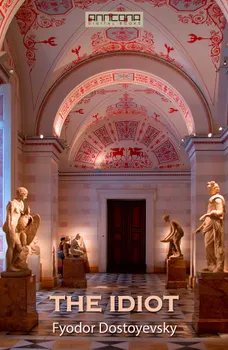
The Idiot is a novel by the Fyodor Dostoyevsky, first published serially in the journal The Russian Messenger in 1868-9. This English translation was first published in 1915.
The title is an ironic reference to the central character of the novel, Prince Lyov Nikolaevich Myshkin, a young man whose goodness and open-hearted simplicity lead many of the more worldly characters he encounters to mistakenly assume that he lacks intelligence and insight.
In the character of Prince Myshkin, Dostoevsky set himself the task of depicting "the positively good and beautiful man". The novel examines the consequences of placing such a unique individual at the centre of the conflicts, desires, passions and egoism of worldly society, both for the man himself and for those with whom he becomes involved. The result, according to philosopher A.C. Grayling, is "one of the most excoriating, compelling and remarkable books ever written; and without question one of the greatest.
The extraordinary child-adult Prince Myshkin, confined for several years in a Swiss sanatorium suffering from severe epilepsy, returns to Russia to claim his inheritance and to find a place in healthy human society.
The teeming St Petersburg community he enters is far from receptive to an innocent like himself, despite some early successes and relentless pursuit by grotesque fortune-hunters.
His naive gaucheries give rise to extreme reactions among his new acquaintance, ranging from anguished protectiveness to mockery and contempt.
But even before reaching the city, during the memorable train journey that opens the novel, he has encountered the demonic Rogozhin, the son of a wealthy merchant who is in thrall to the equally doomed Natasha Filippovna: beautiful, capricious and destructively neurotic, she joins with the two weirdly contrasted men in a spiralling dance of death...
Fyodor Mikhailovich Dostoyevsky was a Russian novelist, short story writer and essayist. Dostoyevsky's literary works explore human psychology in the context of the troubled political, social and spiritual atmosphere of 19th-century Russia.
Although he began writing in the mid-1840s, his most memorable works—including Crime and Punishment, The Idiot and The Brothers Karamazov—are from his later years. His output consists of eleven novels, three novellas, seventeen short novels and three essays. Many literary critics rate him as one of the greatest and most prominent psychologists in world literature.















Lauri
24.6.2025
On miltei herttaista tuntea, miten henkilökohtainen ja todennäköisesti sydämelle läheinen tämä teos oli itse Dostojeskille, ja teoksesta selvästi näkee, miten itse kirjailija oikein halusi puteutua aiheeseen. Kuitenkin rakenteeltaan teos on hosuva ja pitkäveteinen uurtaminen täynnä puol-mitättömiä sivujuonia, joilla ei tunnu olevan paljon väliä tai melkein mitään taiteellista tai filosofistakaan yhteyttä pääaiheeseen. Näin paksukin teos jätti jotkin sivuhahmot hieman epäselväksi ja yksitoikkoisiksi. Olisin halunnut saada paljon enemmän tietoa Ippolitin ja Rogozhinin sisäisistä maailmoista. Teoksella on kuitenkin tärkeä paikka venäläisen kirjallisuuden kanoonissa, joten on sitä ainakin siten kunnioitettava. Tämä oli itselleni viimeinen työn alla oleva Dostojevskin viides suuresta opuksesta, ja kyllähän tästä hyvä mieli jäi ainakin siinä suhteessa, että kunnioitan kirjailijaa tämän teoksen tähden.
Jotta voit kirjoittaa arvostelun, sinun täytyy lataa sovellus