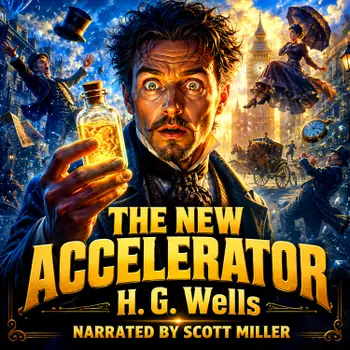
What if a single drop of medicine could give you hours while everyone else experiences only seconds?
When Professor Gibberne unveils a revolutionary stimulant known as the New Accelerator, the promise seems irresistible. The drug does far more than sharpen the mind or energize the body. It speeds every process of human life to such an astonishing degree that the rest of the world appears almost motionless. For one extraordinary experiment, the professor and his skeptical friend step outside ordinary experience and into a reality where fluttering curtains hang frozen in midair, conversations become silent statues, and even a bee drifts through the sky with agonizing slowness.
At first, the experience feels exhilarating. Freed from the pace of everyday life, the pair explore a world that seems suspended for their private inspection. Yet the longer they remain in this accelerated state, the more unexpected complications arise. What begins as scientific triumph quickly raises practical questions, ethical concerns, and physical dangers that no laboratory test could fully predict. Wells combines humor, wonder, and scientific speculation to create one of the most imaginative thought experiments ever written.
Published in 1901, The New Accelerator remains remarkably fresh. Long before modern discussions about productivity, time management, and human enhancement, Wells imagined a discovery capable of transforming every profession and every aspect of daily life. The story showcases his gift for taking a single scientific idea and following it to surprising and entertaining conclusions.
H. G. Wells (1866–1946) was one of the most influential writers in the history of science fiction. His novels include The Time Machine, The War of the Worlds, The Invisible Man, and The First Men in the Moon, works that helped establish many of the foundations of modern speculative fiction.