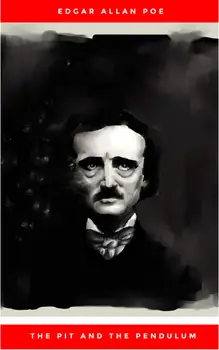
The Pit and the Pendulum

The Pit and the Pendulum" is a short story written by Edgar Allan Poe and first published in 1842. The story is about the torments endured by a prisoner of the Spanish Inquisition, though Poe skews historical facts. The narrator of the story is deemed guilty for an unnamed crime and put into a completely dark room. He passes out while trying to determine the size of the room. When he wakes up, he realizes there is a large, deep pit in the middle of the room. He loses consciousness again and awakens strapped on his back, unable to move more than his head. He soon realizes there is a large blade-like pendulum hanging above him, slowly getting closer to cutting through his chest. He finds a way to escape but the walls of his prison start to move and close in on him, pushing him closer and closer to falling into the pit.

The story is especially effective at inspiring fear in the reader because of its heavy focus on the senses, such as sound, emphasizing its reality, unlike many of Poe's stories which are aided by the supernatural. The traditional elements established in popular horror tales at the time are followed but critical reception has been mixed.

Tietoa kirjasta

The Pit and the Pendulum" is a short story written by Edgar Allan Poe and first published in 1842. The story is about the torments endured by a prisoner of the Spanish Inquisition, though Poe skews historical facts. The narrator of the story is deemed guilty for an unnamed crime and put into a completely dark room. He passes out while trying to determine the size of the room. When he wakes up, he realizes there is a large, deep pit in the middle of the room. He loses consciousness again and awakens strapped on his back, unable to move more than his head. He soon realizes there is a large blade-like pendulum hanging above him, slowly getting closer to cutting through his chest. He finds a way to escape but the walls of his prison start to move and close in on him, pushing him closer and closer to falling into the pit.

The story is especially effective at inspiring fear in the reader because of its heavy focus on the senses, such as sound, emphasizing its reality, unlike many of Poe's stories which are aided by the supernatural. The traditional elements established in popular horror tales at the time are followed but critical reception has been mixed.
Aloita kirja saman tien hintaan 0 €

  • Kokeilujakson aikana käytössäsi on kaikki sovelluksen kirjat
  • Ei sitoumusta, voit perua milloin vain
Kokeile nyt ilmaiseksi
Yli 52 000 ihmistä on antanut Nextorylle viisi tähteä App Storessa ja Google Playssä.

  1. 3.0

    50 Masterpieces you have to read before you die vol: 1 (2020 Edition) : Included: Little Women, The Richest Man in Babylon Emma, The Call Of The Wild ....

    Louisa May Alcott, Dante Alighieri, Marcus Aurelius, Jane Austen, L. Frank Baum, Charlotte Brontë, Emily Brontë, Anne Brontë, Miguel de Cervantes, Agatha Christie, George S. Clason, Arthur Conan Doyle, Joseph Conrad, Charles Dickens, Fyodor Dostoyevsky, Alexandre Dumas, George Eliot, G.K. Chesterton, G.K. Chesterton, Zane Grey, Nathaniel Hawthorne, Napoleon Hill, Homer, Victor Hugo, Frances Hodgson Burnett, Washington Irving, Henry James, Franz Kafka, Rudyard Kipling, Jack London, Leo Tolstoy, H.P. Lovecraft, Lucy Maud Montgomery, Joseph Murphy, Robert Louis Stevenson, Edgar Allan Poe, Marcel Proust, Publius, Mary Shelley, Bram Stoker, Mark Twain, Sun Tzu, Lew Wallace, Wallace D. Wattles, H.G. Wells

  2. 3.0

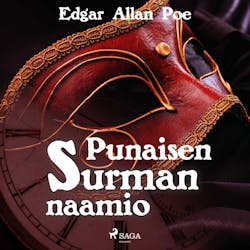
    Punaisen surman naamio

    Edgar Allan Poe

  3. 4.1

    The Raven

    Edgar Allan Poe

  4. Kauhutarinoita

    Edgar Allan Poe

  5. 2.1
    #13

    Korppi

    Edgar Allan Poe

  6. 4.2

    The Fall of the House of Usher

    Edgar Allan Poe

  7. 5.0

    Histoires extraordinaires d'Edgar Allan Poe - Livre Audio

    Edgar Allan Poe, Livres audio en français

  8. The Edgar Allan Poe Collection

    Edgar Allan Poe

  9. The Fall of the House of Usher : A Masterpiece of Gothic Horror

    Edgar Allan Poe

  10. World's Greatest Short Stories

    Daniel Defoe, Benjamin Franklin, Washington Irving, Mateo Falcone, Charlotte Bronte, Mary Shelley, Nathaniel Hawthorne, Nikolai Gogol, Edgar Allan Poe, Fyodor Dostoyevsky, Charles Dickens, Herman Melville, Mark Twain, Guy De Maupassant, Oscar Wilde, Leo Tolstoy, H.G. Wells, Ambrose Bierce, Stephen Crane, Kate Chopin, Jack London, E. M. Forster

  11. 10 Masterpieces You Have to Read Before You Die, Vol. 3

    Edgar Allan Poe, William Shakespeare, H.P. Lovecraft, Mary W. Shelley, Osamu Dazai, Jack London, Fyodor Dostoyevsky, Nathaniel Hawthorne, Frances Hodgson Burnett, Robert Louis Stevenson

  12. Al Aaraaf

    Edgar Allan Poe