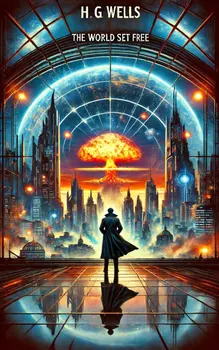
The World Set Free : Vision of a Future Shaped by Atomic Power

H.G. Wells' The World Set Free is a groundbreaking science fiction novel that predicted the advent of nuclear energy long before its discovery. First published in 1914, this visionary work explores the profound impact of atomic power on human civilization, war, and the future of society. A tale of destruction and renewal, it remains one of the most thought-provoking and prophetic books of the 20th century.

Wells masterfully narrates a world where scientific advancements bring both devastation and transformation. The novel follows the discovery of atomic energy, leading to new warfare that threatens global destruction. As nations struggle with the consequences, the world teeters on the brink of chaos—until a radical shift towards a unified, peaceful society emerges. Through its compelling storytelling, The World Set Free examines the dual-edged nature of technological progress and humanity's quest for a sustainable future.

Recognized as one of the earliest literary works to anticipate nuclear power, The World Set Free has been widely acknowledged for its influence on scientists, including those involved in the development of real-world atomic energy. Wells' remarkable foresight has earned him praise from scholars, historians, and science fiction enthusiasts alike. His ideas continue to resonate in modern discussions about technology, ethics, and global governance.

A must-read for fans of classic science fiction, The World Set Free is more than just a novel—it is a prophetic vision of humanity's potential and peril. H.G. Wells' legacy as a futurist and literary genius lives on in this timeless work, offering readers a fascinating glimpse into the possibilities and dangers of a world shaped by scientific discovery.
Tietoa kirjasta

H.G. Wells' The World Set Free is a groundbreaking science fiction novel that predicted the advent of nuclear energy long before its discovery. First published in 1914, this visionary work explores the profound impact of atomic power on human civilization, war, and the future of society. A tale of destruction and renewal, it remains one of the most thought-provoking and prophetic books of the 20th century.

Wells masterfully narrates a world where scientific advancements bring both devastation and transformation. The novel follows the discovery of atomic energy, leading to new warfare that threatens global destruction. As nations struggle with the consequences, the world teeters on the brink of chaos—until a radical shift towards a unified, peaceful society emerges. Through its compelling storytelling, The World Set Free examines the dual-edged nature of technological progress and humanity's quest for a sustainable future.

Recognized as one of the earliest literary works to anticipate nuclear power, The World Set Free has been widely acknowledged for its influence on scientists, including those involved in the development of real-world atomic energy. Wells' remarkable foresight has earned him praise from scholars, historians, and science fiction enthusiasts alike. His ideas continue to resonate in modern discussions about technology, ethics, and global governance.

A must-read for fans of classic science fiction, The World Set Free is more than just a novel—it is a prophetic vision of humanity's potential and peril. H.G. Wells' legacy as a futurist and literary genius lives on in this timeless work, offering readers a fascinating glimpse into the possibilities and dangers of a world shaped by scientific discovery.

Aloita kirja saman tien hintaan 0 €

  • Kokeilujakson aikana käytössäsi on kaikki sovelluksen kirjat
  • Ei sitoumusta, voit perua milloin vain
Kokeile nyt ilmaiseksi
Yli 52 000 ihmistä on antanut Nextorylle viisi tähteä App Storessa ja Google Playssä.

  1. 3.0

    50 Masterpieces you have to read before you die vol: 1 (2020 Edition) : Included: Little Women, The Richest Man in Babylon Emma, The Call Of The Wild ....

    Louisa May Alcott, Dante Alighieri, Marcus Aurelius, Jane Austen, L. Frank Baum, Charlotte Brontë, Emily Brontë, Anne Brontë, Miguel de Cervantes, Agatha Christie, George S. Clason, Arthur Conan Doyle, Joseph Conrad, Charles Dickens, Fyodor Dostoyevsky, Alexandre Dumas, George Eliot, G.K. Chesterton, G.K. Chesterton, Zane Grey, Nathaniel Hawthorne, Napoleon Hill, Homer, Victor Hugo, Frances Hodgson Burnett, Washington Irving, Henry James, Franz Kafka, Rudyard Kipling, Jack London, Leo Tolstoy, H.P. Lovecraft, Lucy Maud Montgomery, Joseph Murphy, Robert Louis Stevenson, Edgar Allan Poe, Marcel Proust, Publius, Mary Shelley, Bram Stoker, Mark Twain, Sun Tzu, Lew Wallace, Wallace D. Wattles, H.G. Wells

  2. SINISTER OMENS: 560+ Supernatural Thrillers, Macabre Tales & Eerie Mysteries : Victorian Ghosts, Gothic Horrors & Classic Monster Tales

    H.P. Lovecraft, H.G. Wells, Edgar Allan Poe, Henry James, Hugh Walpole, M. R. James, Wilkie Collins, E F Benson, Nathaniel Hawthorne, Ambrose Bierce, Arthur Machen, William Hope Hodgson, Arthur Conan Doyle, Grant Allen, Mary Shelley, Bram Stoker, Théophile Gautier, Richard Marsh, Joseph Sheridan Le Fanu, Thomas Hardy, Charles Dickens, Rudyard Kipling, Guy De Maupassant, Elizabeth Gaskell, Mark Twain, Daniel Defoe, Jerome K Jerome, Fitz-James O’Brien, Catherine Crowe, Émile Erckmann, Alexandre Chatrian, Pedro De Alarçon, Amelia B. Edwards, Washington Irving, John Meade Falkner, Harriet Beecher Stowe, Mary E. Wilkins Freeman, Louisa M. Alcott, Edith Nesbit, Mary Louisa Molesworth, Francis Marion Crawford, John Kendrick Bangs, John Buchan, Sabine Baring-Gould, Cleveland Moffett, Louis Tracy, Nikolai Gogol, James Malcolm Rymer, Thomas Peckett Prest, Frederick Marryat, Oscar Wilde, Robert Louis Stevenson, Charlotte Perkins Gilman, W. Jacobs, Saki, Wilhelm Hauff, Mary Elizabeth Braddon, Robert W. Chambers, Edward Bulwer-Lytton, Thomas De Quincey, William Makepeace Thackeray, E T A Hoffmann, Robert E. Howard, David Lindsay, Marie Belloc Lowndes, Edward Bellamy, Jack London, Pliny the Younger, Helena Blavatsky, Fergus Hume, Florence Marryat, Villiers de l'Isle-Adam, William Archer, William F. Harvey, Katherine Rickford, Ralph Adams Cram, Leopold Kompert, Brander Matthews, Vincent O'Sullivan, Ellis Parker Butler, A. T. Quiller-Couch, Fiona Macleod, Lafcadio Hearn, William T. Stead, Gambier Bolton, Andrew Jackson Davis, Nizida, Walter F. Prince, Chester Bailey Fernando, Leonard Kip, Frank R. Stockton, Bithia Mary Croker, Catherine L. Pirkis, Leonid Andreyev, Anatole France, Richard Le Gallienne, Lucy Maud Montgomery, Stanley G. Weinbaum, Horace Walpole, William Thomas Beckford, Matthew Gregory Lewis, Ann Radcliffe, Jane Austen, William Polidori, Charlotte Brontë, Emily Brontë, Walter Hubbell, George W. M. Reynolds, M.P. Shiel, Adelbert von Chamisso

  3. Uni

    H.G. Wells

  4. 4.0

    Maailmojen sota

    H.G. Wells

  5. A Modern Utopia

    H.G. Wells

  6. 5.0

    The Book of Shadows Vol 2

    Bram Stoker, H.G. Wells, Robert W. Chambers, Mary E. Wilkins Freeman, Arthur Machen, Mary Webb, John Buchan, William Fryer Harvey, Sir Hugh Walpole

  7. The Open Conspiracy

    H.G. Wells

  8. #174

    The Red Room : Skepticism Meets Supernatural: The Haunting of the Red Room

    H.G. Wells

  9. The Book of Shadows

    Arthur Quiller-Couch, Robert W. Chambers, H.G. Wells, Mary E. Wilkins Freeman, E Nesbit, Barry Pain, E F Benson, D. H. Lawrence, Thomas Burke

  10. 50 Masterpieces You Have to Read Before You Die – Volume 2

    Jerome K Jerome, Charles Kingsley, James Joyce, Rudyard Kipling, D. H. Lawrence, Sheridan Le Fanu, Oscar Wilde, H.G. Wells, Lewis Carroll, Zenith Horizon Publishing

  11. World's Greatest Short Stories

    Daniel Defoe, Benjamin Franklin, Washington Irving, Mateo Falcone, Charlotte Bronte, Mary Shelley, Nathaniel Hawthorne, Nikolai Gogol, Edgar Allan Poe, Fyodor Dostoyevsky, Charles Dickens, Herman Melville, Mark Twain, Guy De Maupassant, Oscar Wilde, Leo Tolstoy, H.G. Wells, Ambrose Bierce, Stephen Crane, Kate Chopin, Jack London, E. M. Forster