Nana

Nana is a novel by the French naturalist author Émile Zola. Completed in 1880, Nana is the ninth installment in the 20-volume Les Rougon-Macquart series, which was to tell "The Natural and Social History of a Family under the Second Empire."

The novel was an immediate success. Le Voltaire, the French newspaper that was to publish it in installments from October 1879 on, had launched a gigantic advertising campaign, raising the curiosity of the reading public to a fever pitch. When Charpentier finally published Nana in book form in February 1880, the first edition of 55,000 copies was sold out in one day. Flaubert and Edmond de Goncourt were full of praise for Nana. On the other hand, a part of the non-reading public, spurred on by some critics, reacted to the book with outrage. While the novel is held up as a fine example of writing, it is not especially true to Zola's touted naturalist philosophy; instead, it is one of the most symbolically complex of his novels, setting it apart from the earthy "realism" of L'Assommoir or the more brutal "realism" of La Terre (1887). However, it was a great deal more authentic than most contemporary novels about the demimonde.

Nana is especially noted for the crowd scenes, of which there are many, in which Zola proves himself a master of capturing the incredible variety of people. Whereas in his other novels -- notably Germinal (1885) -- he gives the reader an amazingly complete picture of surroundings and the lives of characters, from the first scene we are to understand that this novel treads new ground.

Flaubert summed up the novel in one perfect sentence:

Nana tourne au mythe, sans cesser d'être réelle.

(Nana turns into myth, without ceasing to be real.)

Commencez ce livre dès aujourd'hui pour 0 €

  • Accédez à tous les livres de l'app pendant la période d'essai
  • Sans engagement, annulez à tout moment
Essayer gratuitement
Plus de 52 000 personnes ont noté Nextory 5 étoiles sur l'App Store et Google Play.

  1. Les mieux notés
    4.7

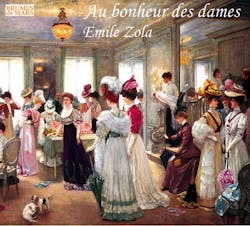
    Au bonheur des dames

    Emile Zola

  2. 50 Chefs-D'œuvre Que Vous Devez Lire Avant De Mourir : Vol 1 (Golden Deer Classics)

    Mark Twain, Stendhal, Edgar Allan Poe, Victor Hugo, Gustave Flaubert, Alexandre Dumas, Arthur Conan Doyle, René Descartes, Lewis Carroll, Charles Baudelaire, Guillaume Apollinaire, Golden Deer, Alain-Fournier, Jules Amédée d'Aurevilly, Paul Bourget, Charlotte Brontë, Emily Brontë, Pierre Corneille, Nikolai Gogol, Gustave Leroux, Marquis De Sade, Jack London, Sinclair Lewis, Daniel Lesueur, Marcel Proust, Edmond Rostand, Jean-Jacques Rousseau, Mary Shelley, Bram Stoker, Sun Tzu, Rodolphe Töpffer, Vatsyayana, Jules Verne, Voltaire, H.G. Wells, Oscar Wilde, Emile Zola

  3. 3.8

    La curée

    Emile Zola

  4. La Bête Humaine

    Emile Zola

  5. 4.4

    L'Assommoir

    Emile Zola

  6. 4.0

    Au bonheur des dames

    Emile Zola

  7. Les mieux notés
    4.8

    Le ventre de Paris

    Emile Zola

  8. Les Repoussoirs

    Emile Zola

  9. Pot-Bouille

    Emile Zola

  10. L'Assommoir : Une histoire captivante de pauvreté, d'ambition et de tragédie

    Emile Zola

  11. J'Accuse : La lettre ouverte explosive qui a secoué la France

    Emile Zola

  12. 1.0

    100 Meisterwerke der Weltliteratur - Klassiker die man kennen muss : Bereicherte Ausgabe. Ein literarisches Panorama: Meisterwerke, Klassiker und Autoren der Weltliteratur

    Johann Wolfgang von Goethe, Jules Verne, Gustave Flaubert, Franz Kafka, Lewis Carroll, Selma Lagerlöf, Sigmund Freud, Johanna Spyri, Theodor Storm, Rainer Maria Rilke, Charles Dickens, Stefan Zweig, Heinrich Heine, Honoré de Balzac, Theodor Fontane, Karl May, Gottfried Keller, Mark Twain, Heinrich Mann, Else Lasker-Schüler, Robert Musil, Walt Whitman, Oscar Wilde, Annette von Droste-Hülshoff, Arthur Schopenhauer, Robert Louis Stevenson, Gustav Freytag, James Fenimore Cooper, Edgar Allan Poe, Heinrich von Kleist, William Shakespeare, Dante Alighieri, Charlotte Brontë, Emily Brontë, Jack London, Arthur Conan Doyle, Joseph Conrad, Jane Austen, Herman Melville, Guy De Maupassant, Walter Scott, Jonathan Swift, Jacob Grimm, Wilhelm Grimm, Alexandre Dumas, Rudyard Kipling, Nathaniel Hawthorne, Homer, O.Henry, Voltaire, Lew Wallace, John Galsworthy, E T A Hoffmann, Marcus Aurelius, Hans Christian Andersen, Anton Pawlowitsch Tschechow, Platon, Friedrich Nietzsche, Iwan Sergejewitsch Turgenew, Tacitus, Nikolai Gogol, Miguel de Cervantes, Mary Shelley, Thomas Wolfe, Emile Zola, Fjodor Michailowitsch Dostojewski, Leo Tolstoi, Joseph Roth, Joseph von Eichendorff, Kurt Tucholsky, Iwan Alexandrowitsch Gontscharow, Oswald Spengler, Moliere, Alfred Adler, Sophie von La Roche, Klaus Mann, Rumi