Divine Comedy (Volume II) : Illustrated Hell

The Divine Comedy describes Dante's journey through Hell (Inferno), Purgatory (Purgatorio), and Paradise (Paradiso), guided first by the Roman poet Virgil and then by Beatrice, the subject of his love and of another of his works, La Vita Nuova. While the vision of Hell, the Inferno, is vivid for modern readers, the theological niceties presented in the other books require a certain amount of patience and knowledge to appreciate. Purgatorio, the most lyrical and human of the three, also has the most poets in it; Paradiso, the most heavily theological, has the most beautiful and ecstatic mystic passages in which Dante tries to describe what he confesses he is unable to convey (e.g., when Dante looks into the face of God: "all'alta fantasia qui mancò possa" — "at this high moment, ability failed my capacity to describe," Paradiso, XXXIII, 142).

"IN the midway of this our mortal life, I found me in a gloomy wood, astray Gone from the path direct: and e'en to tell It were no easy task, how savage wild That forest, how robust and rough its growth, Which to remember only, my dismay Renews, in bitterness not far from death.." (Dante)

IN the midway of this our mortal life,

I found me in a gloomy wood, astray

Gone from the path direct: and e'en to tell

It were no easy task, how savage wild

That forest, how robust and rough its growth,

Which to remember only, my dismay

Renews, in bitterness not far from death.

Yet to discourse of what there good befell,

All else will I relate discover'd there.

How first I enter'd it I scarce can say,

Such sleepy dullness in that instant weigh'd

My senses down, when the true path I left,

But when a mountain's foot I reach'd, where clos'd

The valley, that had pierc'd my heart with dread,

I look'd aloft, and saw his shoulders broad

Already vested with that planet's beam,

Who leads all wanderers safe through every way.

Then was a little respite to the fear,

That in my heart's recesses deep had lain,

All of that night, so pitifully pass'd:

And as a man, with difficult short breath,

Forespent with toiling, 'scap'd from sea to shore,

Turns to the perilous wide waste, and stands

At gaze; e'en so my spirit, that yet fail'd

Struggling with terror, turn'd to view the straits,

That none hath pass'd and liv'd. My weary frame

After short pause recomforted, again

I journey'd on over that lonely steep,

The hinder foot still firmer. Scarce the ascent

Began, when, lo! a panther, nimble, light,

And cover'd with a speckled skin, appear'd,

Nor, when it saw me, vanish'd, rather strove

To check my onward going; that ofttimes

With purpose to retrace my steps I turn'd.

About Dante:

Durante degli Alighieri, simply referred to as Dante (1265–1321), was a major Italian poet of the Middle Ages. His Divine Comedy, originally called La Comedia and later called Divina by Boccaccio, is widely considered the greatest literary work composed in the Italian language and a masterpiece of world literature.

In Italy he is known as il Sommo Poeta ("the Supreme Poet") or just il Poeta. He, Petrarch and Boccaccio are also known as "the three fountains" or "the three crowns". Dante is also called the "Father of the Italian language".
À propos de ce livre

The Divine Comedy describes Dante's journey through Hell (Inferno), Purgatory (Purgatorio), and Paradise (Paradiso), guided first by the Roman poet Virgil and then by Beatrice, the subject of his love and of another of his works, La Vita Nuova. While the vision of Hell, the Inferno, is vivid for modern readers, the theological niceties presented in the other books require a certain amount of patience and knowledge to appreciate. Purgatorio, the most lyrical and human of the three, also has the most poets in it; Paradiso, the most heavily theological, has the most beautiful and ecstatic mystic passages in which Dante tries to describe what he confesses he is unable to convey (e.g., when Dante looks into the face of God: "all'alta fantasia qui mancò possa" — "at this high moment, ability failed my capacity to describe," Paradiso, XXXIII, 142).

"IN the midway of this our mortal life, I found me in a gloomy wood, astray Gone from the path direct: and e'en to tell It were no easy task, how savage wild That forest, how robust and rough its growth, Which to remember only, my dismay Renews, in bitterness not far from death.." (Dante)

IN the midway of this our mortal life,

I found me in a gloomy wood, astray

Gone from the path direct: and e'en to tell

It were no easy task, how savage wild

That forest, how robust and rough its growth,

Which to remember only, my dismay

Renews, in bitterness not far from death.

Yet to discourse of what there good befell,

All else will I relate discover'd there.

How first I enter'd it I scarce can say,

Such sleepy dullness in that instant weigh'd

My senses down, when the true path I left,

But when a mountain's foot I reach'd, where clos'd

The valley, that had pierc'd my heart with dread,

I look'd aloft, and saw his shoulders broad

Already vested with that planet's beam,

Who leads all wanderers safe through every way.

Then was a little respite to the fear,

That in my heart's recesses deep had lain,

All of that night, so pitifully pass'd:

And as a man, with difficult short breath,

Forespent with toiling, 'scap'd from sea to shore,

Turns to the perilous wide waste, and stands

At gaze; e'en so my spirit, that yet fail'd

Struggling with terror, turn'd to view the straits,

That none hath pass'd and liv'd. My weary frame

After short pause recomforted, again

I journey'd on over that lonely steep,

The hinder foot still firmer. Scarce the ascent

Began, when, lo! a panther, nimble, light,

And cover'd with a speckled skin, appear'd,

Nor, when it saw me, vanish'd, rather strove

To check my onward going; that ofttimes

With purpose to retrace my steps I turn'd.

About Dante:

Durante degli Alighieri, simply referred to as Dante (1265–1321), was a major Italian poet of the Middle Ages. His Divine Comedy, originally called La Comedia and later called Divina by Boccaccio, is widely considered the greatest literary work composed in the Italian language and a masterpiece of world literature.

In Italy he is known as il Sommo Poeta ("the Supreme Poet") or just il Poeta. He, Petrarch and Boccaccio are also known as "the three fountains" or "the three crowns". Dante is also called the "Father of the Italian language".
Commencez ce livre dès aujourd'hui pour 0 €

  • Accédez à tous les livres de l'app pendant la période d'essai
  • Sans engagement, annulez à tout moment
Essayer gratuitement
Plus de 52 000 personnes ont noté Nextory 5 étoiles sur l'App Store et Google Play.

  1. 4.0

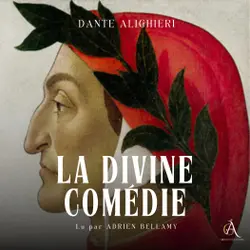
    La Divine Comédie - Livre Audio

    Dante Alighieri, Livres audio en français

  2. Nouveau

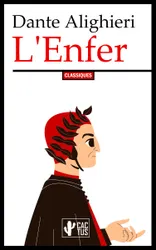
    L'Enfer : Avec notes

    Dante Alighieri

  3. 4.0

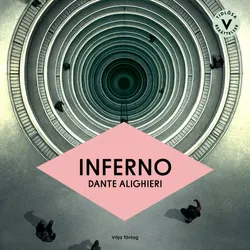
    Inferno (lättläst)

    Dante Alighieri

  4. La Divina Commedia - Audiolibro

    Dante Alighieri

  5. 5.0
    #3

    Paraíso (Comedia)

    Dante Alighieri, José María Micó Juan (Translator)

  6. 100 Obras Maestras de la Literatura Universal : Edición enriquecida. Viaje intertemporal por iconos mundiales y el diálogo cultural histórico

    Johann Wolfgang von Goethe, Gustave Flaubert, Franz Kafka, Lewis Carroll, Sigmund Freud, Henrik Ibsen, Charles Dickens, Honoré de Balzac, Mark Twain, Immanuel Kant, Friedrich Schiller, Harriet Beecher Stowe, Oscar Wilde, Robert Louis Stevenson, Edgar Allan Poe, William Shakespeare, Dante Alighieri, Giovanni Boccaccio, Bram Stoker, Charlotte Brontë, Emily Brontë, Jack London, Henry James, Louisa May Alcott, Victor Hugo, Arthur Conan Doyle, Joseph Conrad, Jane Austen, José Rizal, Edgar Rice Burroughs, Herman Melville, Jonathan Swift, Gustavo Adolfo Bécquer, Vicente Blasco Ibáñez, Benito Pérez Galdós, Jean-Jacques Rousseau, Daniel Defoe, Pedro Calderón de la Barca, Virginia Woolf, Washington Irving, Juan Valera, Horacio Quiroga, Nathaniel Hawthorne, Charles Baudelaire, Wilkie Collins, William Makepeace Thackeray, Voltaire, Apuleius, Leopoldo Alas, John Milton, José Martí, Lope de Vega, Emilio Salgari, Francisco de Quevedo, Rubén Darío, Antonio Machado, José Zorrilla, Tirso de Molina, Emilia Pardo Bazán, Fernando de Rojas, L. Frank Baum, H.G. Wells, J.M. Barrie, H. Rider Haggard, H.P. Lovecraft, Seneca, Hans Christian Andersen, Friedrich Nietzsche, Mary Shelley, Baltasar Gracián, Sófocles, Sun Tzu, Fiódor Dostoyevski, Antón Chéjov, León Tolstoi, Tomás Moro, San Agustín, Nikolái Gógol, Julio Verne, Homero, Platón, Alejandro Dumas, Aristóteles, Hermanos Grimm, Jorge Isaacs, Ignacio De Loyola, Nicolás Maquiavelo, Miguel Cervantes, Teresa de Jesús, Alejandro Dumas hijo, Mijaíl Bakunin, Miguel De Unamuno, Duque de Rivas, Ramón María del Valle-Inclán, Federico García Lorca, Gibrán Jalil Gibrán

  7. La divine comédie - Tome 3 - Le Paradis

    Dante Alighieri

  8. L'enfer : Édition enrichie. La Divine Comédie - Traduit par Rivarol

    Dante Alighieri

  9. 4.0

    La Divina Comedia : Edición enriquecida.

    Dante Alighieri

  10. La Divine Comédie : Tome II : Le Purgatoire

    Dante Alighieri

  11. La Divine Comédie : Tome I : L'Enfer

    Dante Alighieri

  12. La divine comédie - Tome 1 - L'Enfer

    Dante Alighieri