3.2(5)

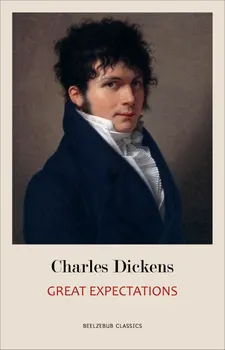
Great Expectations

GREAT EXPECTATIONS is Charles Dickens' thirteenth novel and his penultimate completed novel; a bildungsroman which depicts the personal growth and personal development of an orphan nicknamed Pip. It is Dickens's second novel, after David Copperfield, to be fully narrated in the first person. The novel was first published as a serial in Dickens's weekly periodical All the Year Round, from 1 December 1860 to August 1861. In October 1861, Chapman and Hall published the novel in three volumes.

It is set among marshes in Kent, and in London, in the early to mid-1800s, and contains some of Dickens' most memorable scenes, including the opening, in a graveyard, where the young Pip is accosted by the escaped convict, Abel Magwitch. GREAT EXPECTATIONS is full of extreme imagery -poverty; prison ships and chains, and fights to the death-and has a colorful cast of characters who have entered popular culture. Dickens's themes include wealth and poverty, love and rejection, and the eventual triumph of good over evil. GREAT EXPECTATIONS is popular both with readers and literary critics, and has been translated into many languages, and adapted numerous times into various media.

Upon its release, the novel received near universal acclaim. Thomas Carlyle spoke disparagingly of "all that Pip's nonsense". Later, George Bernard Shaw praised the novel, as "All of one piece and consistently truthful." During the serial publication, Dickens was pleased with public response to GREAT EXPECTATIONS and its sales; when the plot first formed in his mind, he called it "a very fine, new and grotesque idea."
À propos de ce livre

GREAT EXPECTATIONS is Charles Dickens' thirteenth novel and his penultimate completed novel; a bildungsroman which depicts the personal growth and personal development of an orphan nicknamed Pip. It is Dickens's second novel, after David Copperfield, to be fully narrated in the first person. The novel was first published as a serial in Dickens's weekly periodical All the Year Round, from 1 December 1860 to August 1861. In October 1861, Chapman and Hall published the novel in three volumes.

It is set among marshes in Kent, and in London, in the early to mid-1800s, and contains some of Dickens' most memorable scenes, including the opening, in a graveyard, where the young Pip is accosted by the escaped convict, Abel Magwitch. GREAT EXPECTATIONS is full of extreme imagery -poverty; prison ships and chains, and fights to the death-and has a colorful cast of characters who have entered popular culture. Dickens's themes include wealth and poverty, love and rejection, and the eventual triumph of good over evil. GREAT EXPECTATIONS is popular both with readers and literary critics, and has been translated into many languages, and adapted numerous times into various media.

Upon its release, the novel received near universal acclaim. Thomas Carlyle spoke disparagingly of "all that Pip's nonsense". Later, George Bernard Shaw praised the novel, as "All of one piece and consistently truthful." During the serial publication, Dickens was pleased with public response to GREAT EXPECTATIONS and its sales; when the plot first formed in his mind, he called it "a very fine, new and grotesque idea."

Commencez ce livre dès aujourd'hui pour 0 €

  • Accédez à tous les livres de l'app pendant la période d'essai
  • Sans engagement, annulez à tout moment
Essayer gratuitement
Plus de 52 000 personnes ont noté Nextory 5 étoiles sur l'App Store et Google Play.

  1. OLIVER TWIST

    Charles Dickens

  2. 1.0

    Olivier Twist - Livre Audio

    Charles Dickens, Livres audio en français

  3. 5.0

    De grandes espérances - Livre Audio

    Charles Dickens, Livres audio en français

  4. 3.5

    Oliver Twist

    Charles Dickens

  5. 2.8

    Un chant de Noël - Livre Audio

    Charles Dickens, Livres audio en français

  6. 3.0

    Oliver Twist (lättläst)

    Charles Dickens

  7. 5.0

    David Copperfield - Livre Audio

    Charles Dickens, Livres audio en français

  8. World's Greatest Short Stories

    Daniel Defoe, Benjamin Franklin, Washington Irving, Mateo Falcone, Charlotte Bronte, Mary Shelley, Nathaniel Hawthorne, Nikolai Gogol, Edgar Allan Poe, Fyodor Dostoyevsky, Charles Dickens, Herman Melville, Mark Twain, Guy De Maupassant, Oscar Wilde, Leo Tolstoy, H.G. Wells, Ambrose Bierce, Stephen Crane, Kate Chopin, Jack London, E. M. Forster

  9. 5.0

    50 Contes Pour Enfants : (Aladin, La Belle au Bois Dormant, Le Petit Chaperon Rouge, Hansel et Gretel...)

    Charles Perrault, Hans Christian Andersen, Charles Dickens, Leo Tolstoy, Jeanne-Marie Leprince de Beaumont, Frères Grimm, Joseph Jacobs

  10. 50 Masterpieces you have to read before you die vol: 1

    Louisa May Alcott, Jane Austen, Joseph Conrad, D. H. Lawrence, George Eliot, Leo Tolstoy, James Joyce, Charles Dickens, Bram Stoker, Oscar Wilde, Honoré de Balzac, Edgar Rice Burroughs, Anne Brontë, Charlotte Brontë, Emily Brontë, Lewis Carroll, Willa Cather, Miguel de Cervantes, E. Cummings, Fyodor Dostoyevsky, Daniel Defoe, Arthur Conan Doyle, Alexandre Dumas, Gustave Flaubert, Henry James, Victor Hugo

  11. Nouveau
    3.0

    50 Masterpieces you have to read before you die vol: 2

    Lewis Carroll, Mark Twain, Jules Verne, Oscar Wilde, Arthur Conan Doyle, Louisa May Alcott, Jane Austen, G.K. Chesterton, Wilkie Collins, Charles Dickens, Fyodor Dostoyevsky, Alexandre Dumas, F. Scott Fitzgerald, E. M. Forster, Thomas Hardy, Hermann Hesse, James Joyce, Jack London, H.P. Lovecraft, Lucy Maud Montgomery, Edgar Allan Poe, Marcel Proust, William Shakespeare, Robert Louis Stevenson, H.G. Wells, Virginia Woolf, Rudyard Kipling, D. H. Lawrence, Thomas Mann, William Somerset Maugham, Herman Melville, George Sand, Mary Shelley, Walter Scott, Leo Tolstoy, Bram Stoker

  12. 4.0

    Oliver Twist

    Charles Dickens