À propos de ce livre

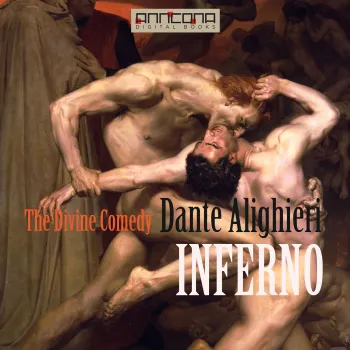
The Divine Comedy – INFERNO

This is an unabridged version of INFERNO, the first part of The Divine Comedy, an epic poem written by Dante Alighieri.

The Divine Comedy is written in the first person, and tells of Dante's journey through the three realms of the dead, lasting from the night before Good Friday to the Wednesday after Easter in the spring of 1300. The Roman poet Virgil guides him through Hell and Purgatory, and Beatrice, Dante's ideal woman, guides him through Heaven. On the surface, the poem describes Dante's travels through Inferno (Hell), Purgatorio (Purgatory), and Paradiso (Paradise/Heaven), but at a deeper level, it represents allegorically the soul's journey towards God.

INFERNO begins on the night before Good Friday in the year 1300, "halfway along our life's path". Dante is thirty-five years old, half of the biblical lifespan of 70, lost in a dark wood (understood as sin), assailed by beasts (a lion, a leopard, and a she-wolf) he cannot evade and unable to find the "straight way" – also translatable as "right way" – to salvation (symbolized by the sun behind the mountain).

Conscious that he is ruining himself and that he is falling into a "low place" where the sun is silent, Dante is at last rescued by Virgil, and the two of them begin their journey to the underworld. Each sin's punishment in INFERNO is a symbolic instance of poetic justice; for example, in Canto XX, fortune-tellers and soothsayers must walk with their heads on backwards, unable to see what is ahead, because that was what they had tried to do in life.

This translation by Charles Eliot Norton, from 1891, is written in prose, a form of grammatical structure and natural flow of speech rather than the original blank verse. The translation includs more than 1,300 footnotes and explanations.

Audio book read by Tony Addison, running time 5 hours, 18 min. Unabridged full version. Also available as E-Book: ePUB, 49,300 words including the endnotes. Average reading time should be around 4 hours and 40 min, but is likely longer due to the content text.

The Divine Comedy is available in one full volume including all three parts, or as separate E-Books or audio books; INFERNO (5 hours, 16 min), PURGATORIO (5 hours, 25 min), and PARADISO (5 hours, 38 min.

Dante Alighieri (c. 1265–1321), was a major Italian poet of the Middle Ages. His Divine Comedy, is widely considered the greatest literary work composed in the Italian language and a masterpiece of world literature.
Commencez ce livre dès aujourd'hui pour 0 €

  • Accédez à tous les livres de l'app pendant la période d'essai
  • Sans engagement, annulez à tout moment
Essayer gratuitement
Plus de 52 000 personnes ont noté Nextory 5 étoiles sur l'App Store et Google Play.

  1. 4.0

    La Divine Comédie - Livre Audio

    Dante Alighieri, Livres audio en français

  2. L'Enfer : Avec notes

    Dante Alighieri

  3. The Divine Comedy - Audiobook

    Dante Alighieri, Classic Audiobooks

  4. La Divina Commedia - Audiolibro

    Dante Alighieri

  5. 3.0

    The Divine Comedy

    Dante Alighieri

  6. 100 Obras Maestras de la Literatura Universal : Edición enriquecida. Viaje intertemporal por iconos mundiales y el diálogo cultural histórico

    Johann Wolfgang Goethe, Gustave Flaubert, Franz Kafka, Lewis Carroll, Sigmund Freud, Henrik Ibsen, Charles Dickens, Honoré de Balzac, Mark Twain, Immanuel Kant, Friedrich Schiller, Harriet Beecher Stowe, Oscar Wilde, Robert Louis Stevenson, Edgar Allan Poe, William Shakespeare, Dante Alighieri, Giovanni Boccaccio, Bram Stoker, Charlotte Brontë, Emily Brontë, Jack London, Henry James, Louisa May Alcott, Victor Hugo, Arthur Conan Doyle, Joseph Conrad, Jane Austen, José Rizal, Edgar Rice Burroughs, Herman Melville, Jonathan Swift, Gustavo Adolfo Bécquer, Vicente Blasco Ibáñez, Benito Pérez Galdós, Jean-Jacques Rousseau, Daniel Defoe, Pedro Calderón Barca, Virginia Woolf, Washington Irving, Juan Valera, Horacio Quiroga, Nathaniel Hawthorne, Charles Baudelaire, Wilkie Collins, William Makepeace Thackeray, Voltaire, Apuleius, Leopoldo Alas, John Milton, José Martí, Lope de Vega, Emilio Salgari, Francisco de Quevedo, Rubén Darío, Antonio Machado, José Zorrilla, Tirso de Molina, Emilia Pardo Bazán, Fernando de Rojas, L. Frank Baum, H.G. Wells, J.M. Barrie, H. Rider Haggard, H.P. Lovecraft, Seneca, Hans Christian Andersen, Friedrich Nietzsche, Mary Shelley, Baltasar Gracián, Sófocles, Sun Tzu, Fiódor Dostoyevski, Antón Chéjov, León Tolstoi, Tomás Moro, San Agustín, Nikolái Gógol, Julio Verne, Homero, Platón, Alejandro Dumas, Aristóteles, Hermanos Grimm, Jorge Isaacs, Ignacio De Loyola, Nicolás Maquiavelo, Miguel Cervantes, Teresa de Jesús, Alejandro Dumas hijo, Mijaíl Bakunin, Miguel De Unamuno, Duque de Rivas, Ramón María Valle-Inclán, Federico García Lorca, Gibrán Jalil Gibrán

  7. Die größten Klassiker des Mittelalters (Kommentiert) : Erweiterte Ausgabe. Mystik, Scholastik und höfische Liebe zwischen Ritterepos, Reisebericht und Renaissance-Satire

    Franz von Assisi, Prophet Mohammed, Dante Alighieri, Omar Chayyām, Marco Polo, Giovanni Boccaccio, Geoffrey Chaucer, Thomas von Aquin, Peter Abelard, Héloïse d'Argenteuil, Sebastian Brant, Hermann Bote, Ludovico Ariosto, Hartmann von Aue, Guillaume de Lorris, Wolfram von Eschenbach, Gottfried von Straßburg, Hildegard von Bingen, Niccolò Machiavelli

  8. La Divine Comédie : Le plus célèbre témoignage de la civilisation médiévale

    Dante Alighieri

  9. La Divine Comédie (Golden Deer Classics) : L'Enfer - Le Purgatoire - Le Paradis

    Dante Alighieri, Golden Deer Classics

  10. La divine comédie - Tome 1 - L'Enfer

    Dante Alighieri

  11. 3.5

    La Divine comédie

    Dante Alighieri

  12. 29 sept.

    The Divine Comedy

    Dante Alighieri