
In "The Essays of Arthur Schopenhauer; Studies in Pessimism," Schopenhauer engages deeply with the human condition, exploring themes of suffering, desire, and the futility of existence. Written with his characteristic incisive clarity and philosophical rigor, this collection critiques the superficiality of contemporary optimism while employing a literary style that is both poignant and accessible. Schopenhauer's essays reveal his profound engagement with philosophy and art, positioning his thoughts within the idealist tradition, yet diverging significantly to advocate for a more somber realism in examining life's inherent struggles. Arthur Schopenhauer, a pivotal figure in Western philosophy, is often hailed as the father of pessimism. His own tumultuous life experiences, marred by personal disappointments and disillusionments, greatly informed his philosophical outlook. Influenced by the works of Kant and Eastern philosophical traditions, Schopenhauer sought to articulate human suffering's deeper truths, making a lasting impact on existentialism and psychology. I recommend "The Essays of Arthur Schopenhauer; Studies in Pessimism" to readers seeking an unflinching examination of life's darker aspects. With its profound reflections and striking insights, this work invites contemplation and challenges optimistic narratives, making it essential for anyone interested in philosophy, psychology, or the human psyche.
The Essays of Arthur Schopenhauer; Studies in Pessimism
Commencez ce livre dès aujourd’hui pour 0 €
- Accédez à tous les livres de l'app pendant la période d'essai
- Sans engagement, annulez à tout moment
Auteur(e) :
Langue :
anglais
Format :
1800 Citations de philosophes
Aristote, Épicure, Platon, Thalès de Milet, – Socrate, Protagoras, Anaximandre, Épictète, Héraclite, Marc Aurèle, René Descartes, Michel de Montaigne, Alexis de Tocqueville, Voltaire, Charles De Montesquieu, Jean-Jacques Rousseau, Emmanuel Kant, Hannah Arendt, Gottfried Wilhelm Leibniz, Georg Wilhelm Friedrich Hegel, Friedrich Nietzsche, Arthur Schopenhauer, David Hume, John Locke, Francis Bacon, Thomas Hobbes, Thomas More, Confucius, Érasme, Lao Tseu, Baruch Spinoza, Søren Kierkegaard, Nicolas Machiavel, Thomas d'Aquin, Henry David Thoreau
L'Art d'avoir toujours raison
Arthur Schopenhauer
L'art d'avoir toujours raison
Arthur Schopenhauer

3500 citations ultimes
Marc Aurèle, Jane Austen, Beaumarchais, Napoléon Bonaparte, Bouddha, Winston Churchill, Cicéron, Confucius, Nicolas de Chamfort, Charles de Gaulle, Antoine de Saint-Exupéry, Léonard de Vinci, Denis Diderot, Fiodor Dostoïevski, Albert Einstein, Ralph Waldo Emerson, Anne Frank, Mahatma Gandhi, Emmanuel Kant, Søren Kierkegaard, Martin Luther King, Georg Christoph Lichtenberg, Abraham Lincoln, Montesquieu, Friedrich Nietzsche, Platon, Marcel Proust, Arthur Schopenhauer, William Shakespeare, – Socrate, Baruch Spinoza, Henry David Thoreau, Lao Tseu, Voltaire, Oscar Wilde

L'Art d'avoir toujours raison (L'édition intégrale) : Édition enrichie. Les stratégies de persuasion et de débat selon Schopenhauer
Arthur Schopenhauer
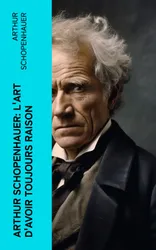
Arthur Schopenhauer: L'Art d'avoir toujours raison : La dialectique éristique
Arthur Schopenhauer
50 citations de Schopenhauer
Arthur Schopenhauer

Métaphysique de l'amour (L'édition intégrale) : Psychologie des désirs
Arthur Schopenhauer

The Essays of Arthur Schopenhauer; the Art of Controversy
Arthur Schopenhauer

L'Art d'avoir toujours raison : une oeuvre du philosophe allemand Arthur Schopenhauer qui traite de l'art de la controverse
Arthur Schopenhauer
400 citations des grands philosophes du XIXème siècle
Georg Wilhelm Hegel, Søren Kierkegaard, Friedrich Nietzsche, Arthur Schopenhauer

2000 citations ultimes
Marc Aurèle, Jane Austen, Bouddha, Cicéron, Emil Cioran, Confucius, Léonard de Vinci, Albert Einstein, Anne Frank, Mahatma Gandhi, Johann Wolfgang Goethe, Carl Jung, Emmanuel Kant, Friedrich Nietzsche, Marcel Proust, Arthur Schopenhauer, William Shakespeare, Baruch Spinoza, Anton Tchekhov, Lao Tseu