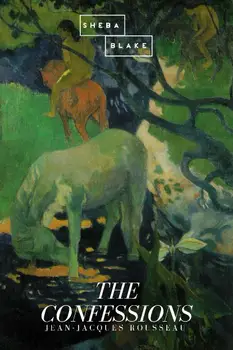
The Confessions

The Confessions is an autobiographical book by Jean-Jacques Rousseau. In modern times, it is often published with the title The Confessions of Jean-Jacques Rousseau in order to distinguish it from Saint Augustine's Confessions. Covering the first fifty-three years of Rousseau's life, up to 1765, it was completed in 1769, but not published until 1782, four years after Rousseau's death, even though Rousseau did read excerpts of his manuscript publicly at various salons and other meeting places. The Confessions was two distinct works, each part consisting of six books. Books I to VI were written between 1765 and 1767 and published in 1782, while books VII to XII were written in 1769–1770 and published in 1789. Rousseau alludes to a planned third part, but this was never completed. Though the book contains factual inaccuracies—in particular, Rousseau's dates are frequently off, some events are out of order, and others are misrepresented, incomplete, or incorrect—Rousseau provides an account of the experiences that shaped his personality and ideas. For instance, some parts of his own education are clearly present in his account of ideal education, Emile, or On Education. Rousseau's work is notable as one of the first major autobiographies. Prior to the Confessions, the two great autobiographies were Augustine's own Confessions and Saint Teresa's Life of Herself. However, both of these works focused on the religious experiences of their authors; the Confessions was one of the first autobiographies in which an individual wrote of his own life mainly in terms of his worldly experiences and personal feelings. Rousseau recognized the unique nature of his work; it opens with the famous words: "I have resolved on an enterprise which has no precedent and which, once complete, will have no imitator. My purpose is to display to my kind a portrait in every way true to nature, and the man I shall portray will be myself."
Om denne boken

The Confessions is an autobiographical book by Jean-Jacques Rousseau. In modern times, it is often published with the title The Confessions of Jean-Jacques Rousseau in order to distinguish it from Saint Augustine's Confessions. Covering the first fifty-three years of Rousseau's life, up to 1765, it was completed in 1769, but not published until 1782, four years after Rousseau's death, even though Rousseau did read excerpts of his manuscript publicly at various salons and other meeting places. The Confessions was two distinct works, each part consisting of six books. Books I to VI were written between 1765 and 1767 and published in 1782, while books VII to XII were written in 1769–1770 and published in 1789. Rousseau alludes to a planned third part, but this was never completed. Though the book contains factual inaccuracies—in particular, Rousseau's dates are frequently off, some events are out of order, and others are misrepresented, incomplete, or incorrect—Rousseau provides an account of the experiences that shaped his personality and ideas. For instance, some parts of his own education are clearly present in his account of ideal education, Emile, or On Education. Rousseau's work is notable as one of the first major autobiographies. Prior to the Confessions, the two great autobiographies were Augustine's own Confessions and Saint Teresa's Life of Herself. However, both of these works focused on the religious experiences of their authors; the Confessions was one of the first autobiographies in which an individual wrote of his own life mainly in terms of his worldly experiences and personal feelings. Rousseau recognized the unique nature of his work; it opens with the famous words: "I have resolved on an enterprise which has no precedent and which, once complete, will have no imitator. My purpose is to display to my kind a portrait in every way true to nature, and the man I shall portray will be myself."

Kom i gang med denne boken i dag for 0 kr

  • Få full tilgang til alle bøkene i appen i prøveperioden
  • Ingen forpliktelser, si opp når du vil
Prøv gratis nå
Mer enn 52 000 personer har gitt Nextory 5 stjerner på App Store og Google Play.

  1. Om ulikheten mellom menneskene : dens opprinnelse og grunnlag

    Jean-Jacques Rousseau

  2. French Literature Classics - Ultimate Collection : Enriched edition. Exploring the Depths of French Literary Classics

    Stendhal, Jules Verne, Gustave Flaubert, Émile Zola, Victor Hugo, Guy De Maupassant, Jean-Jacques Rousseau, François Rabelais, George Sand, Marcel Proust, Gaston Leroux, Charles Baudelaire, Molière, Pierre Corneille, Jean Racine, Voltaire, Pierre Choderlos Laclos, Alexandre Dumas pere, Alexandre Dumas fils

  3. 5.0

    Emile or On Education

    Jean-Jacques Rousseau

  4. 4.2

    The Social Contract

    Jean-Jacques Rousseau

  5. 2. sep.

    Emilio y Sofía o Los solitarios : Texto póstumo continuación de «Emilio o De la educación», tratado clave de Rousseau.

    Jean-Jacques Rousseau

  6. Die größten Klassiker der französischen Literatur

    Victor Hugo, Marcel Proust, Voltaire, George Sand, Emile Zola, Gustave Flaubert, Honoré de Balzac, François Rabelais, Alexandre Dumas, Charles Baudelaire, Stendhal, Denis Diderot, Jean-Jacques Rousseau, Marie-Madeleine La Fayette, Alphonse Daudet

  7. 3.7
    #329

    El contrato social

    Jean-Jacques Rousseau

  8. Forkortet

    Discurso sobre el origen de la desigualdad entre los hombres : Jean Jacques Rousseau

    Jean-Jacques Rousseau

  9. Of The Social Contract : Principles of the Political Right

    Jean-Jacques Rousseau

  10. Discourse on Political Economy :

    Jean-Jacques Rousseau, G. D. H. Cole

  11. Contrato social

    Jean-Jacques Rousseau

  12. Jean-Jacques Rousseau: Der Gesellschaftsvertrag : Prinzipien des Staatsrechts: Ein philosophischer Grundlagentext

    Jean-Jacques Rousseau