The Faerie Queene

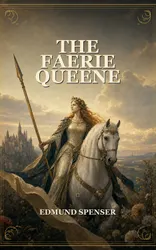
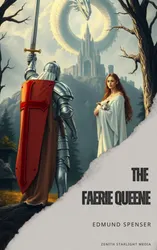
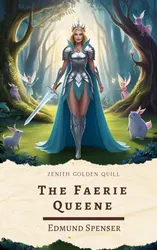
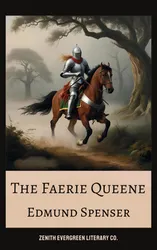
The Faerie Queene is Edmund Spenser's magnum opus, composed for Queen Elizabeth I. The epic poem is incomplete, as only six of the intended twelve books were published before his death. Despite that, it stands as one of the longest poems in the English language. During its composition, Spenser invented a new type of verse form: the Spenserian stanza. The form consists of eight lines in iambic pentameter followed by a line in iambic hexameter, with the rhyme scheme ababbcbcc . He purposely included archaic language and spelling to make the work feel comparable to the Arthurian myths written during the Middle Ages. Spenser used Aristotle's list of virtues as the foundation for his work. Each of the six books follows a different knight who symbolize a unique virtue: the Knight of the Redcross for Holiness, Guyon for Temperance, Britomartis for Chastity, Cambell and Telamond for Friendship, Artegall for Justice, and Calidore for Courtesy. Fragments of an unfinished seventh book—the "Cantos of Mutability"—would have centered on the virtue of Constancy. In a letter to Sir Walter Raleigh, Spenser reveals that King Arthur represents the virtue of Magnificence, "the perfection of all the rest." The first book opens with the Redcross Knight on a quest ordered by Queen Gloriana to defeat a horrible dragon. Traveling with him is Lady Una and her dwarf servant, who are leading the knight to the land where the dragon dwells. A terrible storm forces the travelers to shelter in the nearest cave—and a monster's den.
Om denne boken

The Faerie Queene is Edmund Spenser's magnum opus, composed for Queen Elizabeth I. The epic poem is incomplete, as only six of the intended twelve books were published before his death. Despite that, it stands as one of the longest poems in the English language. During its composition, Spenser invented a new type of verse form: the Spenserian stanza. The form consists of eight lines in iambic pentameter followed by a line in iambic hexameter, with the rhyme scheme ababbcbcc . He purposely included archaic language and spelling to make the work feel comparable to the Arthurian myths written during the Middle Ages. Spenser used Aristotle's list of virtues as the foundation for his work. Each of the six books follows a different knight who symbolize a unique virtue: the Knight of the Redcross for Holiness, Guyon for Temperance, Britomartis for Chastity, Cambell and Telamond for Friendship, Artegall for Justice, and Calidore for Courtesy. Fragments of an unfinished seventh book—the "Cantos of Mutability"—would have centered on the virtue of Constancy. In a letter to Sir Walter Raleigh, Spenser reveals that King Arthur represents the virtue of Magnificence, "the perfection of all the rest." The first book opens with the Redcross Knight on a quest ordered by Queen Gloriana to defeat a horrible dragon. Traveling with him is Lady Una and her dwarf servant, who are leading the knight to the land where the dragon dwells. A terrible storm forces the travelers to shelter in the nearest cave—and a monster's den.
Kom i gang med denne boken i dag for 0 kr

  • Få full tilgang til alle bøkene i appen i prøveperioden
  • Ingen forpliktelser, si opp når du vil
Prøv gratis nå
Mer enn 52 000 personer har gitt Nextory 5 stjerner på App Store og Google Play.

  1. 5.0
    #40

    Harvard Classics Volume 40 : English Poetry 1: Chaucer To Gray

    Geoffrey Chaucer, Golden Deer Classics, Anonymous, Thomas Wyatt, Henry Howard, George Gascoigne, Edward Dyer, John Lyly, Thomas Lodge, George Peele, Robert Southwell, Samuel Daniel, Michael Drayton, Henry Constable, Edmund Spenser, William Habington, Christopher Marlowe, Richard Rowlands, Thomas Nashe, William Shakespeare, Robert Greene, Richard Barnfield, Thomas Campion, Robert Devereux, Henry Wotton, Edward de Vere, Ben Jonson, John Donne, Joshua Sylvester, William Alexander, Richard Corbet, Thomas Heywood, Thomas Dekker, Francis Beaumont, John Fletcher, John Webster, William Drummond, George Wither, William Browne, Robert Herrick, Francis Quarles, George Herbert, Henry Vaughan, Francis Bacon, James Shirley, Thomas Carew, John Suckling, William D'Avenant, Richard Lovelace, Edmund Waller, William Cartwright, James Graham, Richard Crashaw, Thomas Jordan, Abraham Cowley, Alexander Brome, Andrew Marvell, Earl of Rochester, Charles Sedley, John Dryden, Matthew Prior, Isaac Watts, Lady Grisel Baillie, Joseph Addison, Allan Ramsay, John Gay, Henry Carey, Alexander Pope, Ambrose Philips, Colley Cibber, James Thomson, Thomas Gray, George Bubb Dodington

  2. The Faerie Queene

    Edmund Spenser

  3. The Faerie Queene

    Edmund Spenser

  4. The Faerie Queene

    Edmund Spenser

  5. The Faerie Queene

    Edmund Spenser

  6. The Faerie Queene : Edmund Spenser's Epic Allegorical Poem of Chivalry, Virtue, and Fantasy

    Edmund Spenser

  7. The Faerie Queene : Edmund Spenser's Epic Allegorical Masterpiece of Chivalry, Virtue, and Myth

    Edmund Spenser

  8. The Faerie Queene : An Epic Poem of Virtue, Heroism, and Allegory in Elizabethan England

    Edmund Spenser

  9. The Faerie Queene : A Legendary Epic of Virtue and Adventure

    Edmund Spenser

  10. Amoretti: a Sonnet Sequence

    Edmund Spenser

  11. The Complete Poetical Works of Edmund Spenser. Illustrated : The Faerie Queene, Complaints, Daphnaïda, Astrophel, Prothalamion and others

    Edmund Spenser